

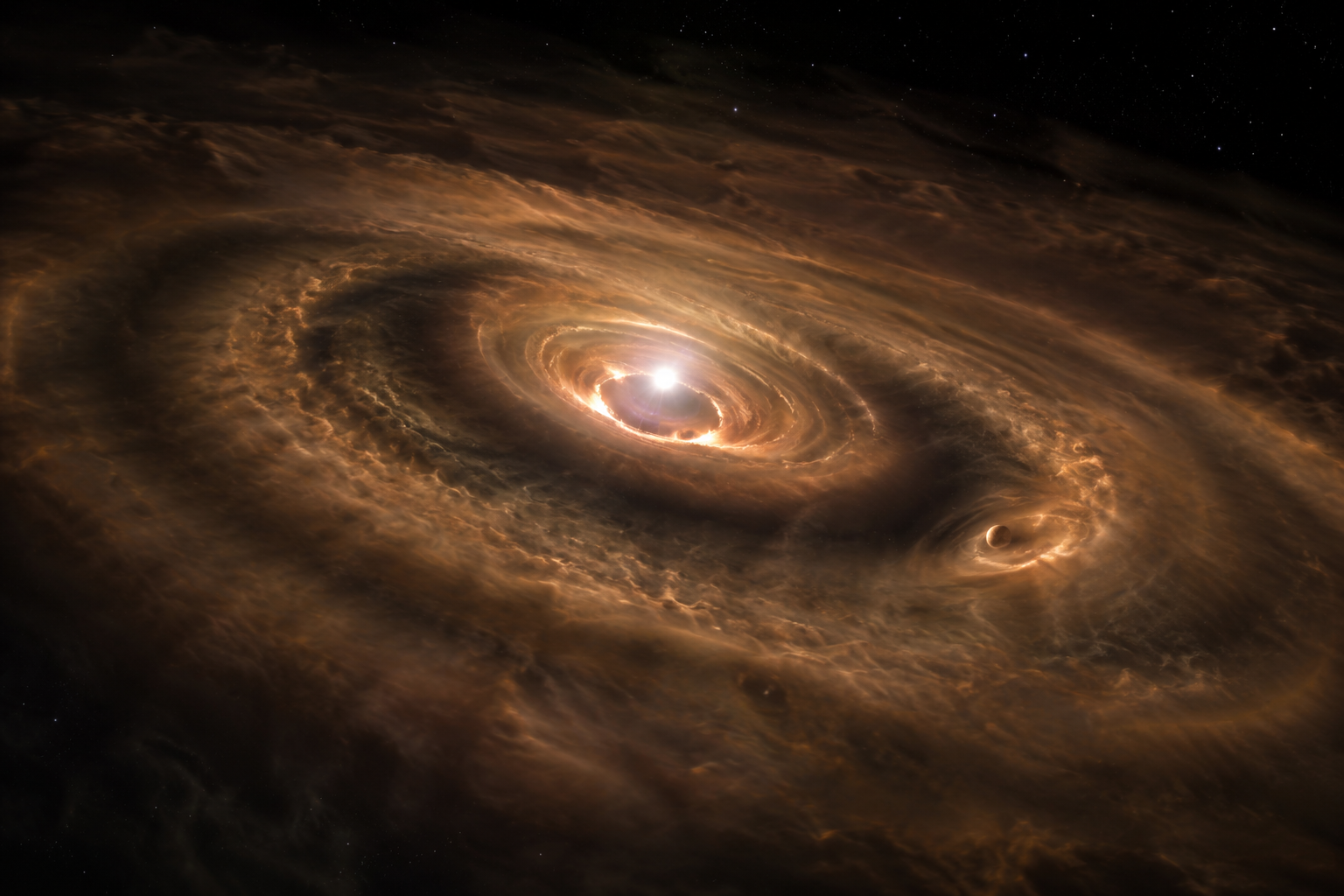
The young star AB Aurigae continues to stand out as one of the most detailed laboratories for studying how planets begin to form inside dusty, gas-rich disks. A new study using the SPHERE instrument on the Very Large Telescope has tracked the motion, structure and possible accretion activity inside the AB Aur disk, revealing a system that is more dynamically complex than a simple rotating disk.
The research focuses on near-infrared polarized images taken over three observing epochs spanning about 3.85 years, along with Hα observations designed to search for emission linked to accreting young objects. Together, the data provide a rare time-based view of how spiral arms, compact features and shadow-like structures move inside a planet-forming environment.
A Young Disk with Spirals, Shadows and Candidate Planets
AB Aurigae is a young intermediate-mass star surrounded by a broad protoplanetary disk. Previous observations have already shown spiral arms, a millimeter dust ring, gas structures and the debated protoplanet candidate AB Aur b. Because the system is bright and extended, it is especially suitable for high-contrast imaging.
In the new study, researchers used SPHERE/IRDIS to image the disk in polarized near-infrared light across three epochs: 2019, 2021 and 2023. They also used SPHERE/ZIMPOL in Hα filters during a 2021 observing run to investigate possible accretion signatures.
The near-infrared images recover the system’s major features, including the inner spiral arms known as S1 and S2, a bridge-like radial feature, compact structures labelled f1, f2 and f3, and several shadow-like patterns. The feature f1, previously identified as a near-infrared “twist,” appears especially important because it is bright, structured and associated with Hα emission in the new visible-light data.
The Disk Mostly Rotates as Expected — But Not Everywhere
The team developed a method to measure disk rotation as a function of distance from the star. By comparing the same structures across the three observing epochs, they found that much of the disk follows broadly Keplerian rotation, meaning its motion is consistent with material orbiting under the gravity of the central star.
However, the inner disk behaves differently. Inside roughly 60 astronomical units, the observed rotation appears slower than expected from a simple Keplerian model. At separations near 25 astronomical units, the deviation reaches about 12 degrees over the 3.85-year observing baseline.
This slower inner motion may have several explanations. It could reflect real gravitational perturbations from multiple young planets or planetary-mass bodies. It could also be affected by changes in disk illumination, vertical disk structure, or material moving out of the main disk plane. The authors caution that the inner disk is difficult to interpret because its morphology is highly structured and variable.
Spiral Arms May Have Different Origins
The two main spiral arms do not behave identically. The western spiral S2 shows a more consistent rotation trend across the observed epochs, while the eastern spiral S1 appears harder to explain with a single simple motion pattern.
This matters because spiral arms in protoplanetary disks can be produced by different mechanisms. They may be linked to gravitational effects from young planets, or they may arise from broader disk instabilities. In AB Aurigae, the study suggests that a possible link between S2 and AB Aur b cannot be ruled out, but the motion of S1 appears too slow to be explained by a simple connection to the feature f1 under a circular-orbit model.
Compact Features Appear to Move Outside the Main Disk Plane
The researchers also examined the compact features f1, f2 and f3. Their orbital analysis suggests that these features may not be moving in the same plane as the main disk. Instead, their possible orbits appear inclined by several tens of degrees relative to the disk plane.
This result remains uncertain because the orbital coverage is short and the features are embedded in complex disk structures. Still, it supports the broader picture of AB Aurigae as a disturbed, three-dimensional planet-forming environment rather than a flat, orderly disk.
Radial Shadows Point to Optically Thick Inner Structures
The images also show thin radial shadow patterns that change position over time. Some of these shadows appear to rotate between the observing epochs, suggesting they may be cast by optically thick material located within the inner disk.
One shadow pattern changes by about 12 degrees over 3.847 years, which the authors say is consistent with a source located at around 31 astronomical units if interpreted as Keplerian motion in the disk plane. Other shadows suggest structures at tens of astronomical units from the star.
These shadows may not require a planet-sized object by themselves. They could also be produced by vertically extended spiral arms, clumps or uneven disk surfaces that block starlight and cast narrow dark lanes across the outer disk.
Hα Emission Highlights the f1 Feature
The Hα observations with SPHERE/ZIMPOL reveal a strong signal associated with f1. Hα emission is important because it can trace hydrogen gas heated by accretion, a process expected when material falls onto a young star, protoplanet or surrounding circumplanetary material.
The study measures an integrated Hα flux of about 8.22 × 10⁻¹⁵ erg/s/cm2 for the full f1 structure. A smaller knot inside f1 has a measured Hα flux of about 1.58 × 10⁻¹⁵ erg/s/cm2.
If the f1 emission came from one or more compact accreting objects, the inferred masses could fall in the planetary-mass range depending on the accretion model used. However, the authors stress that f1 is extended and structured, so applying point-source planet accretion models is uncertain. Another possibility is that some of the detected Hα light is stellar emission scattered by dust clumps in the spiral structure.
AB Aur b Remains Difficult to Confirm in Hα
The debated candidate AB Aur b is only marginally detected in the new ZIMPOL Hα data. The team measures an Hα flux of about 6.46 × 10⁻¹⁶ erg/s/cm2 at the expected location, roughly 13 times lower than the integrated emission from f1.
This weak signal contrasts with some earlier Hα detections reported with other instruments. The paper discusses several possible reasons, including source variability, differences between filter widths, and the possibility that the Hα line profile itself may reduce the measured signal in a narrow-band filter.
The authors do not dismiss AB Aur b, but the new data show that its interpretation remains unresolved. Further observations in other hydrogen lines, especially at infrared wavelengths such as Brγ and Brα, may help determine whether the signal is linked to active planetary accretion, scattered disk light or another process.
A System in an Active Stage of Planet Formation
The study concludes that AB Aurigae is not a simple example of a young disk with one forming planet. Instead, it appears to be a dynamically rich system with spiral arms, shadows, compact features, possible out-of-plane motion and localized Hα emission.
The inner 60 astronomical units are especially important. The slower-than-expected motion, structured spirals and changing shadows may point to interactions with multiple young bodies, eccentric or inclined orbits, or vertically complex disk material.
AB Aurigae therefore remains a key target for understanding how planet formation can unfold in real time. Continued high-resolution imaging, combined with spectroscopy across additional hydrogen lines, will be needed to clarify the nature of f1, the status of AB Aur b and the physical processes shaping this unusually detailed protoplanetary disk.