

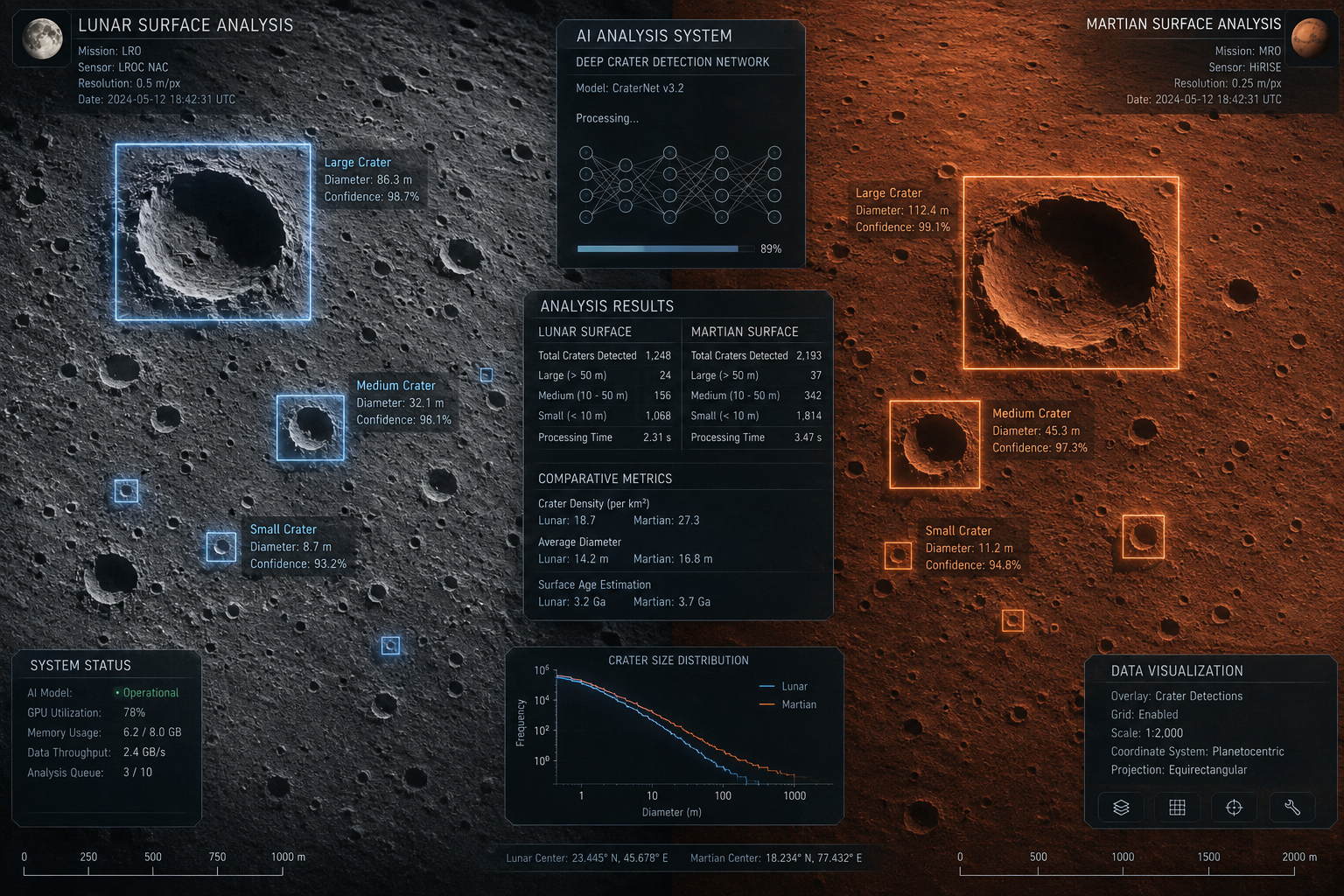
Researchers have developed and tested a deep-learning framework designed to detect and classify impact craters on the Moon and Mars, offering a clearer view of how artificial intelligence could support planetary mapping, surface analysis and future mission planning.
The study, published in npj Space Exploration, compares three major computer-vision approaches: Convolutional Neural Networks, YOLO and ResNet-50. The framework uses a two-stage process in which craters are first detected and localised, then classified by size as large, medium or small.
Why Crater Detection Matters
Impact craters are among the most common and scientifically important features on planetary surfaces. Their distribution, size and shape can help researchers understand geological history, surface age, impact processes and terrain conditions on worlds such as the Moon and Mars.
Manual crater identification is slow, labour-intensive and vulnerable to differences in interpretation. Automated detection systems can process large volumes of planetary imagery more efficiently, which is increasingly important as missions continue to return high-resolution surface data.
A Two-Stage AI Framework
The study proposes a workflow built around detection first and classification second. In the first stage, the YOLO model is used to identify and localise craters within planetary images. In the second stage, CNN, YOLO and ResNet-50 models are compared for their ability to classify crater size.
The researchers used selected regions from Mars and the Moon. Mars imagery was based on high-resolution data from NASA sources, including Mars Reconnaissance Orbiter observations, while lunar crater imagery was processed from a public computer-vision dataset. The images were cropped, resized, annotated and prepared for model training.
The system also tested different prediction strategies for large planetary images. One method processes a full high-resolution image directly, which can help identify larger craters. Another method divides the image into smaller overlapping sections, improving the chance of finding smaller craters. Non-Maximum Suppression was then used to reduce duplicate detections from overlapping regions.
YOLO Shows the Most Balanced Performance
The results show that YOLO delivered the most balanced performance across crater sizes. The model performed well for large and medium craters and maintained useful performance for smaller craters, making it suitable for multi-scale crater detection tasks.
On Mars data, YOLO achieved reported F1-scores of 0.70 for large craters, 0.67 for small craters and 0.76 for medium craters. On lunar data, YOLO recorded F1-scores of 0.66 for large craters, 0.63 for small craters and 0.71 for medium craters.
The study notes that YOLO’s strength comes from its ability to handle objects at different scales. This is important because planetary craters vary widely in size, shape, erosion state and surrounding terrain.
CNN Performs Strongly on Small Craters
The CNN model performed especially well in recognising small craters. For Mars, the CNN model achieved an F1-score of 0.97 for small craters. For the Moon, the reported F1-score for small craters reached 0.99.
However, the model struggled with other crater categories. For example, its performance on medium and large craters was weaker, particularly on the lunar dataset. The researchers link this partly to class imbalance, as small craters were much more common in the dataset than larger craters.
This result shows why high overall accuracy can be misleading in planetary image analysis. A model may appear strong if it performs well on the most common class, while still missing rarer but scientifically important crater types.
ResNet-50 Offers Precision but Misses Larger Craters
ResNet-50 also performed well for small crater recognition, but its results were less reliable for medium and large craters. The model often showed good precision when it detected larger craters, but its recall and F1-scores were low for those categories.
In practical terms, this means ResNet-50 was often correct when it identified a large or medium crater, but it missed many of them. The study suggests that simply increasing neural-network depth does not automatically improve performance for all crater detection tasks.
Class Imbalance Remains a Major Challenge
One of the study’s key findings is that class imbalance strongly affects model performance. The datasets contained far more small craters than medium or large ones. This imbalance can cause models to become highly effective at recognising the dominant class while performing poorly on less represented categories.
The authors identify this as an important limitation and a target for future work. Larger study regions, improved data augmentation, better sampling strategies and cross-planet transfer learning could help create more reliable crater detection models.
What This Means for Planetary Science
The research highlights the growing role of artificial intelligence in planetary surface analysis. Automated crater detection could support geological mapping, landing-site assessment, terrain classification and future exploration planning.
The study does not present a final universal crater-detection system. Instead, it provides a controlled comparison of model behaviour across Moon and Mars datasets, showing that different AI architectures have different strengths depending on crater size and image conditions.
YOLO appears best suited for balanced multi-scale detection, CNN is highly effective for small crater classification, and ResNet-50 offers useful precision but struggles with broader crater-size coverage. Together, these results provide a foundation for more advanced AI tools in planetary mapping.
Future Research Directions
The authors note that the study used selected regions rather than full planetary-scale datasets. Future research may need to test larger areas, reduce sample imbalance and explore model fusion or transfer learning to improve performance across different planetary surfaces.
As missions continue to return higher-resolution imagery from the Moon, Mars and other worlds, automated detection frameworks like this could become increasingly important for managing the scale and complexity of planetary data.