

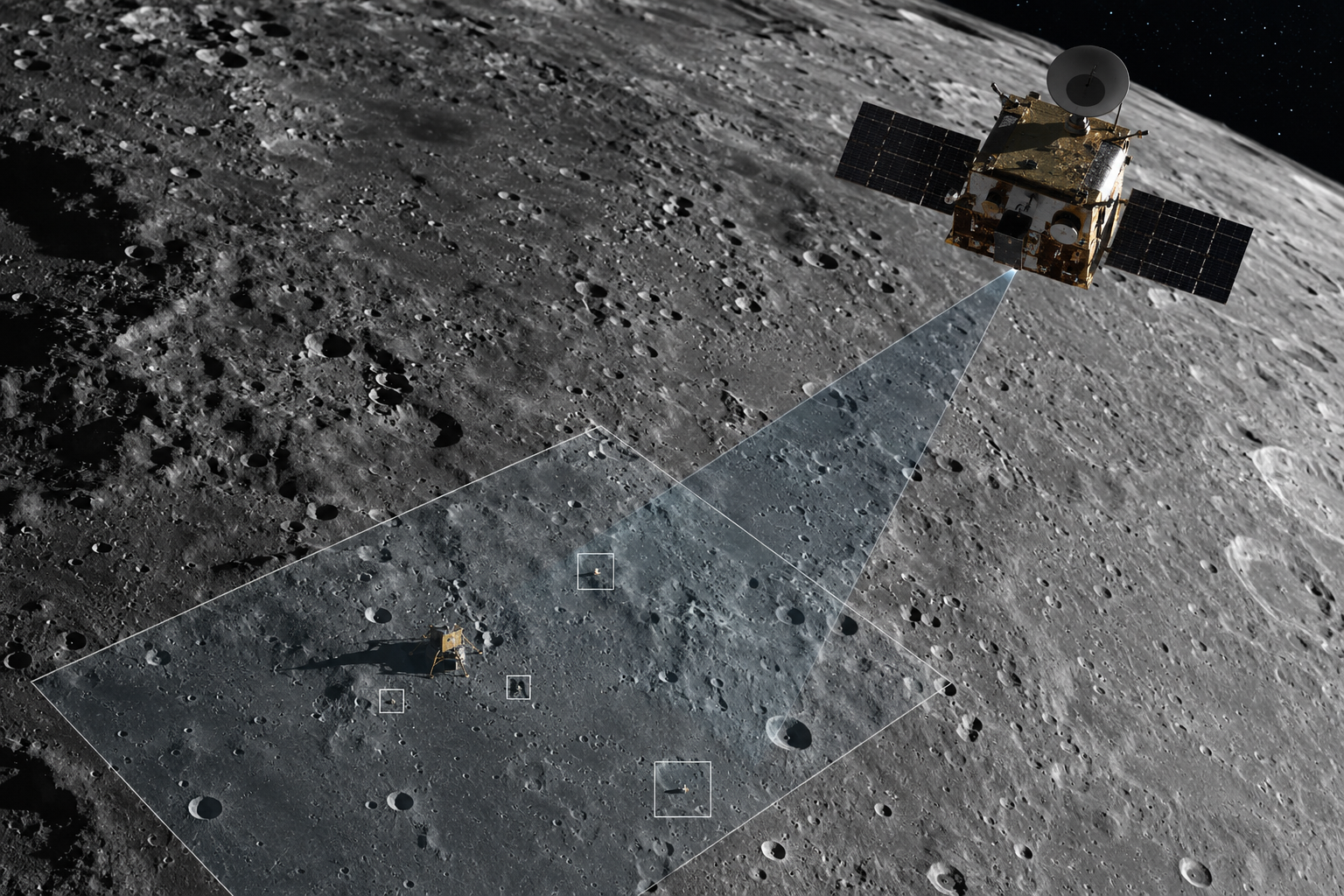
A lightweight machine-learning system may have identified one of the Moon’s most historically important missing spacecraft sites: Luna 9, the first mission to achieve a successful soft landing on the lunar surface. In a study published in npj Space Exploration, researchers report that their computer-vision model detected a cluster of candidate artificial objects near the long-uncertain Luna 9 landing area.
The findings do not confirm the final location of Luna 9. However, the repeated detections across multiple Lunar Reconnaissance Orbiter Camera images give scientists a more focused target for future imaging and analysis.
Why Luna 9 Still Matters
Luna 9, launched by the Soviet Union, made history in 1966 by becoming the first spacecraft to survive a soft landing on the Moon and transmit images from the lunar surface. Despite its importance, the exact position of the spacecraft has remained uncertain for decades.

Finding the lander would help researchers place Luna 9’s historic surface panoramas into their true geological context. It would also improve the catalogue of human-made objects on the Moon, an increasingly important task as lunar exploration accelerates.
How YOLO-ETA Searches the Lunar Surface
The research team developed a computer-vision system called YOLO-ETA, short for You-Only-Look-Once – Extraterrestrial Artefact. The model is adapted from the lightweight TinyYOLOv2 architecture and is designed to detect spacecraft hardware in high-resolution lunar imagery.
Instead of relying on large, resource-heavy systems, YOLO-ETA was built as a compact model that could eventually support edge computing in space missions. This means similar systems may one day help orbiters, landers, or small spacecraft analyse images onboard without needing to send every frame back to Earth first.
The model was trained using Lunar Reconnaissance Orbiter Camera images of Apollo landing sites. These images include known artificial objects such as descent stages, lunar rovers, scientific instruments, and other hardware visible on the Moon’s surface.
Candidate Site Near 7.03° N, 64.33° W
After training and testing the model, the team applied YOLO-ETA to a five-by-five-kilometre region around the historically uncertain Luna 9 landing coordinates. The model’s first detection of a possible landing module was centred near 7.029° N, –64.329° E in an LROC image.
Further searches around the candidate location returned additional detections in multiple LROC Narrow Angle Camera images. The study reports that the principal object was detected repeatedly under different lighting and viewing conditions, with several nearby features also identified as possible associated hardware.
This repeatability is important because lunar images can be affected by shadows, Sun angle, surface texture, and small craters. A feature detected only once could easily be an imaging artefact or a natural object. A feature detected repeatedly under different conditions is more difficult to dismiss.
Possible Spacecraft Hardware and Impact Marks
The candidate features appear within a spatial range that the researchers consider broadly consistent with Luna 9’s landing sequence. Historical descriptions indicate that the spacecraft released an airbag-encased landing capsule shortly before touchdown, while other components may have separated or impacted nearby.
The study also notes two small dark patches roughly 40 to 60 metres south-southwest of the main detection. These could be ordinary small craters, but their location and appearance make them worth examining as possible impact marks from separated spacecraft components.
Topography Supports Further Investigation
The team also examined the local terrain using Lunar Orbiter Laser Altimeter data. Luna 9’s surface panoramas show a notably flat horizon, which has long been used as a clue in narrowing down the landing location.
According to the study, the candidate site lies on a gently raised plain where distant hills may not have appeared above the local horizon from the lander’s low camera viewpoint. This makes the area potentially consistent with the historical Luna 9 images, although the match remains preliminary.
Model Performance and Limits
YOLO-ETA performed best when detecting larger, more distinct spacecraft hardware such as landing modules. On Apollo test data, the model achieved a combined F1 score of about 0.60, while landing-module detections showed stronger performance than smaller objects such as rovers or other hardware.
The model also correctly detected the known Luna 16 lander in LROC imagery, even though it had been trained on Apollo landing-site data. This result suggests that the model was not simply memorising Apollo hardware, but learning broader visual cues associated with artificial objects on the lunar surface.
Still, the researchers are clear that the Luna 9 detection is not definitive. Some false positives occurred during testing, including natural rocks or surface features that the model classified as possible hardware. This is why human review and follow-up imaging remain essential.
Why This Matters for Future Lunar Exploration
The study points to a broader use for compact artificial-intelligence systems in planetary exploration. As more spacecraft, landers, rovers, and infrastructure arrive on the Moon, missions will need better ways to identify, monitor, and catalogue surface assets.
Machine-learning systems like YOLO-ETA could help with:
- locating historical lunar artefacts and heritage sites;
- supporting navigation and situational awareness for future missions;
- monitoring surface changes caused by landings, impacts, and rover activity;
- reducing data-processing pressure by filtering images before downlink.
A Promising Lead, Not a Final Answer
The possible Luna 9 site near 7.03° N, –64.33° E is now a strong candidate for targeted re-imaging by the Lunar Reconnaissance Orbiter or future lunar orbiters. Higher-resolution observations under controlled lighting conditions would be needed to determine whether the detected objects are truly Luna 9 hardware.
For now, the study offers a carefully framed result: not a confirmed rediscovery, but a credible lead. It also demonstrates how compact AI models may become valuable tools for mapping the growing human footprint on the Moon.