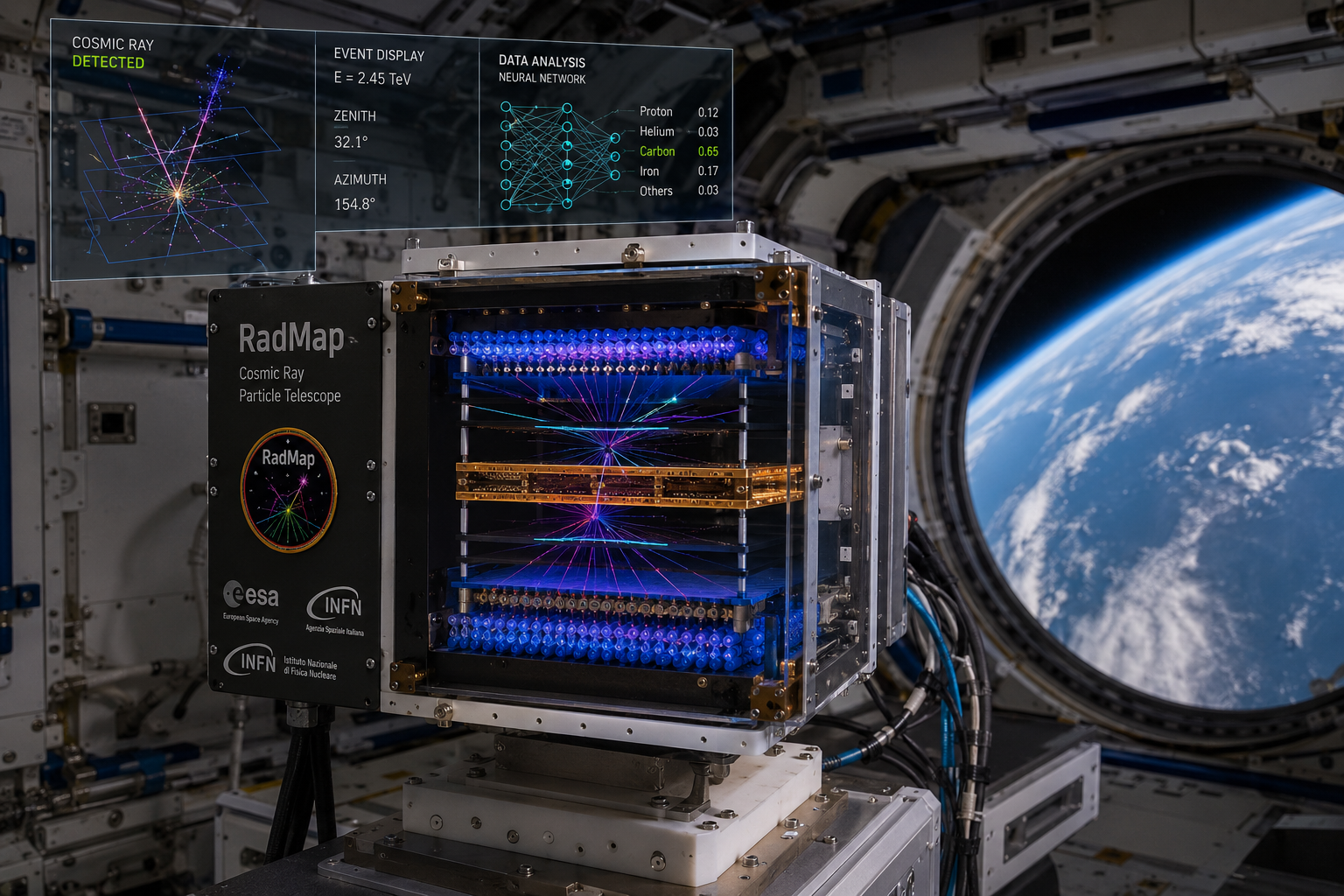
Scientists have developed a neural-network-based framework designed to improve how spacecraft monitor and analyze cosmic radiation in deep space. The system was developed for the RadMap Telescope, a compact radiation-monitoring instrument currently being tested aboard the International Space Station (ISS).
The research focuses on identifying and tracking high-energy cosmic-ray nuclei, which are among the most significant radiation hazards faced by astronauts during future missions to the Moon, Mars, and beyond. The study demonstrates that artificial intelligence can help compact spacecraft instruments achieve detailed spectroscopic measurements previously associated with much larger detector systems.
Why Space Radiation Matters
Space radiation remains one of the biggest risks for long-duration human exploration missions. Galactic cosmic rays and solar energetic particles can damage biological tissue, increase cancer risks, and potentially affect cognitive functions during extended exposure.
The study notes that current operational radiation monitors often struggle to determine the exact identity and energy of incoming particles. This creates uncertainties when estimating the biologically relevant radiation dose astronauts receive.
The new framework aims to solve that problem by allowing the RadMap Telescope to distinguish between different atomic nuclei and measure their energies with improved precision.
Inside the RadMap Telescope
The RadMap Telescope uses an Active Detection Unit (ADU) made from 1024 scintillating plastic fibers arranged in alternating layers. When charged particles pass through these fibers, they produce tiny flashes of light that are recorded by silicon photomultipliers.
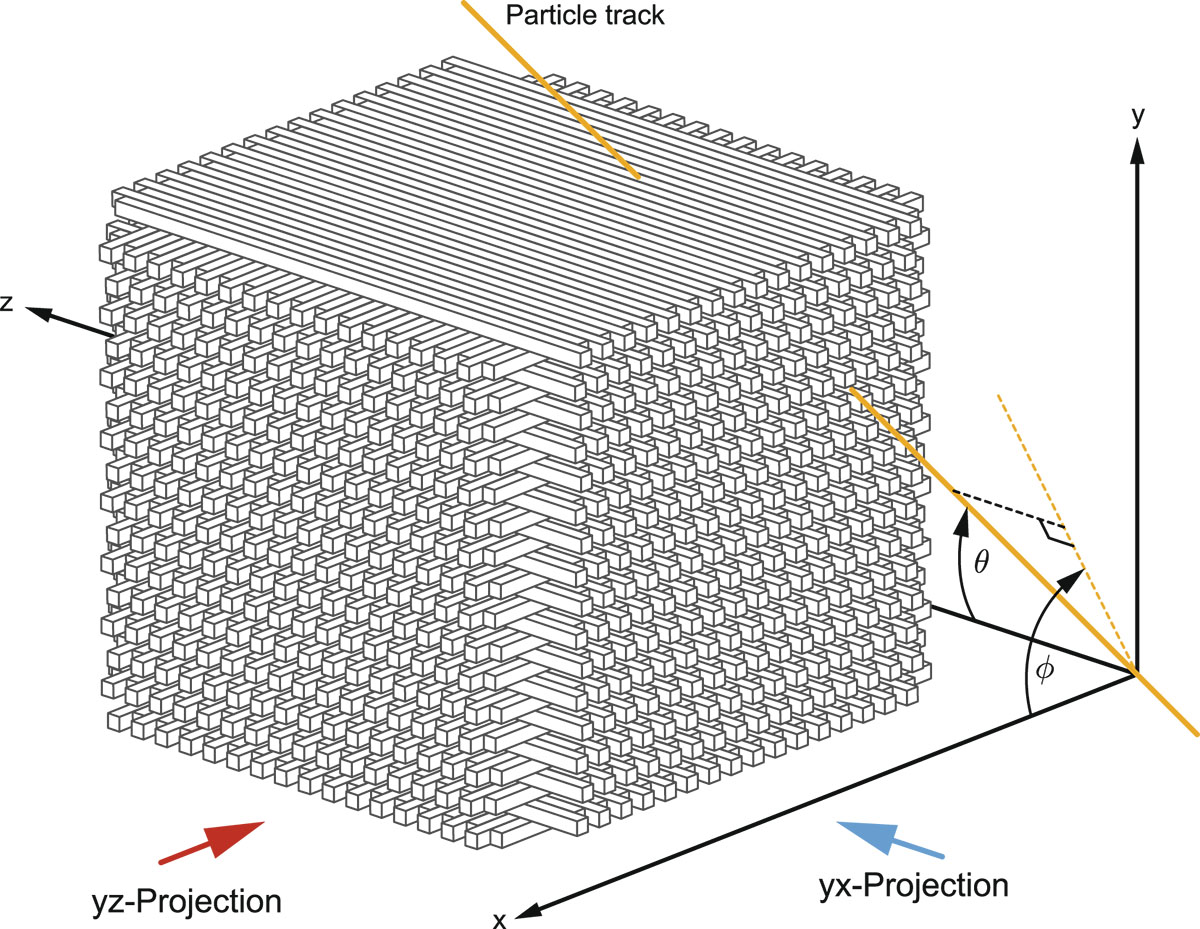
The detector records energy-deposition patterns produced by incoming cosmic-ray particles. These patterns are then analyzed using convolutional neural networks trained on millions of simulated events generated with the GEANT4 physics simulation toolkit.
How Artificial Intelligence Was Used
The researchers created three sequential neural-network systems capable of:
- Reconstructing the trajectory of incoming particles
- Determining the nuclear charge of particles
- Estimating particle kinetic energy
The system processes detector data as image-like projections, allowing convolutional neural networks to identify track structures and energy-deposition signatures.
According to the study, the framework achieved an angular resolution better than 1.4 degrees for particle tracking and reached 99.8% accuracy when identifying hydrogen nuclei. The detector also achieved charge separation above 95% for nuclei with atomic number up to oxygen.
For energy measurements, the framework reached energy resolutions below 20% for particles under 1 GeV per nucleon across elements up to iron.
Challenges With Heavy Cosmic-Ray Nuclei
The study also identified limitations in reconstructing heavier nuclei. As particle charge increases, detector responses become more difficult to separate because of ionization quenching, fragmentation effects, and energy-loss fluctuations.
To address this, the researchers divided the charge-identification process into two separate neural networks — one specialized for lighter nuclei and another for heavier nuclei.
Although the system performed best for hydrogen and helium, the researchers found that even approximate identification of heavier nuclei could still provide better radiation-dose estimates than many currently used monitoring systems.
Applications for Future Deep-Space Missions
The RadMap Telescope was designed specifically for operational radiation monitoring under spacecraft resource constraints. Unlike large astrophysics instruments, the system is compact and optimized for continuous monitoring aboard crewed missions.
The detector also offers nearly omnidirectional coverage, allowing it to measure radiation coming from almost any direction — an important capability inside spacecraft environments where shielding varies depending on orientation.
The study suggests that future improvements could include more advanced neural-network architectures such as transformer models, graph neural networks, and physics-informed AI systems.
Current Status and Future Work
The RadMap Telescope has already collected radiation data aboard the ISS between April 2023 and January 2024. However, the current research represents an idealized simulation-based analysis rather than full operational performance.
The researchers noted that future work must account for additional real-world detector effects such as optical crosstalk, electronic noise, detector misalignment, and shielding from spacecraft structures.
Despite these limitations, the study concludes that the RadMap Telescope demonstrates the feasibility of compact, AI-assisted spectroscopic radiation monitoring for future human space exploration.