

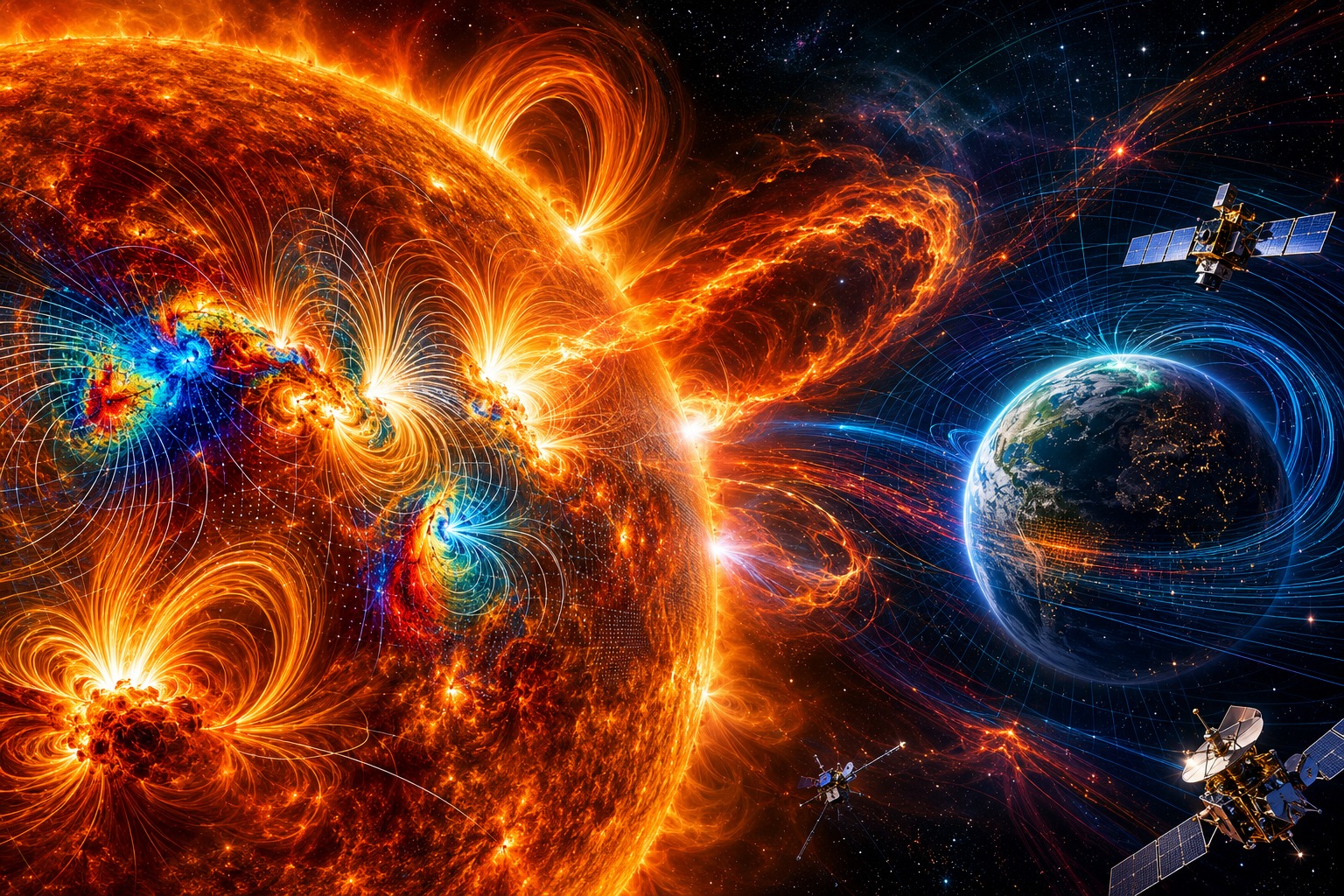
Solar flares are among the most difficult space-weather events to forecast. They can erupt from magnetically complex regions on the Sun with little direct warning, releasing radiation and energetic particles that may affect satellites, communications, navigation systems, aviation and future human missions beyond Earth orbit.
A major European project called FLARECAST set out to test whether modern data science could improve this challenge. The project combined solar physics, big data and machine learning to analyse active regions on the Sun and estimate their likelihood of producing flares. Its conclusion is important: machine learning can improve how scientists study flare risk, but it has not removed the uncertainty built into solar flare behaviour.
What FLARECAST Tried to Do
FLARECAST, short for Flare Likelihood and Region Eruption Forecasting, was funded by the European Union and ran from January 2015 to February 2018. The project had a research-to-operations focus, meaning it was designed not only as an academic study but also as a step toward practical space-weather forecasting tools.
The project focused on solar active regions, the magnetically intense areas on the Sun where major flares often originate. These regions were studied using observations from the Helioseismic and Magnetic Imager onboard NASA’s Solar Dynamics Observatory. The system also used flare information from NOAA’s space-weather catalogues.
Instead of relying on a small number of indicators, FLARECAST treated many possible flare predictors on equal footing. These included magnetic-field measurements, sunspot classifications, polarity inversion line properties, electric currents, magnetic helicity and other physical characteristics of solar active regions.
Machine Learning Met Solar Physics
The scale of the project was large for solar flare forecasting. FLARECAST made use of more than 170 active-region properties during its main analyses, with a total of 209 predictors available in the broader project database. It also tested 14 machine-learning techniques, including supervised and unsupervised methods.
These methods included approaches such as random forests, support vector machines, neural networks, logistic regression, LASSO-based models and clustering algorithms. The aim was to find whether certain combinations of solar magnetic properties could reliably separate flare-producing active regions from quieter ones.
The project also placed strong emphasis on forecast verification. That matters because machine-learning models can appear more accurate than they really are if training and testing data are not separated carefully. FLARECAST showed that rigorous testing is essential to avoid overly optimistic claims about pre-operational flare prediction.
Why Solar Flares Remain Hard to Predict
The study found that solar flares remain inherently difficult to forecast because they behave like rare and partly stochastic events. Major M-class and X-class flares are far less common than smaller flares, creating a serious imbalance in the data used to train prediction models.
This rarity matters for machine learning. A model may learn patterns from common events more easily than from rare extreme events. In solar physics, the most important events for space-weather preparedness are often the rarest ones, which makes reliable prediction even harder.
The project found that no single predictor or machine-learning method solved the problem. Different models often selected different best-performing predictors, especially for major flares. This suggests that flare forecasting is not a simple classification problem where one fixed set of measurements can produce reliable yes-or-no answers.
What the Project Found Useful
Although FLARECAST did not produce a definitive flare-prediction breakthrough, it did identify several useful directions for future work. Properties linked to strong magnetic polarity inversion lines remained important, because major flares often occur where opposite magnetic polarities are tightly packed and highly sheared.
The project also examined predictors related to shear flows, non-neutralized electric currents, magnetic gradients and other measures of magnetic complexity. Some of these properties showed promise in distinguishing more flare-productive active regions from quieter ones, especially when used in combination with other data.
FLARECAST also explored the connection between solar flares and coronal mass ejections. This is important because the most severe space-weather impacts often involve not only a flare but also an Earth-directed CME and associated energetic particles. The project found that some active-region properties may help link flare forecasting with eruption forecasting, but this remains an area for further research.
Not a Failure, But a Reality Check
The key message from FLARECAST is not that machine learning failed. Instead, the project showed that space-weather forecasting must be built on realistic expectations. Solar flare prediction is more likely to remain probabilistic than become a simple yes-or-no forecast.
That distinction is important for operational users. A probability-based forecast can still be valuable if it is timely, transparent and properly verified. Satellite operators, aviation planners, communication services and power-grid managers do not always need certainty; they need reliable risk information that can support decisions.
FLARECAST also showed the value of open data and reusable infrastructure. The project pledged to make its data, codes and infrastructure openly available, allowing future researchers to test new models, compare methods and build on a common forecasting framework.
A Step Toward Integrated Space-Weather Forecasting
Solar flare forecasting is only one part of the larger space-weather problem. A complete system would also need to predict coronal mass ejections, solar energetic particle events, arrival times near Earth and the likely strength of geomagnetic impacts.
FLARECAST’s work points toward that broader goal. Its modular infrastructure, machine-learning framework and active-region database could support future efforts that combine flare, CME and particle-event forecasting into more integrated space-weather prediction systems.
The Sun remains difficult to predict, but projects such as FLARECAST have clarified the path forward. The future of solar flare forecasting will likely depend on better benchmark data, more transparent models, stronger physical interpretation and careful verification rather than on machine learning alone.