

Study Revisits the Origins of Earth’s Life-Essential Elements
How Earth acquired the chemical ingredients necessary for life remains one of planetary science’s most important questions. A new study published in Science Advances examines the distribution of phosphorus and nitrogen in some of the Solar System’s earliest planetesimals and suggests that Earth may have inherited much of its life-essential element inventory from ancient inner Solar System bodies rather than relying primarily on later deliveries from carbonaceous meteorites.
The research focused on understanding the origins of two critical elements: phosphorus, an essential component of DNA, RNA, and cellular energy transfer, and nitrogen, a key ingredient in proteins and biological molecules. Together, these elements provide an important window into the chemical evolution of the young Solar System.
Looking Back to the First Generation of Planetesimals
The earliest known planetesimals formed within the first million years of Solar System history. Most of these objects no longer exist intact, but their metallic cores survive today as iron meteorites. These meteorites preserve a record of conditions that existed before the formation of the terrestrial planets.
Researchers reconstructed the phosphorus-to-nitrogen (P/N) ratios of these ancient parent bodies by combining laboratory experiments, meteorite measurements, and geochemical modeling. The team investigated how phosphorus and nitrogen behaved during the crystallization of metallic cores inside early planetesimals.
The analysis revealed a distinct chemical difference between planetesimals that formed in the inner Solar System and those that formed farther from the Sun. Outer Solar System iron meteorite parent bodies contained higher phosphorus-to-nitrogen ratios than their inner Solar System counterparts.
Laboratory Experiments Recreate Early Solar System Conditions
To understand how these elements were distributed, the researchers conducted high-pressure and high-temperature experiments simulating conditions inside differentiating planetesimals. The experiments examined how phosphorus and nitrogen partitioned between solid and liquid metallic alloys during core formation.
The results showed that the behavior of nitrogen is strongly influenced by the presence of phosphorus and sulfur within metallic melts. These new constraints allowed the team to reconstruct the original elemental inventories of long-destroyed planetesimals with greater accuracy than previous studies.
A Changing Chemical Landscape Across the Solar System
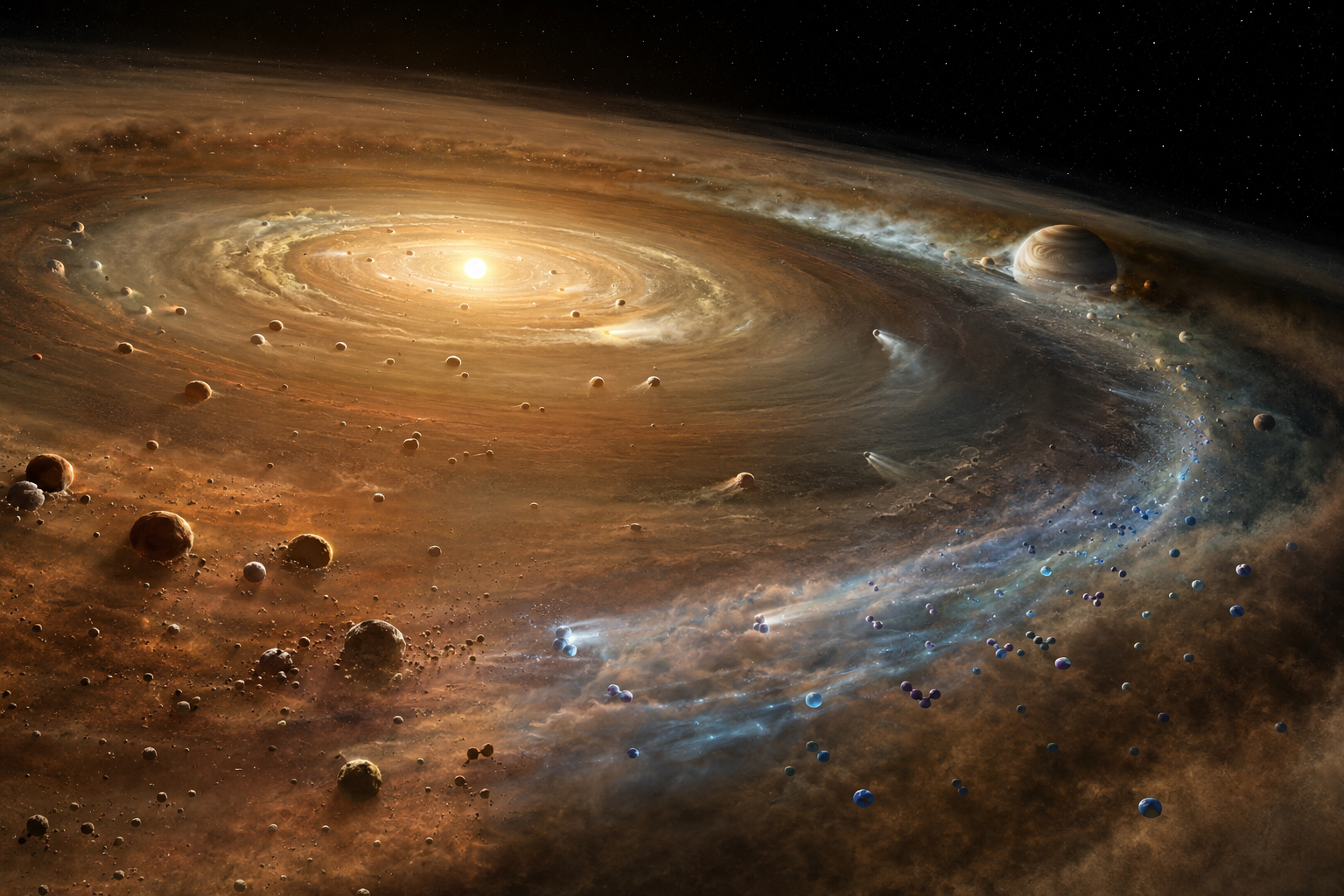
The study suggests that the young Solar System experienced significant chemical evolution during its first few million years. According to the researchers, phosphorus-rich minerals known as schreibersite likely formed in the hot inner regions of the protoplanetary disk and were transported outward by turbulent disk flows.
This process enriched outer Solar System planetesimals in phosphorus during the earliest stages of Solar System history. Later, as the protoplanetary disk cooled and Jupiter grew large enough to influence material transport, this outward movement became less efficient.
As a result, the chemical gradient observed in the first generation of planetesimals eventually disappeared and even reversed in later-forming chondritic meteorites. This indicates that the composition of Solar System building blocks evolved substantially over time.
Implications for Earth's Formation
Traditional models often argue that Earth obtained many of its life-essential elements from carbonaceous chondrites that formed in the outer Solar System. However, the new study challenges the idea that these later-arriving bodies were the primary source.
Using accretion simulations, the researchers tested whether different classes of planetesimals could reproduce the phosphorus-to-nitrogen ratio observed in Earth’s mantle. The results showed that outer Solar System planetesimals generally produced phosphorus-to-nitrogen ratios that were too high, while enstatite chondrite-like materials produced ratios that were too low.
In contrast, inner Solar System iron meteorite parent bodies produced values much closer to those observed in Earth’s bulk silicate mantle, suggesting they may have played a major role during Earth’s growth.
Rethinking the Delivery of Life's Building Blocks
The study also examined whether later atmospheric loss and volcanic degassing could explain Earth's present-day phosphorus and nitrogen inventories. The authors conclude that volatile loss alone cannot fully account for Earth's elemental and isotopic signatures.
Instead, the findings point toward a scenario in which Earth inherited much of its life-essential chemistry directly from the inner Solar System materials that built the planet. This would reduce the need for large amounts of volatile-rich material arriving later from distant regions of the Solar System.
New Clues About Planetary Habitability
The research highlights how the timing and location of planetesimal formation can influence the chemical ingredients available to emerging planets. Understanding how phosphorus, nitrogen, carbon, and other life-essential elements were distributed across the young Solar System helps scientists better understand not only Earth’s origins but also the conditions that may make rocky planets elsewhere habitable.
As future studies refine the chemical inventories of ancient meteorites and early planetesimals, researchers may gain an increasingly detailed picture of how the ingredients for life were assembled during the birth of planetary systems.