

A Long-Standing Meteorite Mystery
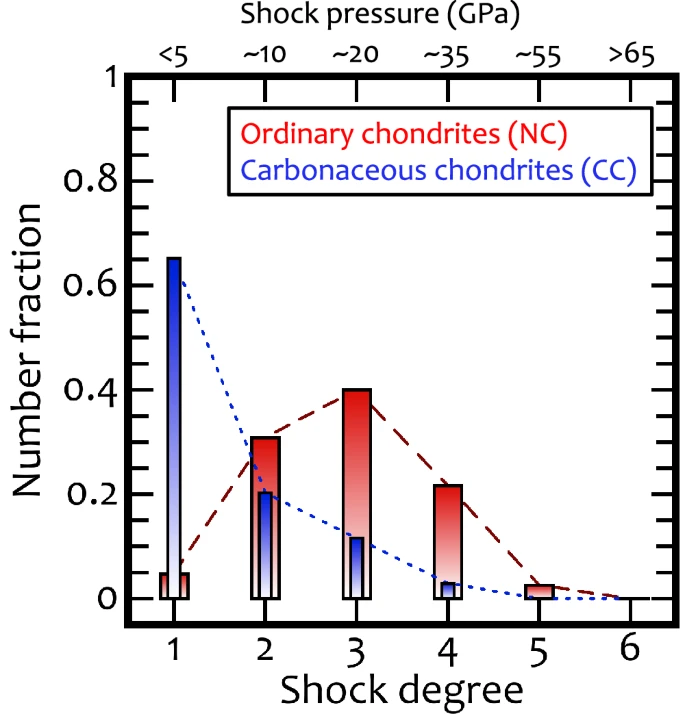
Meteorites preserve some of the oldest physical records of the Solar System. Among them, ordinary chondrites and carbonaceous chondrites have long displayed a puzzling difference. While a large fraction of ordinary chondrites show signs of significant shock metamorphism caused by ancient impacts, carbonaceous chondrites generally appear far less shocked.
For decades, researchers debated whether this contrast reflected fundamentally different impact histories. A new study led by Kosuke Kurosawa and colleagues proposes a different explanation: carbon-rich meteorites may have experienced similar impact environments, but the evidence of strong shocks was selectively removed through impact-driven chemical reactions involving organic matter.
The Shock Metamorphism Dichotomy
Shock metamorphism occurs when meteorites are subjected to powerful impacts that generate extreme pressures and temperatures. Previous observations showed that highly shocked ordinary chondrites are common, whereas highly shocked carbonaceous chondrites are comparatively rare.
The researchers note that this discrepancy cannot be fully explained by differences in aqueous alteration or hydration. Even relatively dry carbonaceous chondrites exhibit the same tendency to appear less shocked than their ordinary counterparts.
Testing the Role of Organic Material
To investigate the phenomenon, the team performed hypervelocity impact experiments using porous laboratory targets designed to mimic the matrix materials found in carbonaceous chondrites. Some samples contained carbon-rich material, while others did not.
Projectiles were fired at speeds ranging from approximately 3 to 7 kilometers per second, comparable to impact velocities commonly found within the asteroid belt. The experiments monitored gases released during impacts using mass spectrometry.
The results revealed a striking pattern. Targets containing carbon produced significantly larger quantities of vaporized gases, particularly carbon monoxide (CO) and carbon dioxide (CO₂), than carbon-free targets.
Local Temperatures Exceeding 2,000 Kelvin
The experiments also showed that impacts generate highly localized regions of extreme heating within porous materials. By analyzing the ratio of carbon monoxide to carbon dioxide produced during impacts, the researchers estimated reaction temperatures exceeding 2,000 Kelvin.
These temperatures are far higher than average bulk heating estimates and indicate that energy becomes concentrated in microscopic regions within the porous matrix. Such localized hotspots drive rapid oxidation of organic material and significantly increase gas production.
The study concludes that carbon-rich asteroid materials respond differently to impacts than carbon-poor materials because their organic compounds provide additional pathways for vapor generation.

How Shock Evidence May Be Lost
According to the researchers, the newly generated carbon monoxide and carbon dioxide gases rapidly expand from the impact site. This expansion can pulverize and accelerate the most heavily shocked material away from the asteroid's surface.
As a result, the rocks that preserve the strongest signatures of shock metamorphism may be preferentially removed into space. What remains behind is material that appears only weakly shocked, even if the asteroid experienced substantial impacts over billions of years.
This mechanism creates an apparent shortage of highly shocked carbonaceous meteorites without requiring a fundamentally different impact history.
Ceres May Preserve the Missing Record
The team modeled how efficiently shocked material could escape from different-sized asteroid bodies. For typical carbonaceous asteroid parent bodies roughly 100 kilometers across, the simulations indicate that highly shocked material can be efficiently ejected into space.
However, the situation changes for the dwarf planet Ceres. Because of its stronger gravity, Ceres is capable of retaining much of this impact-generated debris.
This means that Ceres may preserve geological evidence that has been lost from smaller carbonaceous asteroid parent bodies. The researchers suggest that the dwarf planet could therefore serve as a natural archive of ancient impact processes in the early Solar System.
Implications for Solar System History
The findings challenge the traditional interpretation that carbonaceous asteroid parent bodies simply experienced lower impact velocities than ordinary chondrite parent bodies. Instead, the study indicates that differences in material composition—particularly the abundance of organic compounds—may be the key factor controlling how impact records are preserved.
By demonstrating that impact-driven oxidation can erase evidence of intense shock, the research offers a new framework for understanding meteorite histories, asteroid evolution, and the collisional environment that shaped the early Solar System.
Future investigations of carbon-rich asteroids and observations of Ceres may provide additional evidence to test this hypothesis and further refine our understanding of how impacts altered primitive planetary bodies over billions of years.