

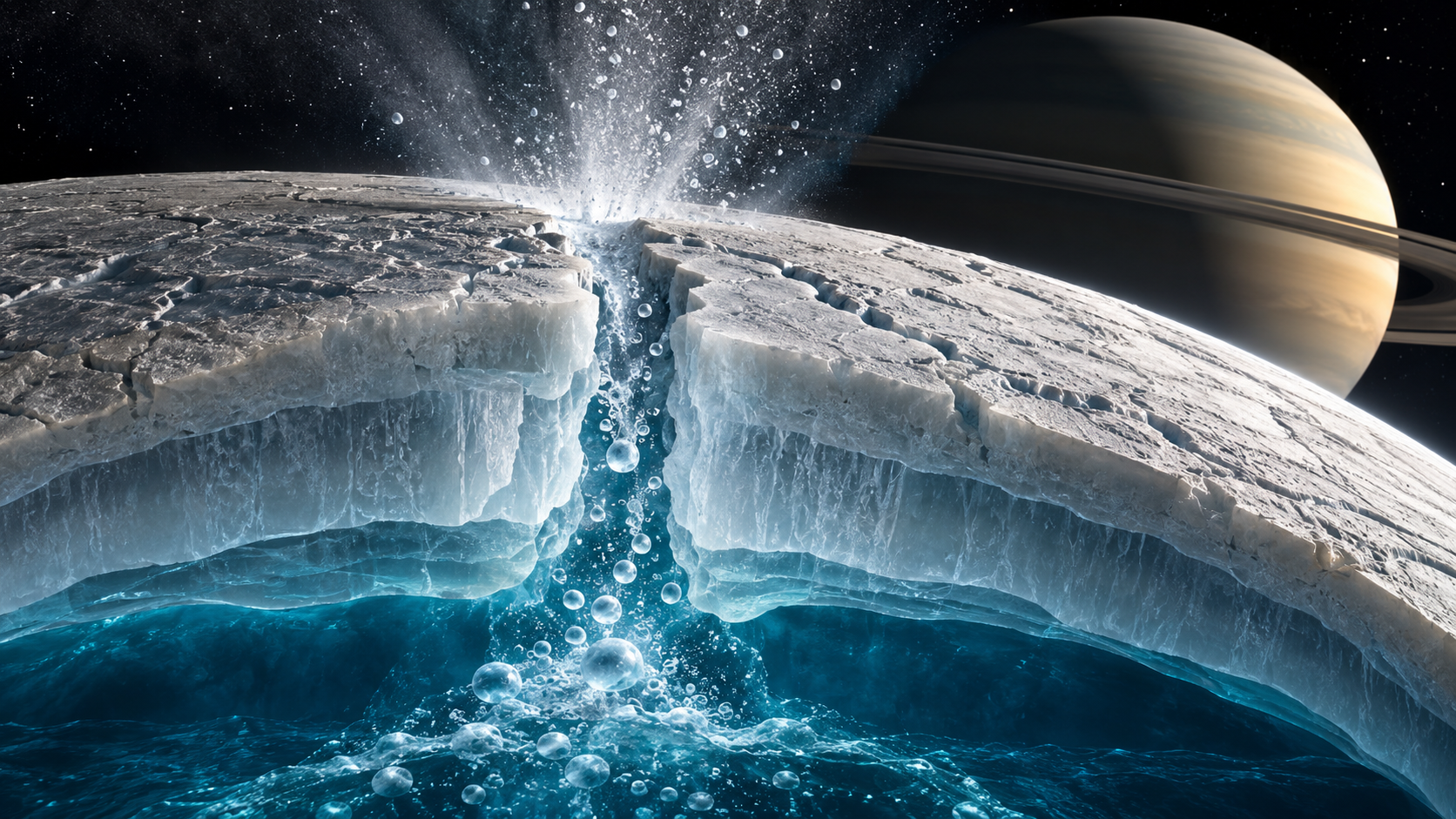
A fresh analysis of data from NASA’s Cassini mission has revealed a more complex route by which material from the hidden ocean of Saturn’s moon Enceladus may reach space. Rather than forming immediately as tiny frozen droplets, salt-rich particles detected around the moon may begin as much larger sprays of ocean water that freeze gradually, chemically separate as they cool, and then shatter into microscopic fragments while travelling through Enceladus’ icy vents.
The study, published in Science Advances on September 25, 2026, examined hundreds of individual salt-rich ice grains measured by Cassini’s Cosmic Dust Analyzer, or CDA. Laboratory freezing experiments and thermodynamic calculations were then used to investigate how the unexpectedly varied particle compositions could have formed.
Cassini Found Salt-Rich Grains With Very Different Compositions
Enceladus contains a global liquid-water ocean beneath its ice shell. Material from that ocean is expelled through fractures near the moon’s south pole, producing a plume of water vapour and ice particles. Some of those particles escape Enceladus and populate Saturn’s diffuse E ring.
Cassini’s CDA instrument analysed individual E-ring ice grains by recording the ions generated when particles struck the detector at several kilometres per second. Previous studies divided the grains into broad compositional groups, including salt-rich particles known as Type 3 grains, which are believed to originate from Enceladus’ subsurface ocean.
For the new study, the researchers examined 961 Type 3 spectra selected from more than 7,300 E-ring particle spectra recorded during favourable Cassini observing periods between 2004 and 2008.
The analysis showed that the salt-rich grains were far from chemically uniform. Individual particles could instead be grouped into several distinct compositions involving compounds associated with:
- sodium chloride,
- sodium carbonate or bicarbonate,
- sodium phosphate,
- sodium hydroxide,
- potassium chloride, and
- mixtures containing both sodium and potassium salts.
One of the clearest patterns involved sodium chloride and carbonate-rich particles. Among 858 regularly classified sodium-rich spectra, only 12 contained detectable signatures of both carbonate and chloride. The researchers calculated that chloride was about 25 times less likely to appear when carbonate was present, indicating that the two components are strongly segregated rather than being randomly distributed among the grains.
The Tiny Grains May Be Fragments of Much Larger Droplets
This chemical separation raised an important question. If Type 3 particles originate from droplets of the same ocean, why do different salts so often appear concentrated in different grains?
The researchers argue that the answer lies in what happens while relatively large droplets freeze. Instead of assuming that the micrometer-sized particles observed by Cassini formed directly from equally small ocean droplets, the study proposes that ocean spray initially contains droplets tens to hundreds of micrometers across.
When salty water freezes, pure water ice forms first while dissolved ions are pushed into the remaining liquid. Different salts then precipitate from this increasingly concentrated brine at different temperatures. If freezing progresses slowly enough, those salt deposits can become physically separated within different regions of the same frozen droplet.
Later fragmentation can break that larger parent particle into much smaller pieces. Individual fragments would then contain different salt-rich regions, producing the chemically distinct microscopic grains observed by Cassini.
Laboratory Droplets Reproduced the Salt Separation
To test this explanation, the team prepared water containing sodium, potassium, chloride, carbonate-related compounds and phosphate at concentrations intended to approximate important aspects of Enceladus’ ocean chemistry. Droplets with nominal diameters of about 15, 200 and 1,000 micrometers were frozen at rates ranging from roughly 1 kelvin per minute to more than 1,000 kelvins per minute.
After freezing, the researchers removed the water ice by freeze-drying and mapped the remaining salt deposits at microscopic scales.
The strongest segregation appeared when larger droplets cooled comparatively slowly. In approximately 200-micrometer droplets, cooling at around 10 kelvins per minute or slower produced clearly separated chloride-rich and carbonate-rich regions. At 20 kelvins per minute and during flash freezing, the chemical elements were distributed much more uniformly.
Very small droplets also proved less effective at separating the salts. In the approximately 15-micrometer samples, strong segregation remained difficult to produce even at the slowest experimental cooling rate.
The results indicate that the parent droplets responsible for Cassini’s chemically distinct grains were probably larger than the final particles measured in space. The experiments suggest that effective segregation requires droplets larger than roughly 10 to 20 micrometers and cooling rates below about 20 kelvins per minute, although the exact conditions depend on droplet size and composition.
Different Salts Crystallize at Different Temperatures
Thermodynamic modelling supported the laboratory results by showing that the major salt phases would not precipitate simultaneously during freezing.
In the model used by the researchers, sodium hydrogen phosphate begins precipitating first. Sodium carbonate minerals follow as the temperature falls further, while sodium and potassium chlorides crystallize much later, when the remaining liquid has become a highly concentrated brine.
This sequence provides a physical mechanism for separating the compounds. A salt that crystallizes early can become trapped in one part of the growing ice structure, while later salts remain dissolved and are carried into other parts of the droplet before they eventually precipitate.
The modelling also helps explain why phosphate-rich grains detected by Cassini lack strong chloride and carbonate signatures and why potassium-rich material is primarily associated with chloride.
Slow Freezing Could Occur Deep Inside Enceladus’ Vents
The required cooling rate has important implications for conditions beneath Enceladus’ surface. Flash freezing would cool an exposed droplet too quickly to generate the observed salt segregation. The researchers therefore propose that the lower sections of the moon’s icy plumbing system provide a much more gradual thermal environment.
Ocean droplets may be produced when gas bubbles burst at the subsurface water surface. Because Enceladus has much weaker gravity than Earth, previous modelling suggests that bubble bursting could generate relatively large droplets, including particles in the submillimeter range.
Those droplets could then become suspended in slowly rising gas. In the lower vent system, the ice walls are expected to become colder only gradually with decreasing depth. Droplets would rapidly adjust to the local gas and wall temperature but would cool slowly overall as they are transported upward through that temperature gradient.
A vent-flow model considered in the study produces cooling rates of only a few kelvins per minute in deeper regions, remaining below about 20 kelvins per minute through much of the modeled channel. That is consistent with the laboratory conditions needed to generate significant salt segregation.
Wall Collisions Could Shatter the Frozen Droplets
Slow freezing explains how the salts become separated inside a large droplet, but Cassini usually detected particles only around micrometer scale. The second part of the proposed mechanism is fragmentation.
As gas rises through narrowing fractures toward the surface, it accelerates dramatically. Frozen particles cannot perfectly follow the changing gas flow and are therefore expected to strike the irregular walls of the vents.
The study argues that collisions at speeds exceeding about 100 metres per second could efficiently break larger frozen droplets into smaller pieces. Near the vent outlet, still higher relative velocities may occur. Repeated impacts would grind salt-segregated parent grains down until fragments reached the micrometer-scale sizes commonly found in Enceladus’ plume and Saturn’s E ring.
Each fragment would inherit material from only a small portion of the original frozen droplet. A piece breaking away from a chloride-rich region could therefore become a sodium chloride-rich Type 3 grain, while another fragment from the same parent droplet could contain predominantly carbonate or phosphate.
A Three-Stage Picture of Enceladus’ Plume Formation
The findings lead to a revised picture of how ocean-derived salt grains could travel from Enceladus’ interior into space.
- Gas bubbles burst at or near the subsurface ocean surface and generate relatively large droplets of salty ocean water.
- The droplets rise slowly through deeper ice vents and freeze gradually, allowing different salts to precipitate and become spatially separated.
- Higher in the vents, accelerating gas drives the frozen droplets into the walls, fragmenting them into much smaller compositionally distinct ice grains before they emerge into the plume.
This model differs from the earlier idea that the salt-rich particles observed by Cassini formed primarily through direct flash freezing of tiny ocean droplets.
Why the Finding Matters for Future Enceladus Missions
The proposed mechanism does not mean Cassini’s Type 3 grains have lost their connection to the ocean. The researchers argue that a sufficiently large collection of fragments should still preserve information about the overall composition of their parent ocean droplets, although fragmentation and later condensation of additional water ice introduce uncertainty when estimating exact dissolved concentrations.
The results could also affect how future spacecraft investigate Enceladus. Rare compounds present at low abundance in the ocean may become concentrated inside only a small fraction of plume grains rather than being evenly distributed among all particles.
That makes individual-particle analysis particularly valuable. A future mission capable of measuring many separate ice grains could encounter uncommon fragments containing unusually high concentrations of specific oceanic salts or other compounds that would be strongly diluted in a bulk sample.
The authors also suggest that related freezing and fragmentation processes could help separate some organic compounds, although that extension remains less firmly established than the salt-segregation mechanism demonstrated in this study.
Cassini ended its mission in 2017, but its dust measurements continue to reveal details of Enceladus’ hidden plumbing system. The new results suggest that the tiny particles surrounding the moon may record not only the chemistry of its ocean, but also the sequence of freezing, salt crystallization and violent fragmentation that occurs during their journey from an ocean beneath the ice into space.