

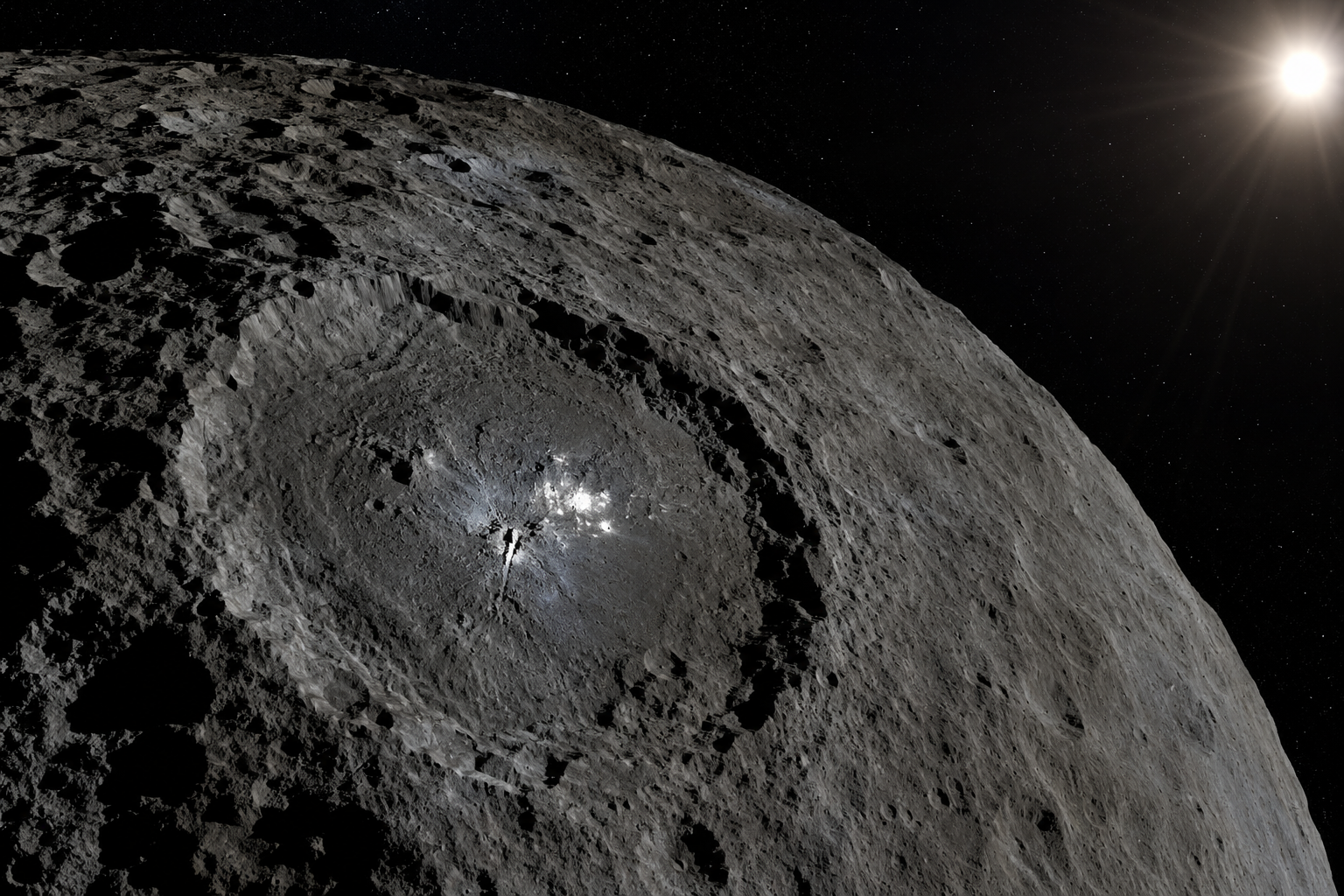
The bright salt-rich deposits of Cerealia Facula inside Occator Crater on Ceres may be among the clearest surface signs of geologically recent activity on the dwarf planet. A new study presented for the EGU General Assembly 2026 revisits the age of these deposits using the highest-resolution imagery collected by NASA’s Dawn mission and improved crater-counting methods.
The work focuses on Cerealia Facula, the prominent bright region near the centre of Occator Crater. These deposits have long attracted scientific interest because they are thought to be linked to endogenic activity, most likely involving cryovolcanic or hydrothermal processes and subsurface brines. Determining when they formed is important for understanding how long Ceres may have remained internally active after the Occator impact.
Why Cerealia Facula Matters
Ceres is the largest object in the main asteroid belt and is classified as a dwarf planet. Unlike many airless rocky bodies, Ceres has shown evidence of water-rich chemistry, bright salt deposits, and possible cryovolcanic processes. Occator Crater, with Cerealia Facula at its centre, is one of the most important locations for studying that history.
Previous crater size–frequency distribution studies suggested that Cerealia Facula is significantly younger than Occator Crater itself. However, earlier estimates were affected by several challenges, including small counting areas, limited crater statistics, complex surface features, and strong brightness variations that make crater detection difficult.
Dawn’s XMO7 Data Provided a Sharper View
The new analysis uses data from multiple phases of NASA’s Dawn mission, including the spacecraft’s seventh and final Extended Mission Orbit, known as XMO7. These observations reached resolutions down to about 2.7 metres, offering the most detailed spacecraft view of Occator Crater and Cerealia Facula.
The research team combined Dawn Framing Camera data from both FC1 and FC2 cameras, including XMO7 clear-filter images and lower-resolution LAMO multispectral data. The result includes high-resolution orthomosaics and a pan-sharpened RGB product with an 8.5-metre ground sample distance, giving researchers improved spatial and spectral detail across the bright deposits.
Improving the Crater-Based Age Estimate
To estimate the age of Cerealia Facula, the researchers used crater size–frequency distribution measurements. This method relies on the principle that older surfaces generally accumulate more impact craters over time, while younger surfaces show fewer craters.
In this study, the team focused on craters larger than 50 metres to reduce detection bias. Multiple analysts performed independent crater counts to assess measurement variability and improve the robustness of the result. The model ages were then calculated using both lunar-derived and asteroid-flux-derived chronology frameworks.
A Young Surface, But With Wide Model Uncertainty
The study confirms that Cerealia Facula formed after the Occator impact. The estimated model ages range from 0.4 million to 39.5 million years, depending on the scaling parameters and chronology model used. The authors identify the most likely age range as being in the single-digit millions of years.
This wide range does not mean the deposit’s youth is unsupported. Instead, it reflects the uncertainty involved in translating crater counts into absolute ages, especially on a small, complex surface with strong albedo contrasts and varied terrain. The study’s improved data products and independent crater counts help reduce detection variability compared with earlier work.
A More Complex Surface Than Previously Seen
The new orthomosaics and digital terrain model show that Cerealia Facula is not a simple smooth deposit. The surface contains steep slopes, fractures, and strong brightness variations, all of which complicate crater identification. These features also provide useful clues about the surface modification processes that shaped the deposit after its formation.
Such complexity supports the broader interpretation that Occator Crater has experienced geologically significant activity after the initial impact. If Cerealia Facula is only a few million years old, it would strengthen the case that brine-related processes persisted on Ceres into relatively recent geological time.
New Public Data Products for Future Research
Beyond the age estimate, a major outcome of the work is the release of improved geospatial datasets for Occator Crater. These include clear-filter orthomosaics, pan-sharpened RGB products, and a digital terrain model. The datasets are publicly available through Zenodo and are intended to support future research on Ceres’ surface geology, cryovolcanic activity, and possible landing-site assessment.
High-quality controlled datasets are especially important for Ceres because Dawn is no longer operating. The mission ended in 2018, so reprocessing and improving existing observations remains one of the main ways to extract new scientific value from the spacecraft’s archive.
What This Means for Ceres
The revised crater-based study reinforces the view that Ceres was not simply a frozen and inactive body after the formation of Occator Crater. Instead, its bright deposits point to a more dynamic history involving subsurface brines, surface alteration, and possible cryovolcanic or hydrothermal activity.
While the exact age of Cerealia Facula remains model-dependent, the new analysis supports the conclusion that the deposit is geologically young compared with the Occator impact. The work also provides a stronger observational foundation for future studies of Ceres, extending the scientific legacy of NASA’s Dawn mission and improving the context for any future exploration of the dwarf planet.