

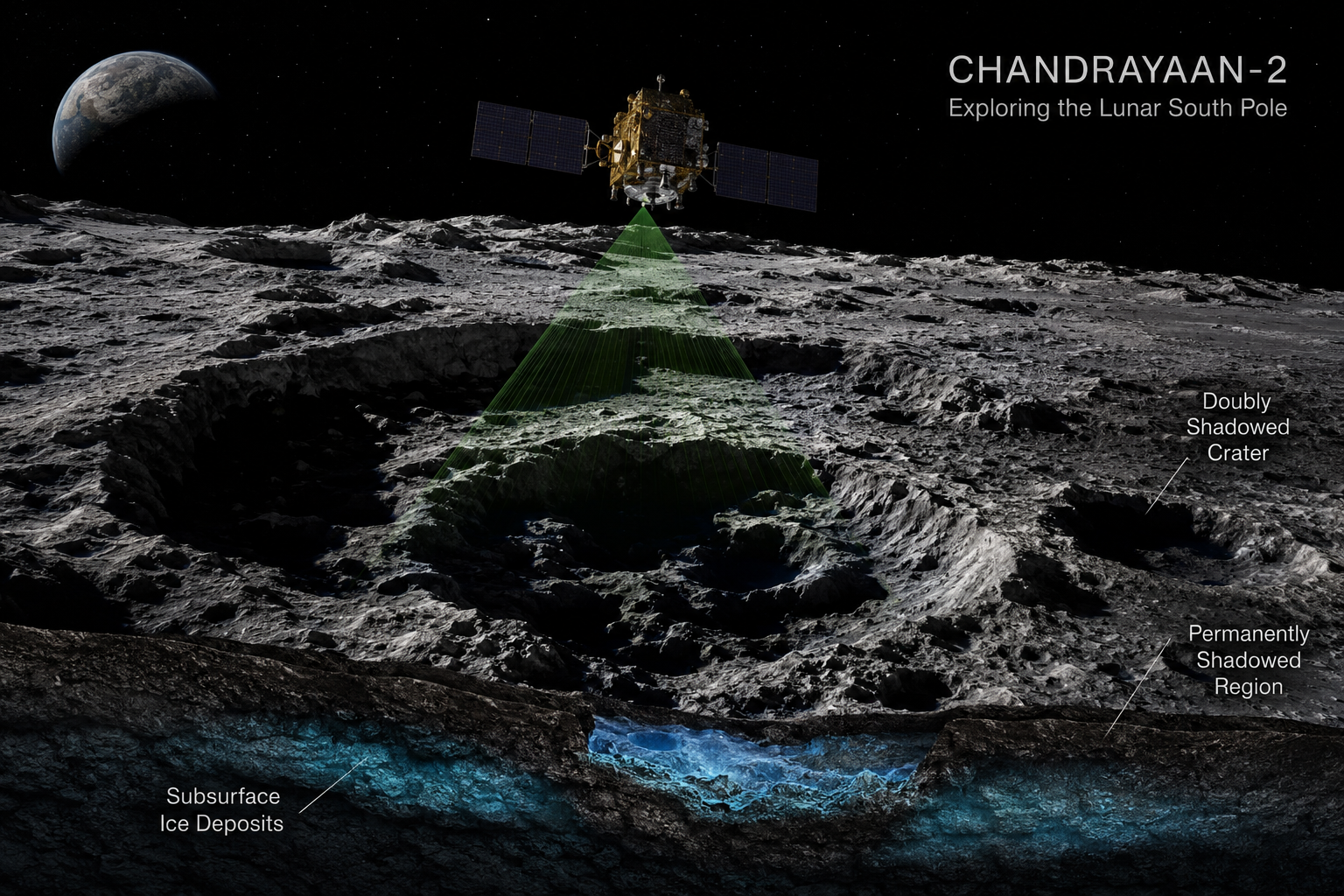
Chandrayaan-2 Detects Signs of Subsurface Ice in Ultra-Cold Lunar Craters
Scientists analyzing radar observations from India’s Chandrayaan-2 mission have identified strong evidence suggesting the presence of subsurface water-ice inside several extremely cold craters near the Moon’s south pole. The study focused on “doubly shadowed craters,” a rare class of lunar craters that remain shielded not only from direct sunlight but also from scattered light and thermal radiation from nearby illuminated terrain.
The research, published in npj Space Exploration, used observations from Chandrayaan-2’s Dual Frequency Synthetic Aperture Radar (DFSAR) instrument to investigate nine doubly shadowed craters located within the larger Faustini, Haworth, and Shoemaker craters.
Why Doubly Shadowed Craters Matter
Doubly shadowed craters are considered some of the coldest known environments in the Solar System. According to thermal models referenced in the study, temperatures inside these craters can fall to approximately 25 Kelvin, or around minus 248 degrees Celsius.
Such extreme conditions make these craters highly favorable locations for preserving water-ice over very long periods. Unlike ordinary permanently shadowed regions, doubly shadowed craters are additionally protected by raised crater rims that block scattered sunlight and heat from surrounding terrain.
The study notes that these unique conditions may allow volatile materials such as water-ice to remain stable beneath the lunar surface for geological timescales.
How Chandrayaan-2 Investigated the Lunar Surface
Researchers used Chandrayaan-2’s DFSAR instrument, which operates at both L-band and S-band radar frequencies and supports full polarimetric observations. This allows scientists to analyze how radar signals scatter beneath the lunar surface.
The team focused on two key radar measurements:
- Circular Polarization Ratio (CPR): Elevated CPR values greater than 1 can indicate volumetric scattering associated with ice-rich material.
- Degree of Polarization (DOP): Lower DOP values indicate stronger depolarization, which is consistent with scattering inside subsurface ice deposits.
The researchers refined the radar detection criterion by concluding that regions showing both CPR greater than 1 and DOP lower than 0.13 provide strong evidence for subsurface ice.
Four Craters Showed Strong Ice Signatures
Among the nine investigated doubly shadowed craters, four displayed radar characteristics consistent with subsurface ice:
- F2 crater inside Faustini
- F3 crater inside Faustini
- H3 crater inside Haworth
- S1 crater inside Shoemaker
The crater designated F2 showed the strongest evidence. Researchers observed widespread elevated CPR signals together with extremely low DOP values, suggesting substantial volumetric scattering beneath the surface.
The study reported CPR values reaching as high as 1.95 in F2, while the crater also displayed a distinctive lobate-rim morphology previously associated with impacts into ice-rich ground.
Possible Evidence of Excavation Into Buried Ice
One of the most notable findings involved the F2 crater within Faustini. Scientists suggest the impact that formed this crater may have penetrated into buried ice deposits beneath the permanently shadowed surface.
The crater lies approximately 180 meters below the surrounding Faustini crater floor, while its own interior extends roughly 300 meters deeper than the upper surface of the host crater floor. Researchers propose that this deeper excavation could have exposed or disturbed ancient subsurface ice.
The crater’s raised lobate rim further supports this interpretation. According to the study, such morphologies may form when impacts occur in volatile-rich terrain.
Not All Craters Contained Detectable Ice Signatures
The remaining investigated craters did not display the same radar characteristics. Researchers caution that this does not necessarily mean those regions are completely ice-free.
The DFSAR instrument mainly probes the upper few meters beneath the surface. If ice deposits exist at greater depths, they may remain undetected by the radar observations used in the study.
The results instead suggest that subsurface ice at the lunar south pole may be spatially heterogeneous, with some craters preserving ice more effectively than others depending on their geological history, local terrain, and thermal environment.
Implications for Future Lunar Missions
Understanding the distribution of lunar water-ice remains a major priority for future exploration programs. Water can potentially support human missions by providing drinking water, breathable oxygen, and rocket fuel through in-situ resource utilization technologies.
The findings also strengthen the scientific importance of doubly shadowed craters as long-term volatile reservoirs on the Moon.
The researchers concluded that combining radar polarimetry with crater morphology and thermal analysis offers a more reliable method for distinguishing genuine ice-rich regions from rough rocky terrain that can produce similar radar signatures.
The study provides additional support for the idea that the Moon’s polar regions may contain localized subsurface ice deposits capable of surviving for billions of years in ultra-cold environments.