

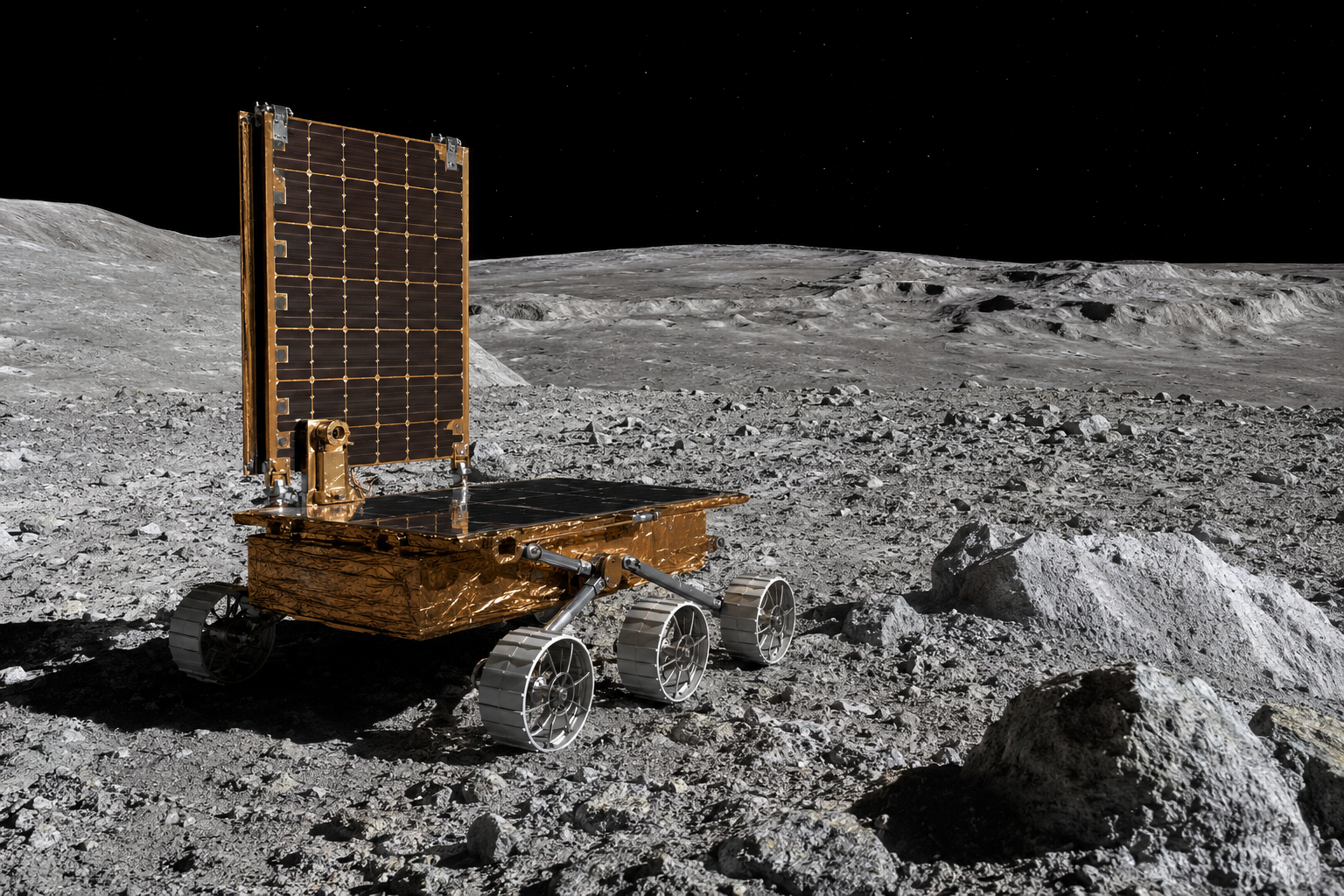
India’s Chandrayaan-3 mission has delivered new insights into the composition of the Moon’s ancient crust. Using measurements from the Alpha Particle X-ray Spectrometer (APXS) aboard the Pragyan rover, scientists have conducted the first detailed geochemical investigation of the mission’s landing site in the southern nearside lunar highlands.
The study reveals that the region is not composed solely of the pristine feldspathic crust traditionally associated with the Moon’s highlands. Instead, the site contains a more magnesium-rich and iron-rich mixture than expected, pointing to a complex geological history shaped by large impact events and deep crustal excavation.
Exploring the Moon’s Ancient Highland Terrain
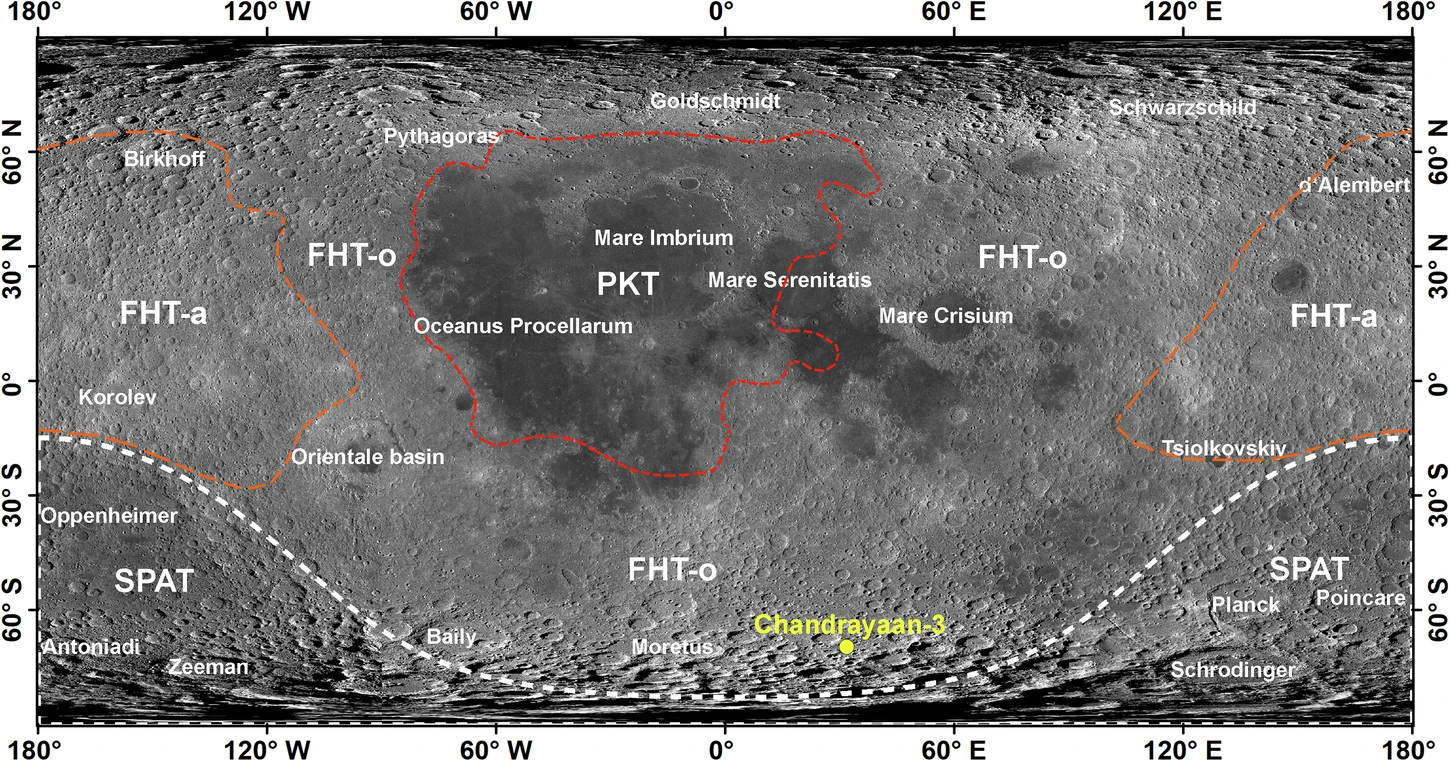
Chandrayaan-3 landed at Shiv Shakti Station near 69.37° south latitude, within the Feldspathic Highland Terrane (FHT), one of the Moon’s oldest geological provinces. The FHT is believed to preserve remnants of the original crust that formed as minerals crystallized from the ancient Lunar Magma Ocean billions of years ago.
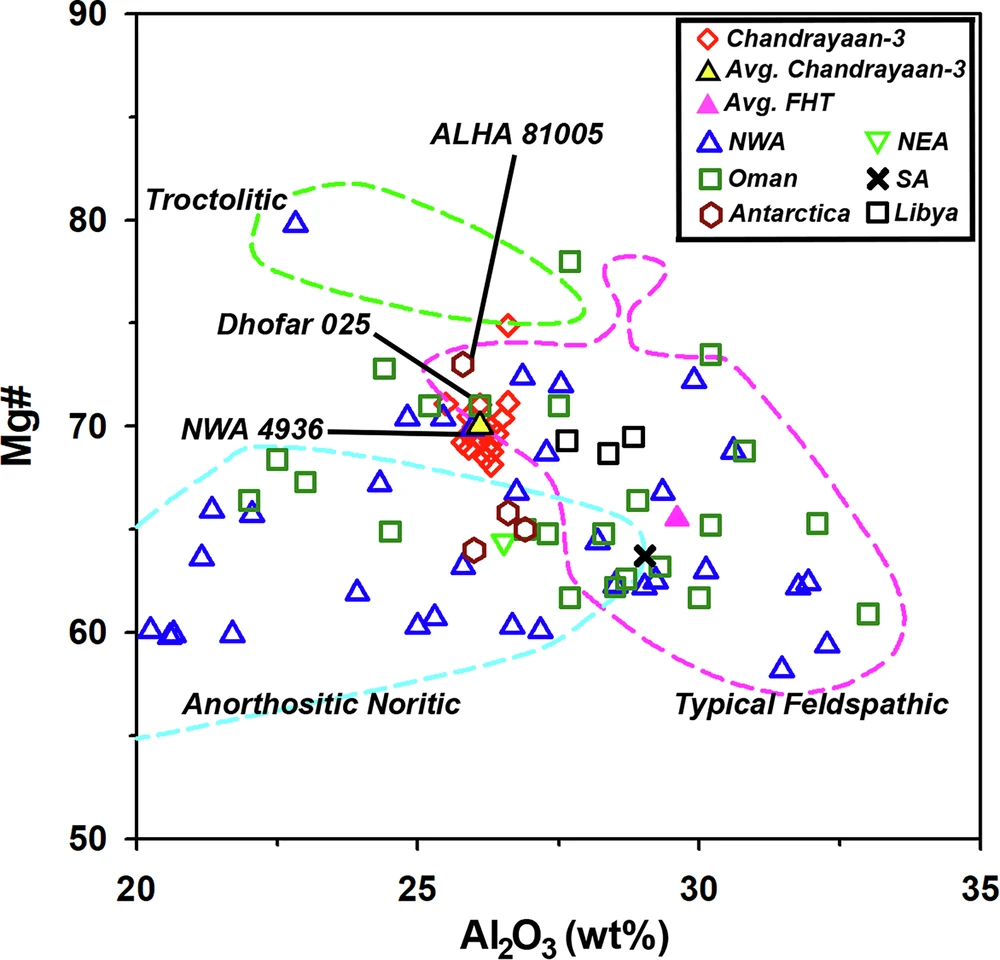
Researchers found that soils at the landing site contain lower aluminum oxide concentrations and significantly higher magnesium and iron content than the average lunar highlands. The measurements indicate a crust that is less feldspathic and more mafic than previously expected for this region.
Evidence of Deep Lunar Material
One of the most significant findings is the elevated magnesium number (Mg#) measured at the landing site. The region also contains more olivine-rich material than is typical for average lunar highlands.
According to the researchers, these characteristics suggest that material from deeper layers of the Moon’s crust—or possibly even the upper mantle—was excavated by ancient impacts and mixed into the local regolith.
A leading candidate for this process is the South Pole–Aitken (SPA) Basin, the largest and one of the oldest known impact basins on the Moon. The Chandrayaan-3 landing site lies relatively close to the basin’s outer influence zone, making it plausible that ejecta from the impact redistributed deep lunar materials across the region.
Connections to Lunar Meteorites Found on Earth
The research team compared Chandrayaan-3 measurements with dozens of lunar meteorites recovered on Earth. Among them, a meteorite known as Allan Hills 81005 (ALHA 81005), discovered in Antarctica, showed the closest overall compositional match.
ALHA 81005 belongs to a rare group known as magnesian anorthosites. These rocks occupy an unusual compositional space between traditional ferroan anorthosite crust and magnesium-rich lunar rocks.
The similarity suggests that some lunar meteorites may preserve geological signatures from terrains comparable to those explored by Chandrayaan-3, helping scientists link laboratory samples on Earth to specific regions on the Moon.
Impact Mixing Shaped the Lunar Surface
To understand the origin of the unusual composition, researchers performed mixing analyses using lunar meteorite data and highland crust compositions. The results indicate that the Chandrayaan-3 site is best explained as a combination of typical feldspathic highland material and troctolitic anorthosites originating from deeper crustal layers.
This supports the idea that major impacts played a critical role in reshaping the Moon’s surface by excavating deep material and redistributing it across vast distances.
What the Findings Mean for Lunar Evolution
The study strengthens the long-standing Lunar Magma Ocean hypothesis, which proposes that the Moon was once covered by a global ocean of molten rock. As this magma ocean cooled, lighter minerals floated to the surface and formed the primordial crust.
Rather than challenging that model, the new results suggest that the original crust was later modified by billions of years of impact-driven mixing and regolith evolution. This process likely created significant regional variations across the lunar highlands.
The findings also imply that some highland regions may contain greater concentrations of olivine-rich and magnesium-rich materials than previously recognized, offering new clues about the Moon’s deep interior.
A New Window into Lunar Geological History
Chandrayaan-3 has provided one of the most important in situ geochemical datasets ever collected from the lunar highlands. By linking rover measurements with orbital observations and lunar meteorites, scientists are building a more complete picture of how the Moon’s crust formed and evolved.
As future missions return additional samples and collect more detailed geochemical measurements, researchers expect to further refine their understanding of the Moon’s ancient crust, the effects of giant impacts, and the geological processes that shaped Earth’s nearest celestial neighbor.