

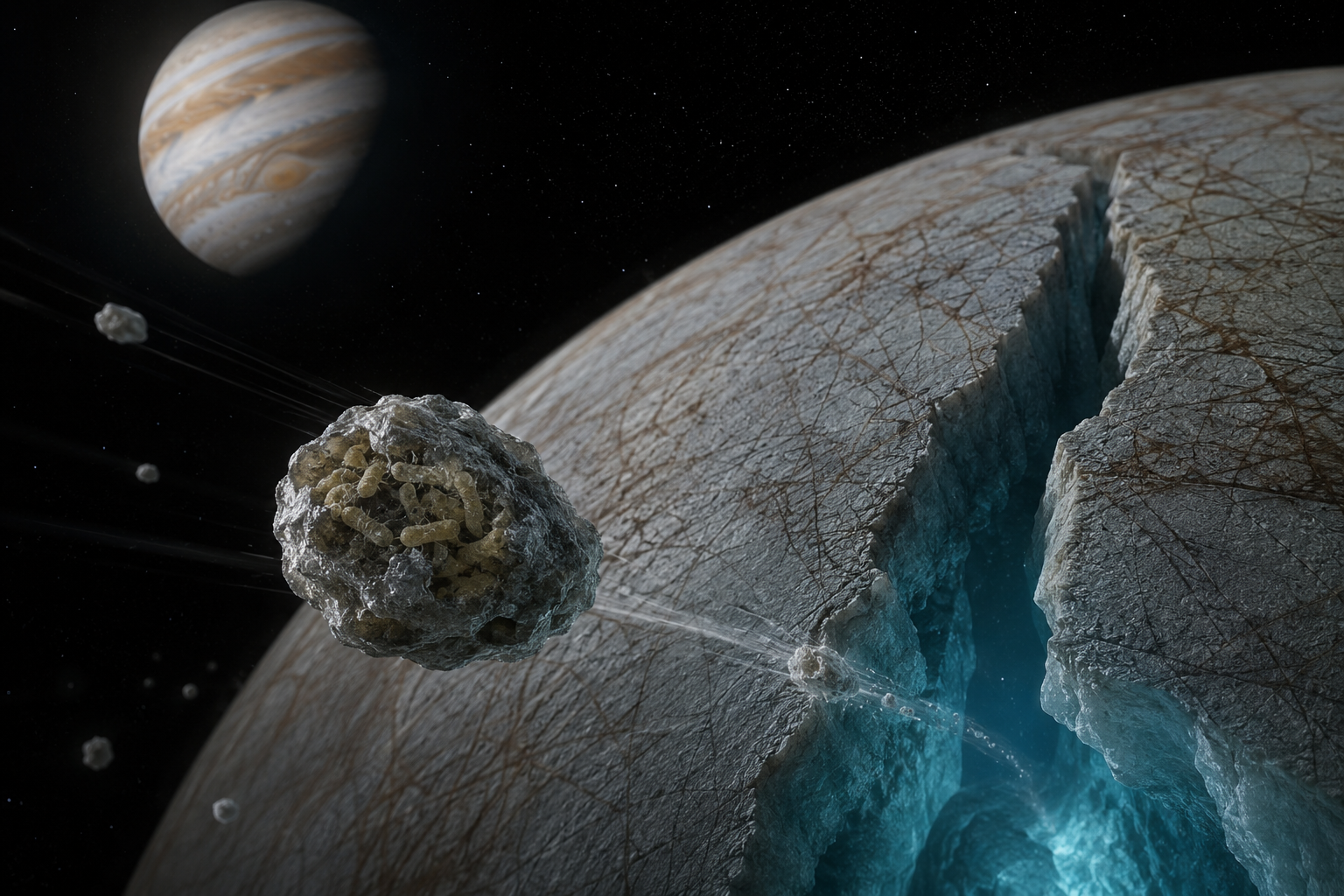
A theoretical study has raised the possibility that Earth itself may have delivered microorganisms to Europa, the ice-covered moon of Jupiter believed to contain a vast ocean beneath its surface. The proposed mechanism involves microscopic terrestrial dust particles carrying bacteria away from Earth and eventually striking Europa.
The research, published in the International Journal of Astrobiology, does not present evidence that terrestrial organisms currently live on Europa. Instead, it develops a mathematical model to estimate whether bacteria-bearing dust could physically escape Earth, travel through the Solar System and survive certain types of impact on the Jovian moon.
Dust Could Potentially Escape Earth
The hypothesis builds on earlier work suggesting that high-speed micrometeorites entering Earth’s upper atmosphere could disturb and accelerate local dust particles. Under particular conditions, some of those grains might reach speeds greater than Earth’s escape velocity.
The study focuses on dust grains approximately 10−4 centimetres in size, which are theoretically large enough to contain individual bacterial cells. To remain biologically viable during acceleration, however, the particles would need to avoid excessive heating.
Using atmospheric density and thermal-radiation estimates at an altitude of about 150 kilometres, the researcher calculated that grains could reach approximately 14 kilometres per second while remaining near 300 kelvin. This is higher than Earth’s escape velocity of about 11.2 kilometres per second.
After overcoming Earth’s gravity, the particles could retain a relative velocity of roughly 8.4 kilometres per second. Their subsequent trajectories would be influenced by solar gravity, radiation pressure and drag from material in interplanetary space.
Modelling the Journey to Jupiter
The study numerically modelled dust grains travelling outward from Earth’s orbit towards Jupiter. Depending on their initial direction, some particles were found to reach the region of Jupiter’s orbit.
The calculations produced an average relative velocity of approximately 20.1 kilometres per second between incoming dust grains and Jupiter. Only particles launched within certain directional ranges would follow trajectories capable of entering the Jovian system.
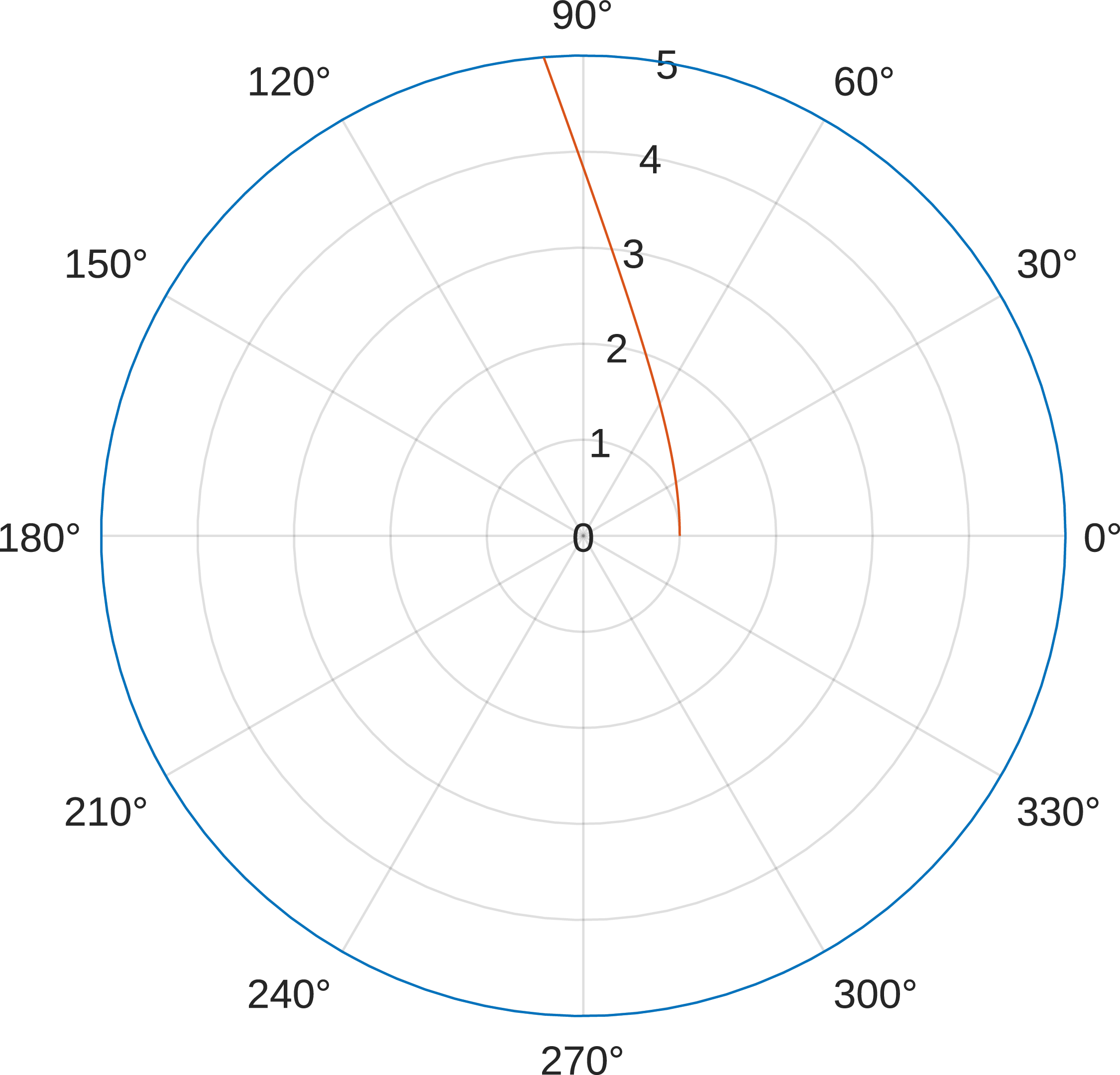
This figure illustrates a dust particle moving from approximately one astronomical unit from the Sun to Jupiter’s orbital distance near five astronomical units.
Survival Would Require a Shallow Impact
Reaching Europa would not necessarily mean that bacteria survived. At the estimated impact speed, a particle striking the surface directly would experience temperatures capable of destroying biological material.
The model therefore examines highly oblique impacts. According to the calculations, bacteria could potentially survive only when a grain approached the icy surface at an angle of roughly one degree relative to it.
This narrow survival window reduces the estimated number of viable impacts considerably. The analysis also accounts for the limited range of Earth-departure directions, the timing required to encounter Jupiter’s orbital region, Jupiter’s gravitational reach and the small probability that a grain entering the Jovian system would collide specifically with Europa.
After applying these reductions, the study estimates that around 3.2 × 10⁸ dust particles per second could strike Europa under conditions in which an enclosed bacterium might survive the impact.
Could the Particles Reach Europa’s Ocean?
Europa’s surface is exposed to intense radiation from Jupiter’s magnetosphere. Previous research cited in the paper suggests that bacteria deposited on the surface could become inactive within approximately 10,000 years.
For terrestrial organisms to reach the subsurface ocean, particles would therefore have to move below the irradiated surface before losing viability. The study identifies Europa’s chaos terrains as one possible pathway.
Chaos terrains are fractured and disrupted regions that may be associated with movement of water or warm ice beneath the crust. They are estimated to cover approximately 20% to 40% of Europa’s surface. Repeated cracking, melting or resurfacing could theoretically carry embedded dust grains deeper into the ice.
The paper notes that Europa’s surface may undergo fracturing over timescales ranging from thousands to hundreds of thousands of years. This creates a possible, but unverified, route through which microorganisms deposited on the surface might eventually encounter subsurface liquid water.
Trillions of Trillions of Potential Particles
Europa’s relatively young icy surface is estimated in the study to be around 30 million to 80 million years old. Extending the calculated particle flux across this period produces a total of approximately 3 × 10²³ to 8 × 10²³ potentially survivable dust-grain impacts.
This figure represents the output of the model rather than a direct measurement. It depends on several assumptions, including the rate at which Earth releases suitable dust, the fraction containing viable organisms, their resistance to space radiation, the accuracy of the orbital calculations and the likelihood of transport through Europa’s ice.
The paper also does not establish that any transferred Earth organism could remain metabolically active, reproduce or adapt to Europa’s ocean. Conditions beneath the moon’s crust—including temperature, pressure, chemistry, salinity and available energy sources—remain incompletely understood.
A Panspermia Hypothesis Awaiting Evidence
The proposed process is a form of panspermia, the hypothesis that life or its biological building blocks can move naturally between planetary bodies. Most Solar System panspermia research has focused on rocks ejected by major impacts, while this study considers much smaller atmospheric dust grains as possible biological carriers.
The calculations suggest that transfer from Earth to Europa may be physically possible under a restricted set of conditions. They do not demonstrate that the transfer occurred or that Europa contains Earth-derived life.
Future missions capable of examining Europa’s surface composition, radiation-processed ice and material linked to the subsurface ocean could help scientists assess its habitability. Until biological material is directly detected and independently verified, the possibility that Earth seeded Europa remains an intriguing but speculative hypothesis.