

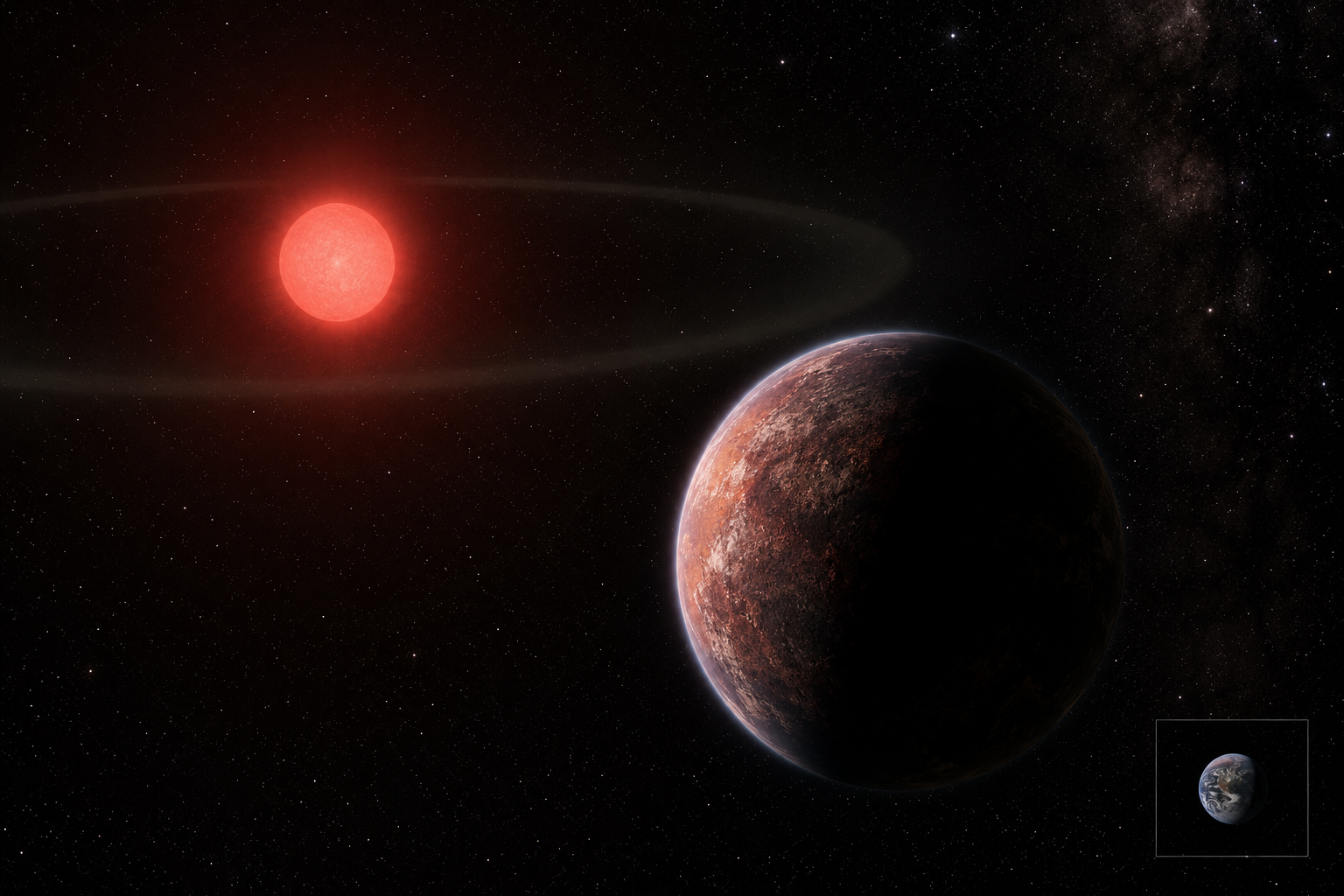
A nearby exoplanet once believed to be a relatively massive super-Earth has been found to be much smaller after astronomers reanalyzed observations from multiple world-leading instruments. The revised measurements suggest that GJ 3378 b, located just 7.7 parsecs (about 25 light-years) from Earth, has a minimum mass of only 2.3 Earth masses instead of the previously reported 5.3 Earth masses. Despite the revision, the planet still orbits within its star's conservative habitable zone, making it one of the closest potentially rocky worlds known.
A Planet Revisited with More Data
The new study combined radial velocity observations from four precision spectrographs: the Habitable-zone Planet Finder (HPF), NEID, CARMENES, and SPIRou. Researchers incorporated 137 new HPF measurements and 18 new NEID observations alongside previously published datasets to produce the most comprehensive analysis of the planetary system to date.
While an earlier study identified GJ 3378 b as orbiting its host star every 24.73 days, the expanded dataset consistently favored a shorter orbital period of 21.45 days. The revised solution also reduced the planet's measured gravitational influence on its host star, leading to a substantially lower mass estimate.
Still Inside the Habitable Zone
Although the planet's orbit is closer to its host star than previously believed, GJ 3378 is a cool M4 red dwarf whose habitable zone lies much nearer than the Earth's distance from the Sun. The revised orbit places GJ 3378 b at approximately 0.097 astronomical units, where it receives about 91% of the sunlight that Earth receives.
The study estimates an equilibrium temperature of approximately 272 Kelvin, close to Earth's effective temperature before atmospheric warming is considered. This means the planet remains within the conservative liquid-water habitable zone, assuming suitable atmospheric conditions exist.
A Better Candidate for a Rocky World
The lower mass significantly changes scientists' expectations for the planet's composition. A planet with a minimum mass of around 2.3 Earth masses is much more likely to possess a predominantly rocky interior than one exceeding five Earth masses. Based on current planetary mass-radius relationships, the researchers estimate GJ 3378 b would likely have a radius of about 1.3 times that of Earth if viewed nearly edge-on.
This does not confirm the planet is Earth-like, but it strengthens the possibility that it belongs to the class of terrestrial super-Earths rather than a volatile-rich mini-Neptune.
Balancing on the "Cosmic Shoreline"
The researchers also investigated whether GJ 3378 b may have retained an atmosphere over billions of years. Red dwarf stars emit strong X-ray and ultraviolet radiation, especially during their youth, which can gradually strip atmospheres from nearby planets.
Using an atmospheric retention model based on the planet's estimated escape velocity and the total high-energy radiation received throughout its history, the team found that GJ 3378 b lies almost exactly on the so-called "cosmic shoreline". This theoretical boundary separates planets likely to retain atmospheres from those expected to lose them through long-term radiative erosion.
Because the planet falls almost directly on this boundary, the study concludes that current evidence neither confirms nor rules out the existence of a long-lived atmosphere.
No Transit Detected
The team also searched observations from NASA's Transiting Exoplanet Survey Satellite (TESS) for signs that the planet passes directly in front of its host star. Despite multiple observing windows, no transit was detected.
Without a transit, astronomers cannot directly measure the planet's radius or atmospheric composition using current techniques. The planet's true mass also remains unknown because radial velocity observations measure only a minimum mass.
A Valuable Target for Future Giant Telescopes
Despite these limitations, GJ 3378 b remains an exceptionally valuable target. Its host star lies only about 25 light-years away, placing it among the nearest habitable-zone planetary systems known.
The authors suggest that future extremely large ground-based telescopes, including upcoming 30-meter-class observatories, may eventually be capable of directly imaging planets within the habitable zones of nearby red dwarfs. Although GJ 3378 b would require imaging systems capable of achieving particularly small inner working angles, it represents an attractive candidate for future characterization efforts.
Improving Our Picture of Nearby Habitable Worlds
The study highlights how additional observations can substantially refine the properties of known exoplanets. By combining measurements from several independent instruments, the researchers resolved discrepancies in earlier observations and produced a more robust orbital solution.
Rather than revealing a relatively massive super-Earth, the updated analysis paints GJ 3378 b as a smaller, potentially rocky planet orbiting within its star's habitable zone. As next-generation observatories come online during the coming decade, nearby worlds like GJ 3378 b are expected to become prime targets in the search for atmospheres and, ultimately, signs of habitability.