JWST Maps the Cosmic Web Across Billions of Years
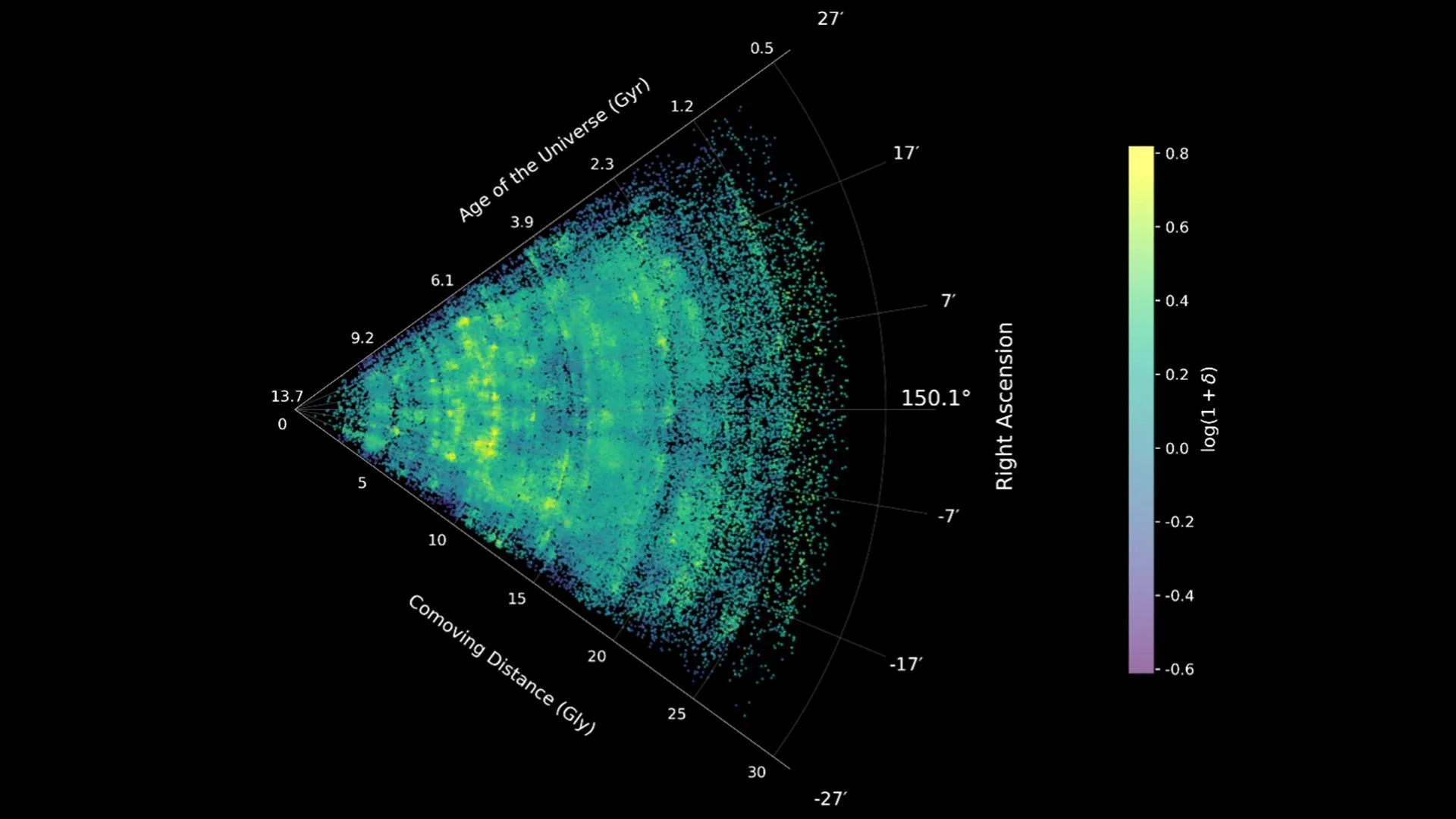
Astronomers working with the James Webb Space Telescope (JWST) have reconstructed one of the most detailed maps ever created of the Universe’s large-scale structure, commonly known as the cosmic web. The research uses observations from the COSMOS-Web survey to trace how galaxies evolved within dense clusters, filaments, and void-like regions across cosmic history, reaching as far back as redshift z ∼ 7.
The study analyzed approximately 164,000 galaxies using deep infrared imaging from JWST. Researchers found that galaxy growth and star formation are strongly connected to the surrounding cosmic environment, with dense regions accelerating galaxy mass assembly in the early Universe and later suppressing star formation in smaller galaxies.
The findings were published in The Astrophysical Journal.
What Is the Cosmic Web?
The cosmic web is the large-scale structure of the Universe formed by interconnected filaments, galaxy clusters, sheets, and vast empty voids. These structures emerged from tiny density fluctuations shortly after the Big Bang and evolved over billions of years under gravity.
Galaxies are not distributed randomly across space. Instead, they tend to gather in dense regions connected by filamentary structures, while enormous low-density voids occupy the spaces between them. Understanding how galaxies behave inside these environments helps astronomers study the physical processes driving galaxy evolution.
The new research used JWST’s infrared sensitivity to study these structures much farther back in time than previous surveys could achieve.
COSMOS-Web Provided the Largest JWST Survey for the Study
The COSMOS-Web program covers approximately 0.54 square degrees of the sky using JWST’s NIRCam instrument and complementary MIRI observations. The survey reaches extremely faint infrared depths, allowing astronomers to detect galaxies from the relatively nearby Universe all the way to redshift z ∼ 10.
According to the study, COSMOS-Web provides significantly improved photometric redshift precision and deeper galaxy detection compared to earlier surveys such as COSMOS2020. This enabled the researchers to build cleaner and more accurate density maps of the cosmic web.
The team reconstructed 157 separate redshift slices spanning from z = 0.4 to z = 9.5, although the study determined that reliable environmental analysis remains strongest up to approximately z ∼ 7.
Massive Galaxies Prefer Dense Cosmic Environments
The study found a strong relationship between galaxy mass and environmental density. Across most cosmic epochs, more massive galaxies were more likely to reside inside dense regions of the cosmic web.
This trend was especially strong for quiescent galaxies — galaxies that have largely stopped forming stars — at redshifts below z ≲ 2.5. In these regions, galaxies inside overdense environments were often several times more massive than galaxies in less crowded regions.
At earlier cosmic times, particularly beyond z ≳ 2.5, the relationship weakened and became concentrated mainly within the most extreme overdense regions, likely representing early protoclusters where galaxy assembly occurred rapidly.
Star Formation Behaved Differently Across Cosmic Time
The research also examined how star formation rates changed depending on environment.
At lower redshifts (z ≲ 1.2), galaxies in dense regions generally showed lower star formation activity. This trend was driven largely by quiescent galaxies, which dominated crowded environments and suppressed the overall average star formation rate.
However, at higher redshifts (z ≳ 1.8), the relationship reversed. Galaxies inside dense regions showed enhanced star formation activity compared to galaxies in sparse environments. Researchers suggest this was likely caused by abundant cold gas supplies, stronger galaxy interactions, and rapid growth inside young protocluster environments.
The study also found that star-forming galaxies maintained relatively stable specific star formation rates across different environments, indicating that both stellar mass and star formation increased together in dense regions.
Environmental Quenching Became Stronger Later in Cosmic History
The team investigated two major mechanisms responsible for shutting down star formation:
- Mass quenching, linked to internal galaxy processes such as black hole feedback and halo heating.
- Environmental quenching, caused by external effects including gas stripping, galaxy interactions, and suppression of fresh gas inflow in dense environments.
The results show that mass-driven quenching dominated during earlier cosmic epochs, particularly beyond z ≳ 2.5. As the Universe evolved, environmental quenching became increasingly important, especially for lower-mass galaxies at redshifts below z ≲ 0.8.
By the present-day Universe, both internal and environmental processes appear to contribute together to the evolution of massive galaxies in dense regions.
JWST Extends Environmental Studies Deeper into Cosmic History
Compared to previous large-scale surveys, COSMOS-Web significantly improves the study of the cosmic web by providing deeper infrared observations, higher galaxy counts, and more accurate photometric redshift measurements.
The researchers noted that earlier surveys often overestimated overdense regions and underestimated void-like environments because of limited sampling and lower precision. JWST’s improved capabilities allowed the team to recover smaller-scale structures and more accurate density contrasts.
The study concludes that the cosmic web has played a critical role in shaping galaxy evolution across nearly the entire observable history of the Universe. From accelerating early stellar mass growth in protoclusters to suppressing star formation in dense environments at later times, the large-scale structure appears deeply connected to how galaxies form and evolve.
Future Research
The researchers plan to expand the analysis further by refining the classification of filaments, nodes, and voids within the cosmic web. The COSMOS-Web dataset may also help astronomers better understand unresolved cosmological questions related to galaxy clustering, dark matter structure formation, and the evolution of the early Universe.
The team has also released tools for public visualization of the reconstructed cosmic web, including a three-dimensional augmented reality model designed for educational and outreach purposes.