

Researchers Explore Lunar-Based Gravitational Wave Detection
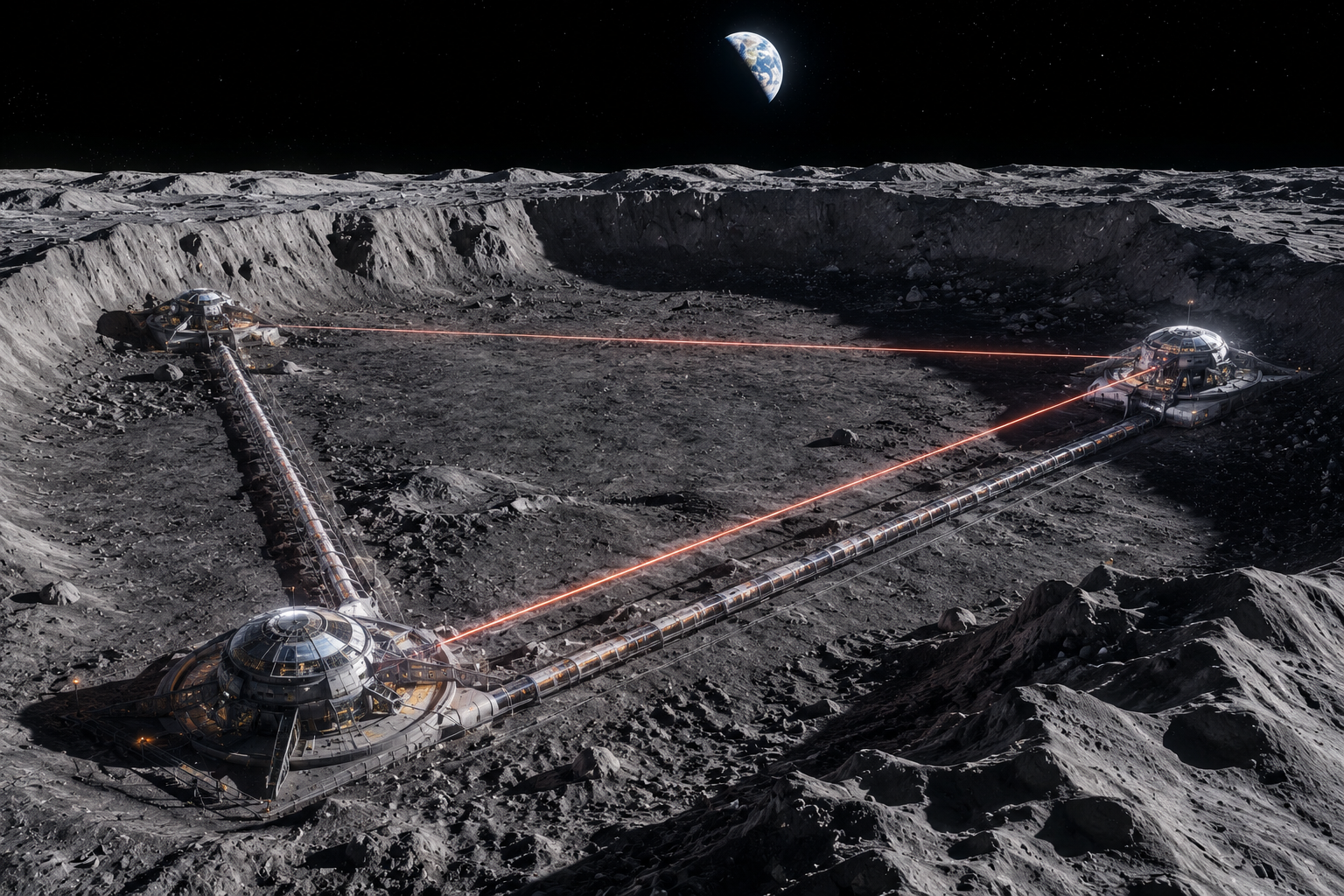
A newly published study has examined how a future gravitational wave observatory on the Moon could improve the detection and localization of cosmic events occurring across the universe. The proposed observatory, known as the Crater Interferometry Gravitational-wave Observatory (CIGO), is designed to operate in the mid-frequency gravitational wave band between 0.1 and 10 Hz — a range that is currently difficult to observe using existing Earth-based or planned space-based detectors.
The research was published in npj Space Exploration and investigates how CIGO could work alongside missions such as LISA and TianQin to improve gravitational wave astronomy.
Why the Mid-Frequency Band Matters
Current ground-based observatories such as LIGO primarily observe higher-frequency gravitational waves, while future space missions like LISA are optimized for much lower frequencies. The intermediate deci-hertz range remains comparatively underexplored.
According to the researchers, this frequency range may contain signals from:
- Intermediate-mass black hole mergers
- Compact binary white dwarf systems
- Core-collapse supernovae
- Potential early-universe phenomena
The study notes that bridging this observational gap could help scientists better understand compact astrophysical objects and test aspects of general relativity.
Why Build a Detector on the Moon?
The Moon offers several environmental advantages for gravitational wave detection. Unlike Earth, the lunar surface lacks atmospheric activity, human-generated disturbances, and large-scale tectonic motion. Researchers state that seismic noise on the Moon at low frequencies may be several orders of magnitude lower than on Earth.
The proposed CIGO observatory would place three interferometer stations near the Moon’s north pole in an equilateral triangular configuration with arm lengths of approximately 100 kilometers. Unlike free-flying space interferometers, the stations would remain anchored to the lunar surface.
The paper explains that this rigid configuration could simplify operations compared to some space-based detector architectures by removing the need for complex time-delay interferometry systems.
CIGO Performance Compared With LISA and TianQin
Using simulations of 3,600 gravitational wave sources distributed across the sky, the researchers evaluated the angular localization accuracy of CIGO alongside LISA and TianQin.
The study found that:
- At frequencies around 0.1 Hz, TianQin and CIGO performed similarly
- Above approximately 2.87 Hz, CIGO achieved significantly better localization accuracy than both LISA and TianQin
- At higher frequencies, the combined detector network became dominated by CIGO’s performance
The researchers reported that at 10 Hz, CIGO’s angular resolution exceeded that of the other detectors by multiple orders of magnitude in their simulations.
Lunar Noise Remains a Major Engineering Challenge
Despite the promising results, the study also highlights several technical challenges. Simulations incorporating lunar environmental noise showed that seismic and thermal disturbances could substantially reduce performance below 2.87 Hz.
The researchers suggest that future lunar detectors may require advanced seismic isolation systems and environmental monitoring technologies to achieve the projected sensitivity levels.
The paper also notes that current noise estimates remain conservative and that future detector designs could improve sensitivity further.
Tetrahedral Upgrade Could Improve Sky Coverage
The study additionally explored an upgraded configuration called TCIGO, which adds a fourth station at the bottom of a lunar crater to form a tetrahedral geometry.
According to the simulations, this configuration could improve angular resolution by roughly a factor of five compared to the original three-station CIGO design. It could also reduce localization blind spots caused by the fixed orientation of the original detector plane.
The authors acknowledge that a perfectly regular tetrahedral crater configuration may not exist naturally on the Moon and describe the design primarily as an idealized concept for studying performance improvements.
Future of Lunar Gravitational Wave Astronomy
The researchers conclude that lunar-based gravitational wave observatories could become an important part of future multi-band gravitational wave astronomy. By operating between the frequency ranges targeted by ground-based and space-based detectors, systems like CIGO may help create more continuous observational coverage across the gravitational wave spectrum.
While the project remains conceptual, the study adds to growing international interest in using the Moon as a platform for advanced astrophysics infrastructure in the coming decades.