

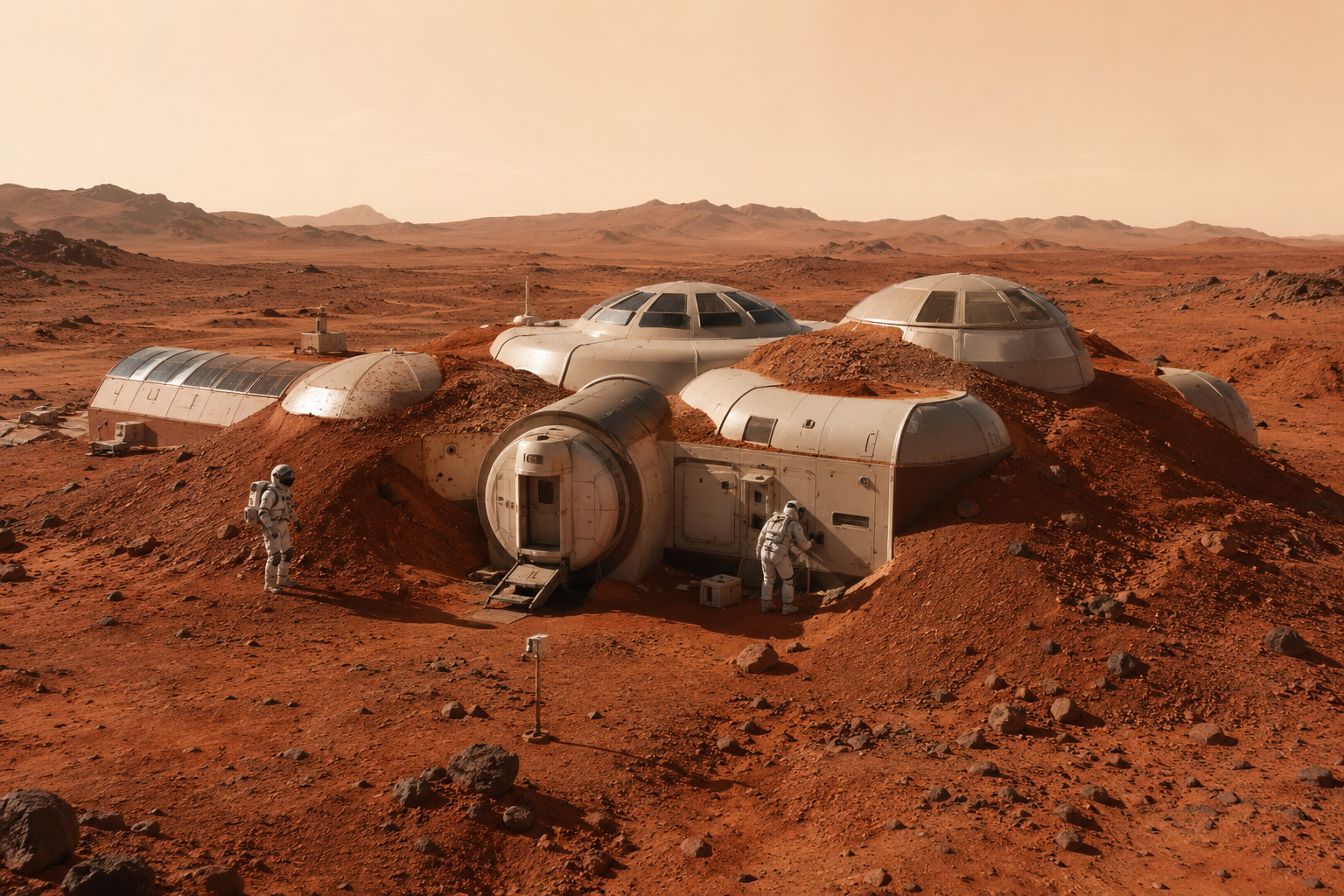
As space agencies and private companies advance plans for long-duration human missions to Mars, one challenge continues to stand out: how to build habitats that can survive years of exposure to the planet’s harsh environment while minimizing maintenance and resupply needs. A new study published in npj Space Exploration proposes a data-driven answer, identifying a narrow range of habitat geometries that may significantly reduce long-term upkeep burdens for future Martian settlements.
Why Habitat Shape Matters on Mars
Mars presents an extreme environment characterized by low atmospheric pressure, intense radiation, abrasive dust, and large temperature swings. While much attention has focused on construction methods and life-support systems, the researchers argue that habitat geometry itself plays a major role in determining maintenance requirements.
The shape of a habitat influences how much surface area is exposed to the environment, how heat is lost, how structural joints are distributed, and how vulnerable the structure is to long-term degradation. Even small differences in geometry can affect the frequency of repairs and the amount of replacement material required over a habitat’s operational lifetime.
Using Earth Buildings as Mars Analogs
Because no long-term Martian habitats currently exist, the research team turned to Earth analogs. They analyzed 59,192 extreme-environment building samples derived from 631 built habitats across 384 cities in 70 countries and territories. The study used refurbishment-phase embodied carbon intensity as a proxy for maintenance-related material replacement and logistics burden.
The goal was not to directly compare hotels or buildings with Mars habitats, but to identify geometric relationships that remain relevant regardless of location. Researchers focused on three primary morphological characteristics:
- Footprint Ratio
- Aspect Ratio
- Shape Factor
Together, these metrics describe how compact a structure is, how its height relates to its footprint, and how much surface area is exposed relative to enclosed volume.
A Narrow Corridor of Optimal Designs
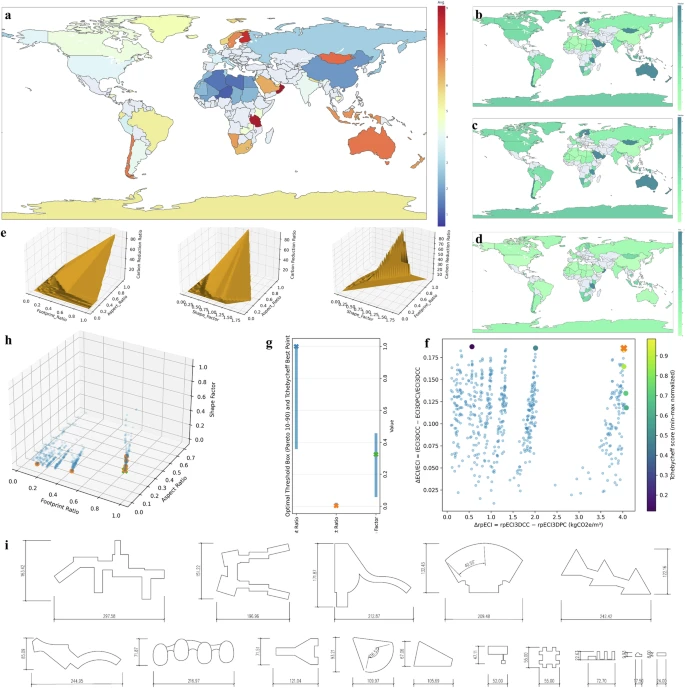
Using explainable machine-learning techniques, the researchers discovered that habitat performance is not controlled by a single geometric parameter. Instead, the best-performing designs emerged within a narrow “morphology-threshold corridor” where multiple shape characteristics reinforce one another.
The study identified an optimal range approximately defined by:
- Shape Factor: 1.01–1.06
- Footprint Ratio: 0.92–0.94
- Aspect Ratio: 0.93–0.96
Within this corridor, structures achieved the strongest combination of absolute maintenance savings and proportional efficiency improvements. The results suggest that future Mars habitats may benefit from remaining within these geometric boundaries rather than pursuing extreme compactness or highly elongated designs.
Machine Learning Reveals Hidden Relationships
The researchers applied SHAP interaction analysis, an explainable artificial intelligence technique, to understand how different geometric properties interact.
Rather than producing simple linear relationships, the models revealed plateau, ridge, and saddle-shaped performance landscapes. These patterns indicate that geometry variables influence one another in complex ways, meaning that improving one design characteristic may only be beneficial when paired with appropriate values of the others.
Pareto Optimization Identifies Best-Balanced Habitat Forms
The team also performed dual-objective optimization to find habitat geometries that simultaneously maximize both absolute and relative maintenance reductions.
Out of hundreds of candidate designs, only seven occupied the non-dominated Pareto frontier, demonstrating that truly optimal solutions are relatively rare. A best-balanced solution achieved an absolute improvement of 4.02 kgCO₂e per cubic meter alongside a relative improvement ratio of 0.186.
The concentration of these high-performing designs within a small region of morphology space supports the idea that future Mars habitats could be designed around a constrained and testable geometric framework./p>
Reviewing Four Decades of Habitat Design Research
Beyond geometric analysis, the study also reviewed 530 publications on algorithm-driven extraterrestrial habitat design published between 1981 and 2025. The researchers found that nearly 88% of these papers were published after 2015, reflecting rapid growth in the field.
The review identified a significant shift from traditional topology optimization approaches toward artificial intelligence, generative design, and machine-learning-assisted design workflows. Deep and generative AI methods now represent a growing share of habitat design research, indicating that future habitat architectures may increasingly be developed through automated optimization systems.
The Current State of Mars Habitat Development
The researchers also examined 74 Mars habitat development platforms spanning 19 countries. Most projects currently operate within Technology Readiness Levels (TRL) 4–6, representing technologies that have progressed beyond basic concepts but have not yet reached full operational maturity.
Higher maturity projects were primarily associated with field stations and long-duration analog habitats, which may provide future opportunities to test the proposed geometric corridor under real-world operating conditions.
Implications for Future Mars Settlements
The authors emphasize that the identified corridor should not be viewed as a universal blueprint for every Mars habitat. Factors such as radiation shielding, regolith-based construction, underground habitats, inflatable modules, and life-support integration will continue to influence final designs.
However, the findings suggest that geometry can serve as a powerful first-order design constraint. By narrowing the search space before detailed engineering analysis begins, future habitat designers may be able to develop more resilient and maintainable structures while reducing long-term logistics demands on missions to Mars.
As humanity moves closer to establishing a permanent presence on the Red Planet, studies such as this provide an increasingly important bridge between terrestrial experience and extraterrestrial architecture. Rather than relying solely on theoretical concepts, researchers are beginning to extract measurable design laws that could help shape the first generation of sustainable Martian habitats.