

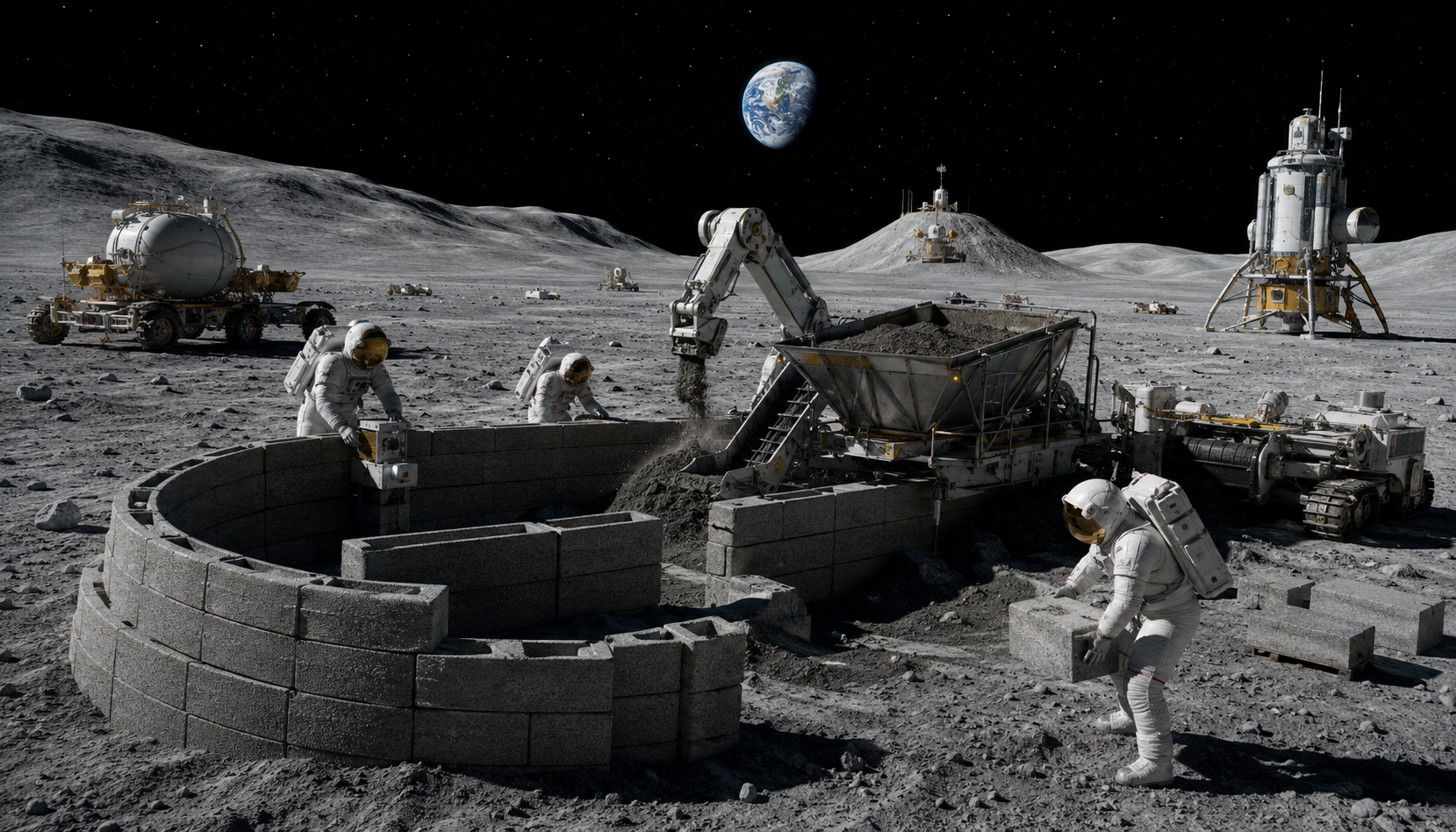
As space agencies and researchers work toward establishing long-term human settlements on the Moon and Mars, one of the biggest engineering challenges remains how to construct durable infrastructure without transporting massive quantities of building materials from Earth. A new study published in npj Space Exploration has examined whether lunar and Martian surface materials could themselves function as cement for extraterrestrial construction.
The findings suggest that while regolith—the loose layer of rock fragments and dust covering planetary surfaces—can strengthen concrete-like mixtures as an inert filler, it does not behave like a cementitious binder under the processing conditions investigated. This distinction has important implications for future in-situ resource utilization (ISRU) strategies aimed at reducing dependence on Earth-supplied construction materials.
Why regolith matters for future space habitats
Transporting construction materials beyond Earth is prohibitively expensive. Earlier launch cost estimates placed the cost of delivering materials to the Moon at well over US$1 million per kilogram, making the use of locally available resources essential for sustainable exploration.
Both the Moon and Mars possess abundant regolith. Lunar regolith forms layers several metres deep across the surface, while Martian regolith consists largely of basaltic material mixed with weathering products such as clay minerals and sulfates. These resources are expected to become the primary raw material for roads, landing pads, radiation shielding and eventually habitats.
Because only tiny quantities of genuine extraterrestrial regolith exist on Earth, scientists rely on carefully engineered terrestrial simulants that closely reproduce the mineralogical and chemical properties of lunar and Martian soils.
Testing six different regolith simulants
The research team investigated six modern regolith simulants—two representing lunar environments and four representing Martian terrains. Each material was tested in three different conditions:
- Untreated
- Thermally processed (burned)
- Mechanically processed (milled)
In total, the researchers produced eighteen different cement blends by replacing 50% of ordinary Portland cement with regolith simulants. They then evaluated the materials using multiple complementary techniques, including isothermal calorimetry, electrical conductivity measurements, thermogravimetric analysis, particle-size measurements and compressive strength testing.
Untreated regolith showed almost no cement-like behaviour
The first objective was to determine whether the simulants could behave like hydraulic or pozzolanic cementitious materials on their own.
Across every untreated lunar and Martian simulant, heat production during hydration remained extremely low compared with known reactive cementitious materials. Even when exposed to potassium hydroxide solutions designed to simulate cement pore chemistry, cumulative heat generation remained far below accepted thresholds for reactive supplementary cementitious materials.
The results indicate that untreated regolith simulants possess negligible intrinsic cementitious reactivity and therefore cannot function as standalone binders under these conditions.
Heating and grinding offered only limited improvements
The researchers also investigated whether simple processing techniques could activate the regolith.
Mechanical milling significantly reduced particle size—by roughly 85% on average—while thermal treatment altered mineral phases by heating the materials between approximately 600°C and 900°C depending on the simulant.
Although both treatments produced small increases in measured heat release, the improvements remained well below established reactivity thresholds. None of the processed simulants approached the behaviour of conventional pozzolanic materials such as metakaolin.
The study therefore concludes that moderate thermal activation and short-duration mechanical grinding are insufficient to transform these regolith simulants into effective cementitious binders.
Regolith still performed well as a structural filler
While the simulants failed to behave as cement, they still contributed mechanically when mixed with ordinary Portland cement.
All blended mixtures displayed similar hydration behaviour regardless of whether the regolith had been untreated, burned or milled. Most produced compressive strengths between approximately 11 and 30 MPa after 28 days of curing.
Rather than chemically participating in cement hydration, the regolith mainly acted as an inert granular filler. This filler effect allowed the production of mechanically stable composite materials despite replacing half of the Portland cement.
The researchers note that these strength levels may already be useful for certain non-structural and semi-structural applications during future planetary construction missions.
Some Martian measurements required careful interpretation
One interesting observation emerged during conductivity testing.
Several Martian simulants appeared to exhibit good pozzolanic behaviour according to standard conductivity measurements. However, this conflicted with calorimetry results that consistently showed little reactivity.
The authors concluded that sulfate- and carbonate-rich Martian simulants likely altered solution chemistry through non-pozzolanic reactions rather than genuine cement formation. This means conductivity tests alone may overestimate the reactivity of chemically complex Martian materials and should be supplemented with additional analytical methods.
What this means for building on the Moon and Mars
The findings suggest that future extraterrestrial construction should not assume untreated regolith can replace cement simply by being mixed with water.
Instead, regolith appears most valuable as a locally sourced filler or aggregate combined with engineered binders that could eventually be manufactured using in-situ resource utilization technologies.
The researchers also note that their work examined only moderate thermal activation below 1000°C. Previous studies indicate that much higher temperatures capable of partial melting may produce substantially different material behaviour, making this an important area for future investigation.
A practical baseline for future ISRU research
Rather than ruling out regolith-based construction, the study establishes an important baseline for future lunar and Martian infrastructure development.
The results show that today's high-fidelity regolith simulants generally function as inert fillers instead of reactive cementitious binders under moderate processing conditions. As future ISRU technologies mature, combining locally sourced regolith with advanced manufactured binders may provide a practical pathway toward constructing durable roads, landing pads and habitats that support sustained human presence beyond Earth.