

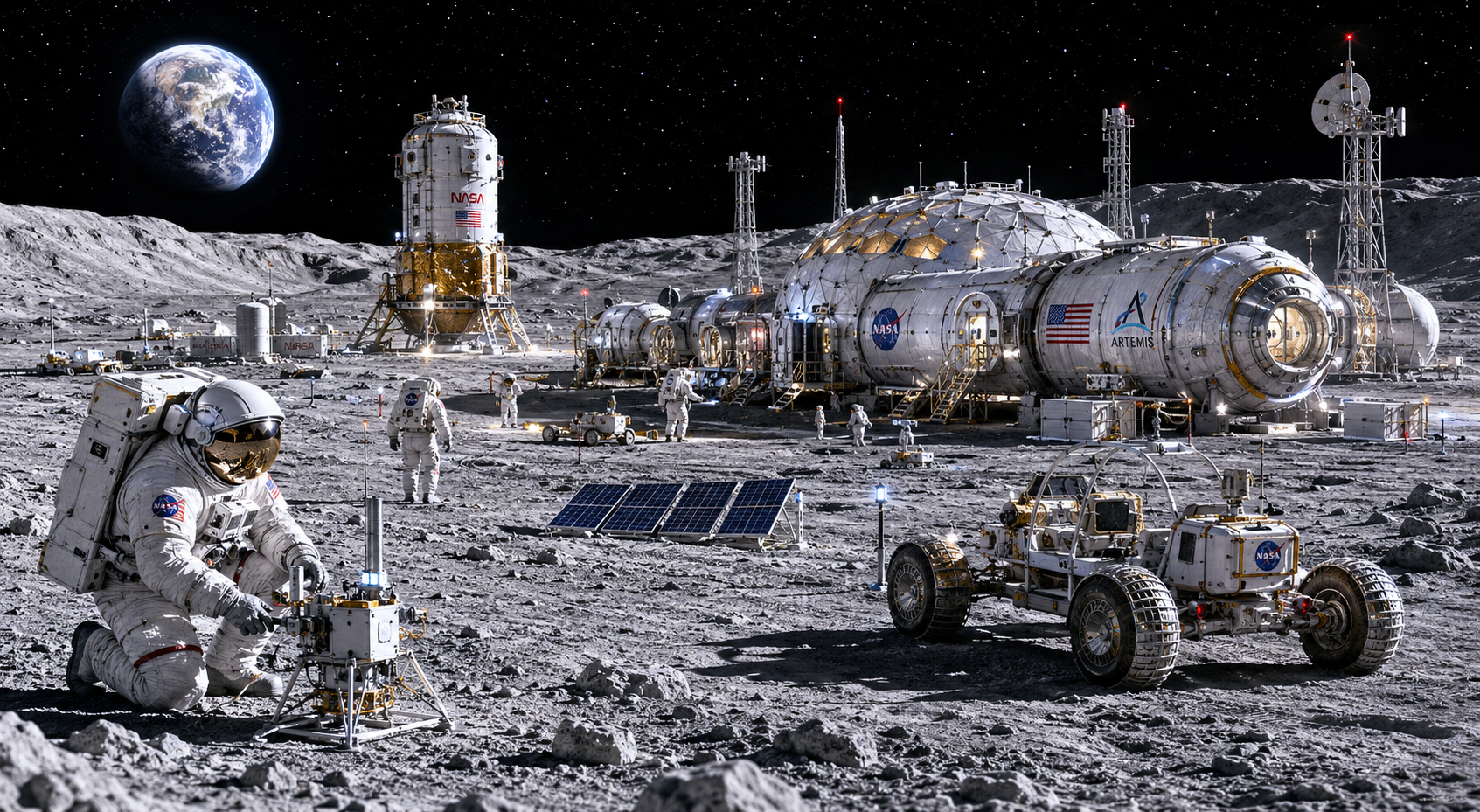
NASA has announced a major agencywide shift in its exploration strategy, outlining plans to move Artemis toward a phased lunar base, increase the pace of Moon missions, preserve a continuous U.S. presence in low Earth orbit, and demonstrate nuclear electric propulsion on a Mars-bound spacecraft before the end of 2028.
The announcements were made during NASA’s “Ignition” event on March 24, 2026. The plan is framed around the United States’ National Space Policy and places renewed emphasis on repeatable lunar operations, commercial hardware, international partnerships, and faster movement from laboratory technologies to flight demonstrations.
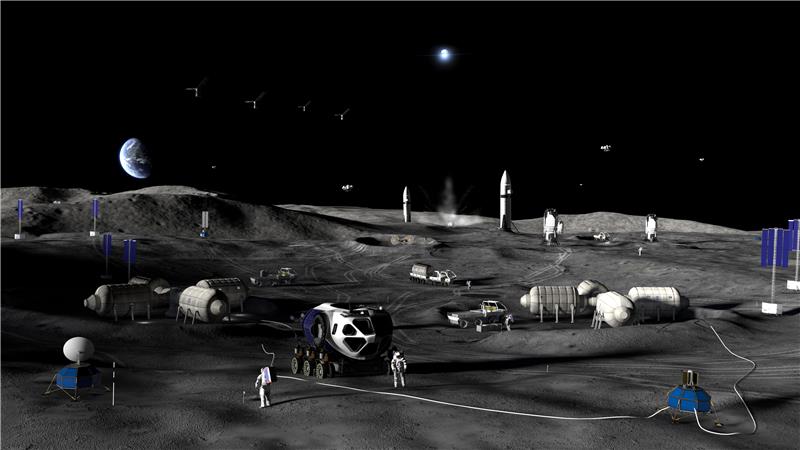
NASA Refocuses Artemis Around Lunar Surface Infrastructure
Under the updated approach, NASA says Artemis will move toward a more focused and phased architecture that builds capability landing by landing. Artemis III, scheduled for 2027 under the revised plan, is expected to test integrated systems and operational capabilities in Earth orbit before the Artemis IV lunar landing.
Looking beyond Artemis V, NASA said it intends to incorporate more commercially procured and reusable hardware for frequent crewed missions to the Moon. The agency is initially targeting lunar surface landings every six months, with the possibility of increasing that cadence as systems mature.
A key change is NASA’s decision to pause Gateway in its current form and shift attention toward infrastructure that directly supports sustained surface operations. NASA said applicable Gateway-related hardware may be repurposed where useful, while international partner commitments will be aligned with the new surface-focused objectives.
The Three-Phase Moon Base Plan
NASA described its Moon base strategy as a three-phase plan intended to move from early robotic and technology demonstrations toward long-duration human presence.
Phase One: Build, Test, Learn
The first phase focuses on repeatable lunar activity rather than isolated missions. Through Commercial Lunar Payload Services and the Lunar Terrain Vehicle programme, NASA aims to send rovers, scientific instruments, and technology demonstrations to the lunar surface.
These missions are expected to support mobility, power generation, communications, navigation, surface operations, and lunar science. NASA also referenced radioisotope heater units and radioisotope thermoelectric generators as part of the broader surface power and technology pathway.
Phase Two: Establish Early Infrastructure
The second phase would introduce semi-habitable infrastructure and regular logistics support for recurring astronaut operations. NASA said this phase will include major international contributions, including a pressurized rover from the Japan Aerospace Exploration Agency.
Other partner payloads, rovers, infrastructure systems, and transportation capabilities may also become part of this stage as the Moon base architecture develops.
Phase Three: Enable Long-Duration Human Presence
In the third phase, cargo-capable human landing systems would deliver heavier infrastructure needed for a continuous human foothold on the Moon. NASA named the Italian Space Agency’s Multi-purpose Habitats and the Canadian Space Agency’s Lunar Utility Vehicle as planned contributions within this long-duration surface architecture.
This phase marks the intended transition from periodic lunar expeditions to a more permanent base model. However, the schedule will depend on hardware readiness, procurement, budgets, and partner contributions.
A New Low Earth Orbit Transition Strategy
NASA also outlined an additional strategy for low Earth orbit as the International Space Station approaches the end of its operational life. The agency noted that the station has supported more than 4,000 research investigations, more than 5,000 researchers, and visitors from 26 countries.
Under the proposed alternative pathway, NASA would procure a government-owned Core Module that attaches to the International Space Station. Commercial modules would then be validated using station capabilities before later detaching into free flight.
The goal is to avoid a gap in U.S. human presence in low Earth orbit while giving commercial station providers time to mature technical systems, operations, financing models, and customer demand. NASA said it will seek industry input through Requests for Information to shape partnership structures and risk-sharing approaches.
Science Missions Remain Part of the Strategy
NASA presented the Moon base plan as part of a broader science strategy rather than only a human exploration programme. The agency said an accelerated Commercial Lunar Payload Services cadence could target up to 30 robotic landings starting in 2027.
Near-term lunar science payloads include the VIPER rover and the LuSEE-Night mission. NASA also plans to seek payloads for additional 2027 and 2028 flights, opening opportunities for researchers, students, industry, and international partners to place instruments on the lunar surface.
Beyond the Moon, NASA highlighted several developing missions. These include the Nancy Grace Roman Space Telescope, Dragonfly’s planned launch toward Saturn’s moon Titan, NASA’s contribution to the European Space Agency’s Rosalind Franklin rover, and a future Earth science mission focused on convective storm dynamics.
Space Reactor-1 Freedom Targets Mars Before 2028 Ends
One of the most significant technology announcements is Space Reactor-1 Freedom, described by NASA as the first nuclear-powered interplanetary spacecraft. The mission is targeted to launch to Mars before the end of 2028 and will demonstrate advanced nuclear electric propulsion in deep space.
Nuclear electric propulsion uses electrical power from a nuclear source to accelerate propellant efficiently. NASA says this approach could support high-power, efficient mass transport in deep space, especially for destinations where solar power becomes less practical.
When Space Reactor-1 Freedom reaches Mars, NASA says it will deploy the Skyfall payload of Ingenuity-class helicopters to continue aerial exploration of the Red Planet. The mission is also intended to establish flight heritage, regulatory precedent, and industrial capability for future fission power systems.
Workforce and Industrial Supply Chain Reforms
NASA said the new strategy also depends on workforce changes and closer oversight across the aerospace supply chain. The agency plans to rebuild core competencies, convert thousands of contractor positions to civil service, and expand pathways for interns, early-career professionals, and experienced industry talent.
NASA also plans to embed subject-matter experts across major vendors, subcontractors, and critical-path components. The stated goal is to identify production issues earlier, challenge assumptions, and accelerate delivery across major programmes.
What Comes Next
The announcements are an ambitious roadmap rather than a completed transition. NASA said Requests for Information and draft Requests for Proposals will follow to shape lunar payload delivery, commercial infrastructure, science partnerships, and low Earth orbit transition plans.
If implemented as described, the strategy would reshape Artemis from a sequence of individual lunar missions into a broader surface infrastructure campaign. It would also connect lunar exploration, low Earth orbit commercialisation, nuclear propulsion, and Mars technology demonstrations under one coordinated agencywide direction.