

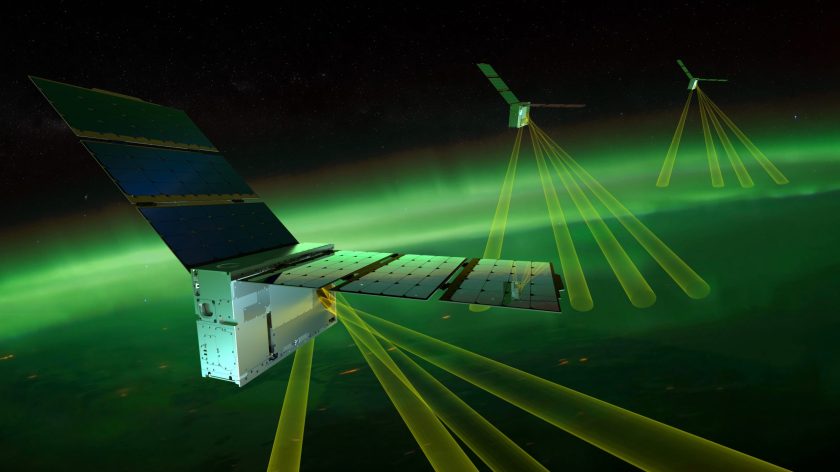
NASA’s Electrojet Zeeman Imaging Explorer (EZIE) mission has officially entered its primary science phase, marking the beginning of a 16-month effort to study one of the most dynamic and influential phenomena in Earth’s near-space environment: auroral electrojets. The mission is expected to provide unprecedented insights into how energy from the Sun interacts with Earth’s magnetic field and upper atmosphere.
Following a successful launch aboard a SpaceX Falcon 9 rocket from Vandenberg Space Force Base in California on March 14, 2025, mission teams completed a series of spacecraft health checks and collected initial “first light” observations. With all systems operating as expected, EZIE is now cleared to begin routine scientific observations.
What Are Auroral Electrojets?
Auroral electrojets are vast electric currents that flow through Earth’s upper atmosphere near the polar regions. They are generated when charged particles from the Sun interact with Earth’s magnetosphere during geomagnetic disturbances.
These currents are closely associated with auroras, the spectacular northern and southern lights that illuminate high-latitude skies. However, auroral electrojets are more than just a visual phenomenon. They can influence radio communications, navigation systems, satellites, and even electrical power infrastructure on the ground.
Understanding how these currents form, evolve, and transport energy is a major objective in space weather research.
Three CubeSats Working Together
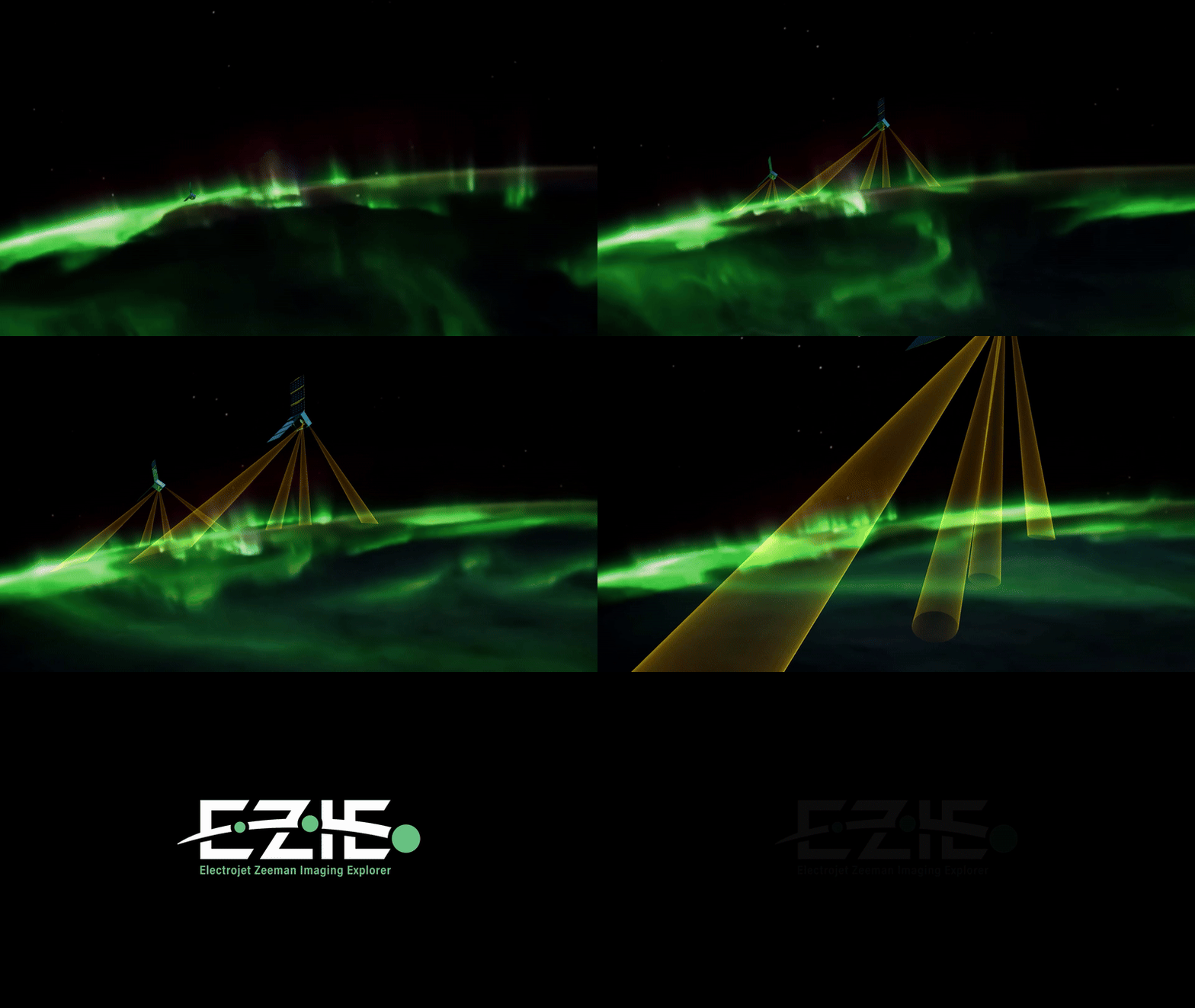
The EZIE mission consists of three CubeSats, each approximately the size of a carry-on suitcase. Rather than operating independently, the spacecraft fly in a coordinated “pearls-on-a-string” formation.
As the satellites pass over the same region of Earth several minutes apart, they collect sequential measurements that allow researchers to observe how auroral electrojets change over time. This formation provides a unique three-dimensional view of the currents and their evolution.
Orbiting approximately 370 miles (590 kilometers) above Earth, the satellites travel from pole to pole while continuously mapping magnetic signatures produced by the electrojets.
Unlocking Space Weather Mysteries
Scientists have studied auroral electrojets for decades, but many questions remain unanswered regarding their structure, variability, and role in transferring energy through Earth's upper atmosphere.
By measuring the magnetic fingerprints generated by these currents, EZIE aims to reveal how energy released during geomagnetic storms is deposited into the atmosphere. This information is essential for improving space weather forecasting and understanding how solar activity affects technological systems.
More accurate knowledge of these processes could help researchers better predict conditions that may disrupt satellite operations, communications networks, navigation systems, and electrical grids.
Benefits Beyond Earth
The scientific value of EZIE extends beyond Earth’s environment. Many planets throughout the solar system possess magnetic fields and experience interactions with charged particles from the Sun.
Observations from EZIE may improve understanding of magnetized worlds such as Jupiter and Saturn, where powerful auroral systems also exist. Insights gained from the mission could contribute to future comparative studies of planetary magnetospheres and space weather environments across the solar system.
Mission Partners and Technology
The EZIE mission is funded by NASA’s Heliophysics Division within the Science Mission Directorate. Mission management is provided through NASA’s Explorers Program Office at the Goddard Space Flight Center in Greenbelt, Maryland.
The Johns Hopkins Applied Physics Laboratory leads the mission, while Blue Canyon Technologies built the three CubeSat spacecraft. NASA’s Jet Propulsion Laboratory developed the Microwave Electrojet Magnetogram instrument carried aboard each satellite, enabling the mission’s groundbreaking measurements.
Together, the three spacecraft will create the first dedicated global maps of auroral electrojets from space, offering a new perspective on one of Earth’s most important space weather systems.
A New Era for Auroral Research
As EZIE begins its science operations, researchers anticipate a wealth of new data that could reshape understanding of how solar activity influences Earth and other planets. By capturing the structure and evolution of auroral electrojets in unprecedented detail, the mission is expected to advance both fundamental space physics and practical space weather forecasting capabilities.
Over the coming months, EZIE’s observations may help answer long-standing questions about the flow of energy through near-Earth space while providing critical information for protecting technology and infrastructure increasingly dependent on a stable space environment.