

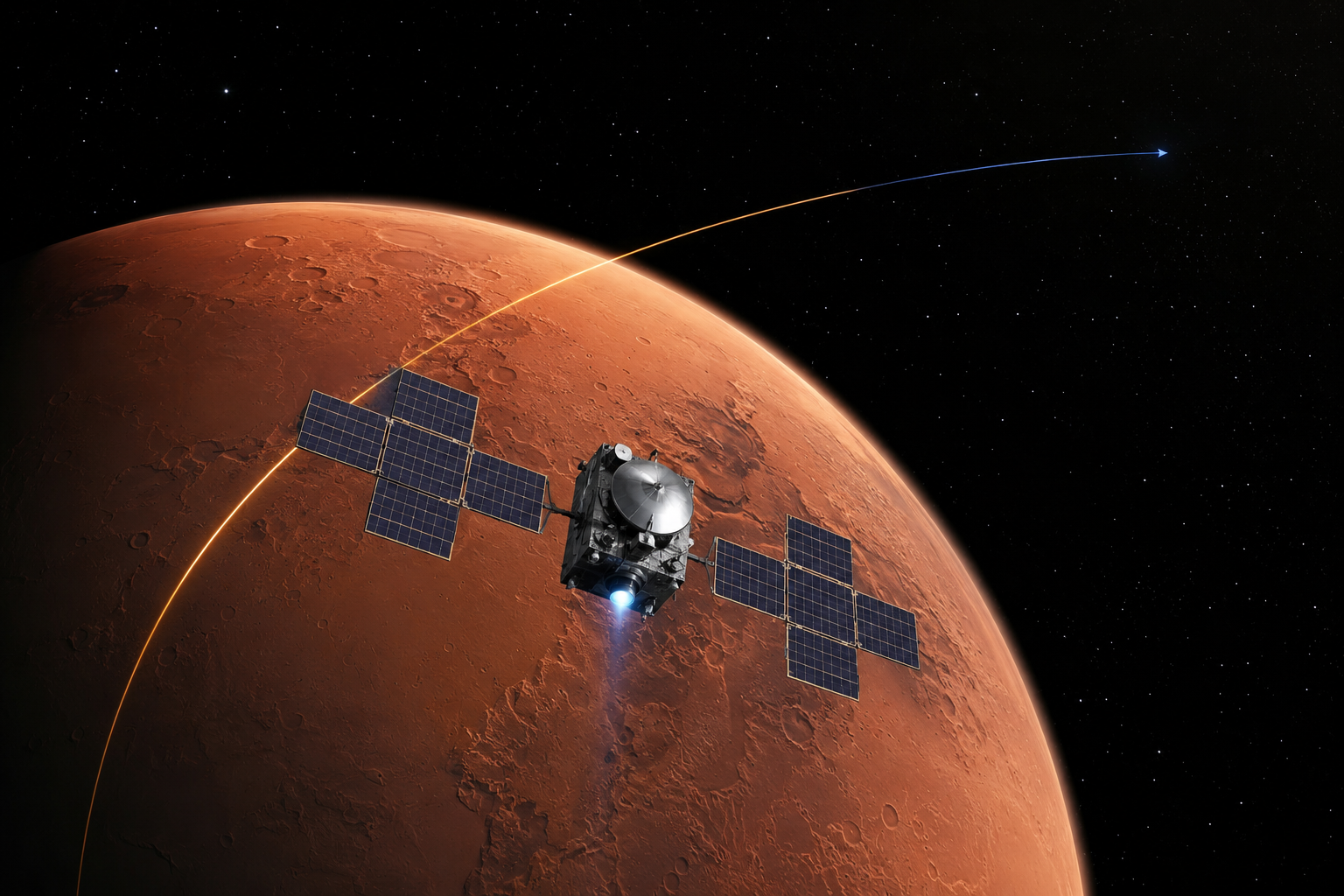
NASA’s Psyche spacecraft is preparing for a crucial milestone in its journey across the solar system as it performs a close flyby of Mars on May 15. The maneuver will use the Red Planet’s gravity to accelerate the spacecraft and adjust its trajectory toward its ultimate destination: the metal-rich asteroid Psyche, one of the most intriguing objects in the asteroid belt.
The spacecraft will pass approximately 2,800 miles (4,500 kilometers) above the Martian surface at a speed of about 12,333 mph (19,848 kph). Rather than relying solely on its solar-electric propulsion system, the mission will take advantage of Mars’ gravitational pull to conserve xenon propellant and improve mission efficiency.
A Critical Gravity Assist
Launched on October 13, 2023, Psyche is powered by solar-electric propulsion, gradually building speed through ion engines fueled by xenon gas. While this propulsion system is highly efficient, gravity assists remain one of the most effective methods for changing a spacecraft’s velocity and direction without consuming large amounts of propellant.
The Mars flyby is designed to provide the precise trajectory adjustment required for Psyche to reach the asteroid belt and enter orbit around asteroid Psyche in late 2029.
Mission planners completed a major trajectory correction maneuver on February 23, firing the spacecraft’s thrusters continuously for approximately 12 hours to refine its approach and ensure an accurate flyby.
Testing Science Instruments Around Mars
Beyond navigation benefits, the Mars encounter offers a rare opportunity to test and calibrate Psyche’s scientific instruments under realistic operating conditions.
The spacecraft’s multispectral imager will collect thousands of observations of Mars during the encounter. These measurements will help mission scientists refine imaging techniques and operational procedures that will later be used while studying asteroid Psyche.
According to the mission team, this will be the first opportunity to calibrate the imager using a large planetary target rather than distant stars or objects occupying only a few pixels in the camera’s field of view.
What the Camera Will See
As Psyche approaches Mars, the planet will initially appear as a thin crescent rather than the fully illuminated disk commonly seen in photographs. This viewing geometry occurs because the spacecraft is approaching Mars from the planet’s night side.
The changing illumination conditions throughout the flyby will provide imaging specialists with a variety of calibration opportunities while also producing visually striking views of the planet.
Beginning on May 7, the mission started releasing raw images showing a distant Mars embedded within a star field. Additional processed imagery from the flyby is expected in the weeks following the encounter, including a time-lapse sequence of the spacecraft’s passage past the planet.
Searching for Dust and Future Moonlets
Scientists will also investigate the possibility that Mars is surrounded by a faint dusty torus. Such a structure could form when micrometeorite impacts strike the surfaces of the planet’s moons, Phobos and Deimos, ejecting dust particles into space.
Under favorable lighting conditions, sunlight scattered by this dust could become visible in processed images obtained during the flyby.
The spacecraft will additionally conduct “satellite search” observations around Mars. These observations serve as a rehearsal for future searches around asteroid Psyche, where scientists will investigate whether the asteroid possesses any small natural satellites or moonlets.
Additional Science Opportunities
Several of Psyche’s other scientific instruments will also gather data during the encounter.
- The magnetometer will measure how Mars’ magnetic environment interacts with charged particles from the Sun.
- The gamma-ray and neutron spectrometer will monitor changes in cosmic-ray flux as the spacecraft passes through the Martian environment.
- Navigation and radio science teams will use the flyby to validate operational procedures for future deep-space missions.
Data collected during the encounter will also be compared with measurements from multiple spacecraft already operating at Mars.
Support from Other Mars Missions
Several active missions at Mars are expected to contribute complementary observations during the flyby. These include NASA’s Mars Reconnaissance Orbiter, Mars Odyssey, the Curiosity rover, and the Perseverance rover, along with the European Space Agency’s Mars Express and ExoMars Trace Gas Orbiter.
Comparing observations from these missions with Psyche’s measurements will help scientists validate and calibrate the spacecraft’s instruments before it begins studying its asteroid target.
Tracking the Flyby
Engineers will closely monitor radio signals exchanged between Psyche and NASA’s Deep Space Network during the encounter. Changes in the spacecraft’s velocity will be measured through Doppler shifts in the transmitted signals, allowing mission controllers to rapidly confirm the success of the gravity assist.
Once the flyby is complete, Psyche will continue its journey toward the main asteroid belt, carrying out one of NASA’s most ambitious efforts to investigate a potentially metal-rich planetary building block left over from the early formation of the solar system.
The Mars encounter represents far more than a navigation maneuver. It serves as a full-scale rehearsal for the spacecraft’s future operations, allowing scientists and engineers to test instruments, refine observation techniques, and prepare for humanity’s first close exploration of asteroid Psyche.