

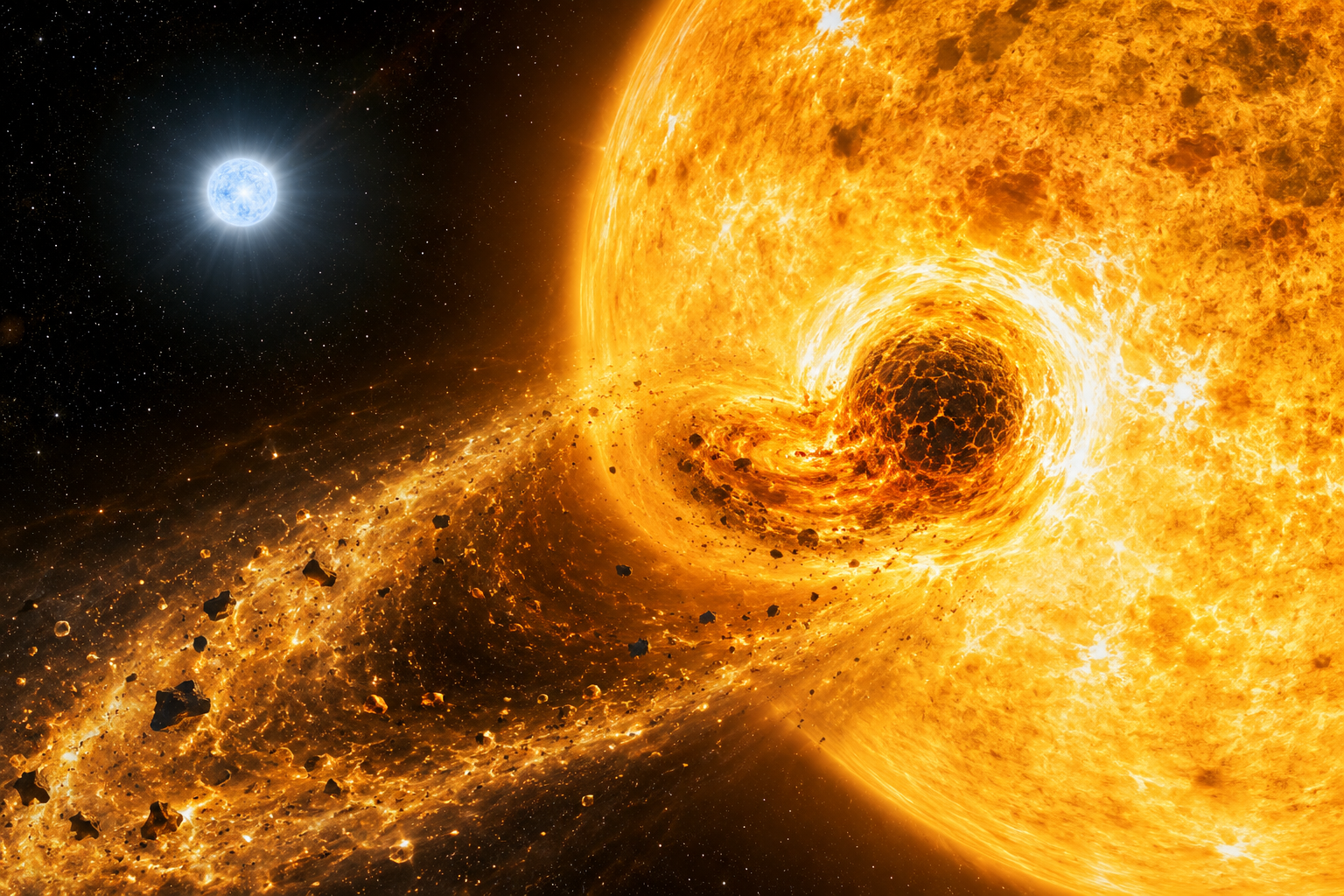
Astronomers studying the binary star system HD 81809 have explored a remarkable possibility: one of the stars may have consumed a large amount of planetary material, fundamentally altering its chemical makeup. The research addresses an unusual discrepancy between the two stars in the system, which appear to have formed together but now display dramatically different surface compositions.
Binary stars are expected to share nearly identical chemical properties because they originate from the same molecular cloud. However, HD 81809 presents an exception. While the primary star, HD 81809A, is significantly metal-poor, its companion HD 81809B exhibits nearly solar metallicity, creating a chemical paradox that standard stellar evolution models struggle to explain.
A Binary System With a Chemical Contradiction
The HD 81809 system consists of two Sun-like stars. Recent studies combining spectroscopy, asteroseismology, photometry, and orbital measurements revealed that the two stars differ in iron abundance by approximately 0.57 dex, a surprisingly large discrepancy for a binary system.
Observations indicate that HD 81809A has an iron abundance of about [Fe/H] = -0.57 dex, while HD 81809B is consistent with solar metallicity. Such a difference is difficult to produce through known internal stellar processes such as atomic diffusion and chemical mixing.
Researchers therefore investigated whether HD 81809B may have experienced a planetary engulfment event, swallowing metal-rich material from one or more planets or planetary cores during its lifetime.
Testing Planetary Engulfment Scenarios
Using the MESA stellar evolution code, the researchers modeled a wide range of accretion scenarios. These included gradual accretion throughout the star’s life, sudden engulfment events occurring early in its evolution, and late-stage accretion events occurring near the star’s current age.
The simulations examined how varying amounts of metal-rich material would affect the star’s surface chemistry, temperature, gravity, and seismic properties.
The results showed that reproducing the observed iron abundance of HD 81809B requires a substantial amount of accreted material. Models indicate that a recent engulfment event would need approximately 25 to 75 Earth masses of metals, while events occurring earlier in the star’s history would require more than 150 Earth masses due to dilution and mixing effects.
Iron Can Be Explained, Lithium Cannot
One of the most intriguing findings involves lithium. HD 81809B contains an unusually high lithium abundance compared to what standard stellar evolution models predict for a star of its age and mass.
While planetary engulfment naturally increases lithium at the stellar surface, the simulations revealed a problem. The amount of material needed to reproduce the observed iron enrichment generally causes lithium levels to become much higher than observed.
According to the models, matching the measured lithium abundance would require accretion of less than approximately six Earth masses of material. This is far below the amount needed to explain the iron enrichment.
This mismatch suggests that either the engulfed material possessed a chemical composition different from typical Solar System bodies, or additional physical processes are influencing the star's surface abundances.
The Role of Thermohaline Mixing
The researchers also examined thermohaline convection, a mixing process triggered when heavier material settles above lighter material inside a star.
When metal-rich planetary material is deposited onto the stellar surface, thermohaline mixing can rapidly redistribute the material into deeper layers. The simulations showed that this process reduces both iron and lithium enrichment over timescales of roughly 200 million years.
Although thermohaline mixing weakens the chemical signature of planetary engulfment, it does not completely resolve the lithium discrepancy. Even with this additional mixing mechanism, the simulations could not simultaneously reproduce the observed iron and lithium abundances.
Could the Engulfed Material Have Been Different?
To explore alternative possibilities, the team tested accretion scenarios using compositions similar to CI chondrite meteorites, which are considered among the most primitive materials in the Solar System.
These simulations produced somewhat stronger iron enrichment because meteorite-like material contains a higher fraction of iron. However, they also increased lithium abundance, leaving the fundamental problem unresolved.
The authors suggest that the actual planetary material engulfed by HD 81809B may have possessed a composition very different from Solar System meteorites. The system itself appears enriched in alpha elements, implying that any planets formed around it may also have had unusual chemical properties.
Alternative Explanations Remain Possible
The study also considered other explanations for the chemical disparity. One possibility is that HD 81809B formed elsewhere and was later captured into the system. However, previous modeling of this scenario produced implausibly old ages and stellar masses that conflict with observations.
Another possibility involves the accretion of large amounts of dust and pebbles during the star's early formation stages. While such a process could alter surface composition, it would likely require even greater amounts of material than the planetary engulfment scenarios examined in this study.
A Valuable Laboratory for Planet-Star Interactions
The findings suggest that planetary engulfment remains one of the most plausible explanations for the chemical anomaly observed in HD 81809B. The simulations indicate that swallowing the equivalent of tens of Earth masses of metal-rich material could explain the star’s enhanced iron abundance and lower effective temperature.
However, the lithium puzzle remains unresolved. Future observations capable of measuring stellar oscillations in greater detail, along with searches for rotation and magnetic activity signatures, may provide stronger evidence for whether HD 81809B truly consumed one or more planets during its lifetime.
If confirmed, HD 81809B would represent one of the clearest examples yet of planetary engulfment altering the observable chemistry of a mature star, offering astronomers a rare opportunity to study the long-term consequences of planet-star interactions.