

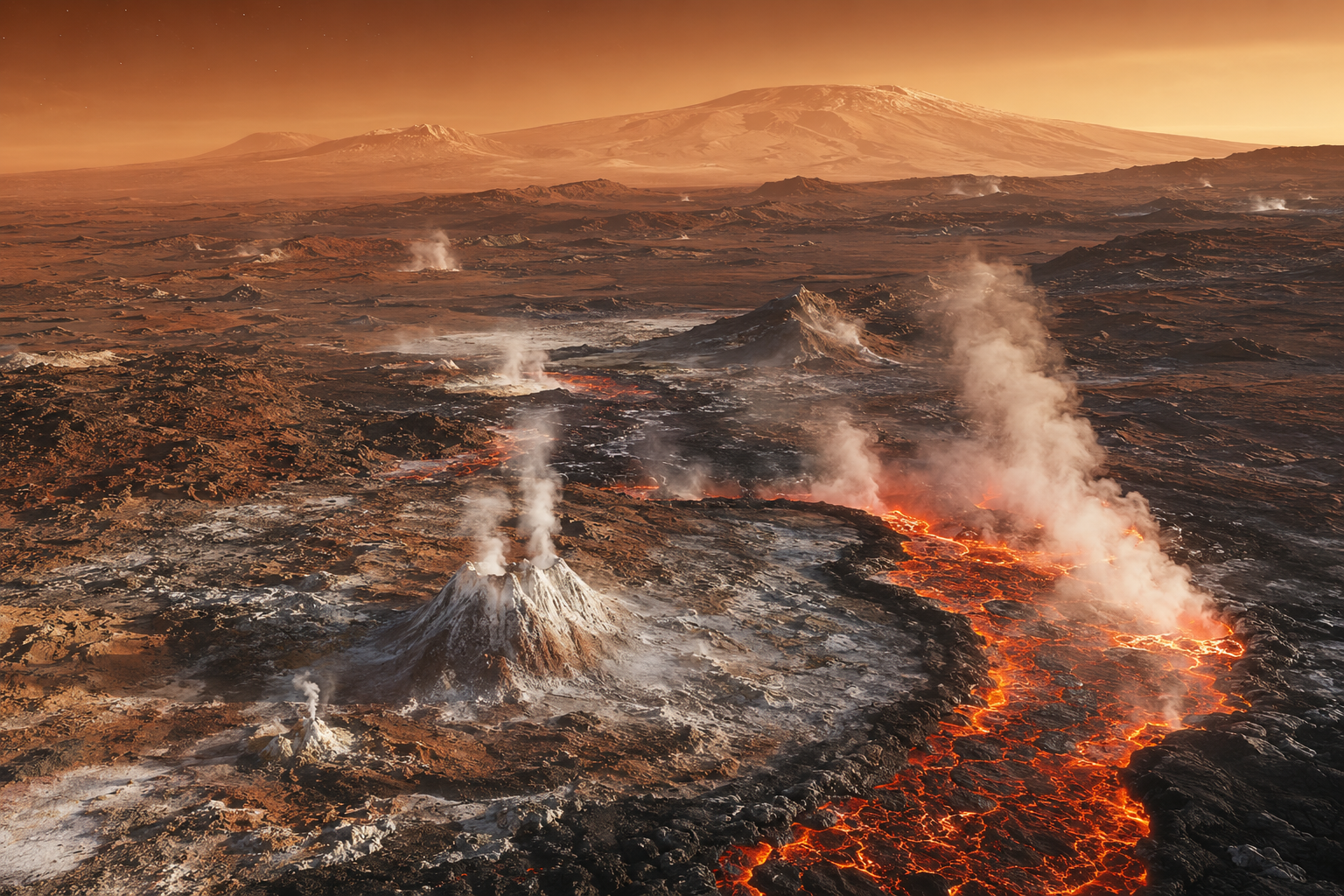
Evidence of Explosive Lava-Water Interactions Found in Mars’ Tharsis Region
Scientists studying high-resolution orbital imagery of Mars have identified geological evidence suggesting that lava interacted explosively with subsurface ice in the planet’s Tharsis volcanic province during the relatively recent late Amazonian epoch. The findings provide new insight into the historical distribution of water ice on Mars and raise further interest in volcanic hydrothermal systems as potential environments for past microbial habitability.
The study focused on volcanic terrain located south of Ascraeus Mons, one of the giant Tharsis volcanoes. Researchers mapped more than 2,100 small conical structures distributed across lava flows in the region. Based on their morphology, clustering patterns, and geological context, the team concluded that the structures are most likely rootless cones formed by explosive interactions between advancing lava and buried water ice.
What Are Rootless Cones?
Rootless cones are volcanic landforms produced when lava flows move across water-rich or ice-rich ground. The intense heat rapidly converts water into steam, generating phreatomagmatic explosions that eject volcanic material and form cratered cones on top of the lava surface. Unlike conventional volcanoes, these features are not connected directly to deep magma conduits.
The Martian cones identified in the study typically measure around 96 meters in basal width and about 4 meters in height, with many displaying central craters and raised rims. Some appear in chains aligned with lava flow directions, while others cluster near lava margins where lava likely stagnated and interacted longer with buried ice.
The researchers compared the structures with known volcanic landforms on both Earth and Mars and ruled out alternative origins such as mud volcanoes, pingos, and hornitos. Morphological comparisons showed strong similarities with previously identified Martian rootless cone fields in regions including Amazonis Planitia and Hrad Vallis.
Young Geological Age Suggests Ice Persisted Near Mars’ Equator
Crater-count dating of the lava flows hosting the cones indicates ages ranging from approximately 215 million to 98 million years old, placing their formation within the late Amazonian epoch. Some underlying lava flows were dated between 205 million and 69 million years old.
These ages are considered geologically young for Mars and suggest that subsurface ice existed near equatorial regions far more recently than many earlier climate models predicted. The discovery challenges the assumption that low-latitude ice deposits became extremely rare during Mars’ later geological history.
The study also connects the timing of the lava-ice interactions with periods of high Martian axial tilt, or obliquity, which may have allowed atmospheric water vapor to accumulate as ice in equatorial volcanic regions. Researchers propose that repeated cycles of volcanic activity and climate-driven ice accumulation created conditions favorable for these explosive eruptions.
Signs of Ancient Hydrothermal Activity
Using spectral observations from the Compact Reconnaissance Imaging Spectrometer for Mars (CRISM), the research team identified hydrated sulfate-bearing minerals associated with some of the volcanic cones. The detected spectral signatures include absorption features consistent with hydrated minerals and possible sulfate phases.
Scientists interpret these minerals as evidence of short-lived hydrothermal systems generated by lava heating subsurface ice. According to the study, steam and heated water likely circulated through fractures in the cooling lava flows, producing chemically altered minerals near the surface.
Thermodynamic modeling cited in the paper suggests that such hydrothermal environments may have persisted for decades or even centuries depending on lava thickness and ice concentration. The analyzed lava flows were estimated to be between 10 and 25 meters thick.
Potential Implications for the Search for Life
The researchers argue that these volcanic hydrothermal systems may represent promising astrobiological targets. Hydrothermal environments can provide liquid water, heat, and chemical energy — three important ingredients associated with habitability. The sulfate-bearing minerals identified in the study could also help preserve potential biosignatures if microbial life ever existed in these environments.
The findings expand the range of environments considered potentially habitable on Mars. Rather than focusing exclusively on the planet’s ancient Noachian-era terrains, the study suggests that relatively young volcanic regions may also preserve important records of past habitability.
The discovery adds another piece to the evolving understanding of Mars as a planet that remained volcanically and climatically active much longer than once believed. Future robotic missions exploring volcanic terrains in Tharsis may help determine how widespread these lava-ice interactions were and whether traces of ancient life could still be preserved within their mineral deposits.