

Satellite Observations Reveal a More Dynamic Night-Time Earth
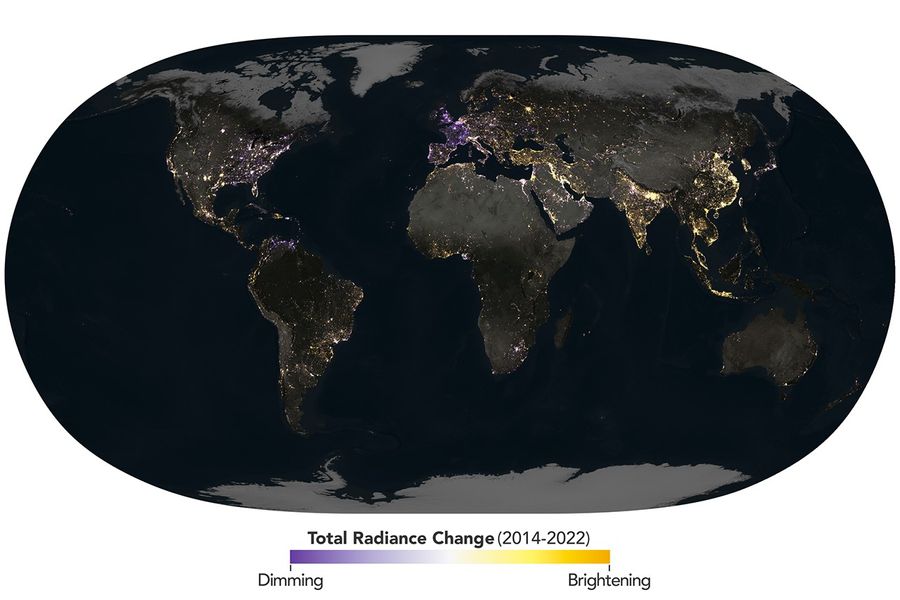
Earth’s illuminated nightscape is changing far more rapidly and unpredictably than previously understood, according to a new study published in Nature. Using nearly a decade of daily satellite imagery from NASA’s Black Marble program, researchers found that artificial light at night (ALAN) is not simply expanding in a steady upward trend. Instead, cities, industrial regions, and infrastructure networks around the world are experiencing repeated cycles of brightening and dimming.
The research analyzed global night-time light dynamics between 2014 and 2022 using more than 1.16 million daily satellite observations. Scientists discovered that areas undergoing change experienced an average of 6.6 separate lighting shifts during the study period, highlighting a much more volatile human footprint than previously recognized.
Daily NASA Black Marble Data Enabled High-Frequency Tracking
The study relied on NASA’s Black Marble night-time light dataset, which provides daily corrected observations of Earth’s surface illumination. Unlike older annual or monthly composites, the Black Marble system corrects for atmospheric conditions, lunar illumination, terrain effects, and cloud contamination, allowing researchers to detect short-term lighting changes with much greater precision.
Researchers adapted a continuous change detection system known as VZA-COLD to identify both abrupt and gradual lighting changes at roughly 500-meter spatial resolution across inhabited land regions between 70° north and 60° south latitude.
Brightening and Dimming Are Happening Simultaneously
The findings challenge the long-standing assumption that Earth’s night lights are primarily becoming brighter over time. While the planet’s total night-time radiance increased by approximately 16% during the study period, the researchers found that dimming events are also becoming more common and intense.
According to the study:
- Brightening contributed a radiance increase equal to 34% of the 2014 global baseline.
- Dimming offset roughly 18% of that increase.
- Both brightening and dimming intensified significantly after 2020.
Scientists noted that this coexistence of opposing trends reflects increasingly complex societal, economic, and infrastructure dynamics worldwide.
Urbanization, Energy Policies, and Conflicts Drive the Changes
The study identified multiple drivers behind global lighting volatility. Rapid urbanization and infrastructure development were major causes of brightening, particularly across Asia and parts of Africa. China and India accounted for some of the largest increases in illuminated areas due to industrial expansion, urban growth, and rural electrification programs.
At the same time, several regions experienced substantial dimming. Europe showed widespread reductions in night-time lighting linked to energy efficiency initiatives, LED transitions, and national light pollution policies. France alone recorded a 33% net decrease relative to its 2014 baseline.
In contrast, dimming in Venezuela reflected economic collapse and infrastructure deterioration rather than planned conservation measures. Researchers also observed highly volatile lighting patterns in oil and gas regions such as Texas and North Dakota, where industrial activity and gas flaring created repeated cycles of brightening and dimming.
Satellite Night Lights Captured Major Global Events
The high-frequency daily observations allowed scientists to track the societal impacts of major world events in near real time. During the COVID-19 pandemic, large-scale dimming patterns appeared across parts of Asia as lockdowns reduced industrial activity and transportation. The timing aligned closely with the earliest and strictest pandemic restrictions.
The data also captured changes associated with the 2022 European energy crisis following the Russia–Ukraine conflict. Several European countries showed sharp declines in night-time radiance as governments implemented energy-saving measures.
The researchers argue that these rapid lighting fluctuations could become valuable indicators for monitoring economic activity, infrastructure resilience, disaster impacts, and humanitarian crises.
Night-Time Light Is Emerging as a Dynamic Societal Indicator
The study concludes that Earth’s illuminated surface should no longer be viewed as a simple measure of continuous growth. Instead, the researchers describe the planet’s nightscape as a dynamic and increasingly volatile system shaped by technological transitions, energy policies, urban redevelopment, economic instability, and geopolitical disruptions.
According to the authors, future satellite monitoring of artificial night-time lighting could play a growing role in understanding human activity patterns, evaluating infrastructure resilience, and supporting disaster response and policy planning worldwide.