

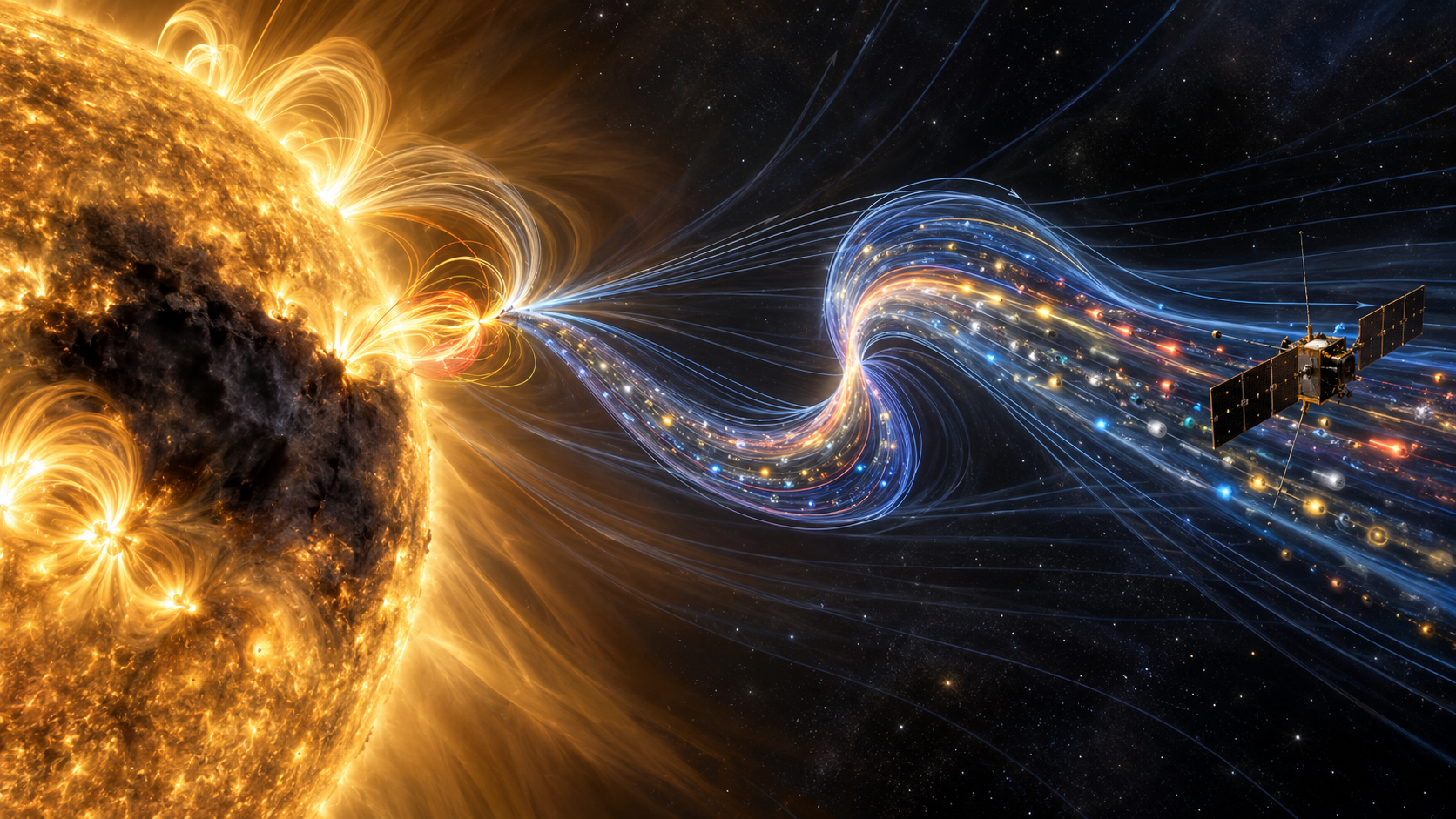
Measurements from the ESA/NASA Solar Orbiter spacecraft have provided direct evidence connecting a magnetic switchback in the solar wind to plasma released from hot, closed magnetic structures in the Sun’s corona. The observations strengthen the case that interchange reconnection can release switchback-associated plasma into open magnetic field lines, while waves and turbulence may control how the resulting structure travels through the solar wind.
The study, led by Jesse T. Coburn and colleagues and published in Nature Astronomy, analysed a series of magnetic switchbacks observed by Solar Orbiter on 2 March 2022. At the time, the spacecraft was about 0.55 astronomical units from the Sun, equivalent to roughly 120 solar radii.
Magnetic Switchbacks Carry Clues From the Sun
Magnetic switchbacks are sharp folds or reversals in the magnetic field embedded within the solar wind. Instead of the magnetic field maintaining its usual orientation, a field line can temporarily bend back on itself before returning to its previous direction.
Spacecraft including Parker Solar Probe and Solar Orbiter have detected large numbers of these structures, particularly closer to the Sun. Their origin, however, has remained uncertain. Some models propose that switchbacks are produced by magnetic reconnection in the corona, while others show that large-amplitude Alfvén waves, velocity shear or turbulence can generate similar structures as the solar wind expands outward.
The new study approaches the question through the composition of the plasma itself. Rather than relying only on magnetic-field geometry, the researchers examined heavy ions carried inside a switchback. These ions can retain information about the temperature and physical environment where the solar wind originated.
Heavy Ions Reveal a Hot Coronal Source
Solar Orbiter detected a major switchback between approximately 20:25 and 21:55 UTC on 2 March 2022. During the event, the researchers observed increases in several heavy-ion charge-state ratios, including oxygen O7+/O6+ and two carbon ratios, C6+/C4+ and C6+/C5+.
These enhanced charge states are important because the ionization state of elements such as oxygen and carbon depends strongly on the electron temperature of the corona. Close to the Sun, collisions continually change the charge states of ions. As the plasma expands and its density falls, these reactions become too infrequent to continue and the charge states effectively become fixed, or “freeze in.”
The solar wind can therefore preserve a chemical and thermal record of conditions much closer to the Sun. Higher charge states generally indicate that the material passed through hotter coronal plasma before escaping.
During the principal switchback, the researchers also measured an increase in solar-wind electron temperature and a reduction in the abundance of doubly ionized helium relative to protons. Taken together, the elevated oxygen and carbon charge states and reduced helium abundance were interpreted as signatures of plasma associated with hot, closed coronal magnetic loops.
Tracing the Plasma Back to a Coronal Hole
To determine where the material could have originated, the team combined Solar Orbiter measurements with observations from NASA’s Solar Dynamics Observatory. Extreme-ultraviolet images from the Atmospheric Imaging Assembly were used to estimate electron temperature and density in a large equatorial coronal hole through a differential emission measure analysis.
The researchers then constructed a semi-empirical model of the corona. Starting with the measured temperature and density in the low corona, the model followed how carbon and oxygen charge states would evolve as plasma travelled outward and eventually became frozen into the solar wind.
The resulting charge-state predictions were compared with the values measured directly by Solar Orbiter. The analysis identified two plausible source environments: the boundary of the coronal hole and relatively hot magnetic loops located within the coronal hole itself.
The researchers identified several regions inside the coronal hole with conditions capable of producing the enhanced charge-state ratios. Estimated loop lengths were approximately 9.50, 7.97 and 12.4 megametres, consistent with compact coronal structures seen in the region.
Interchange Reconnection Offers an Escape Route
Closed coronal loops normally confine their plasma. For material from such a loop to enter the solar wind, it must gain access to magnetic field lines that extend outward into interplanetary space.
The study argues that this occurred through interchange reconnection. In this process, a closed magnetic loop reconnects with an adjacent open magnetic field line. The magnetic connectivity changes, allowing previously confined plasma to escape outward along the newly opened field.
The compositional evidence is particularly important because it indicates that plasma within the switchback had properties expected from closed, comparatively hot coronal structures even though Solar Orbiter encountered it within solar wind associated with a coronal hole.
The authors therefore conclude that interchange reconnection provides the most likely mechanism for releasing the observed plasma. The study does not, however, claim to establish that reconnection alone determines every aspect of how a switchback forms and evolves.
Alfvén-Like Motion Points to Waves and Turbulence
The behaviour of the switchback after its release reveals a second part of the process. During the major event, the magnetic-field strength remained approximately constant through much of the reversal, while the radial proton velocity increased by an amount comparable to the local Alfvén speed.
Both values were approximately 50 kilometres per second for the relevant velocity change. The relationship between the magnetic field and particle velocities was consistent with a large-amplitude, outward-propagating Alfvén-like fluctuation.
Alfvén waves are disturbances in magnetized plasma in which changes in particle motion and magnetic fields remain closely coupled. The measurements indicate that even if interchange reconnection released the plasma near the Sun, wave or turbulence processes can remain important as the switchback travels outward.
The heavy ions provided another clue. Outside the switchback, heavy ions generally travelled faster than the protons. Inside the switchback, their relative drift changed sign. The researchers found this behaviour consistent with theoretical expectations for multi-ion, large-amplitude Alfvén-like fluctuations.
Switchbacks May Preserve a Record of Coronal Physics
The findings suggest that magnetic switchbacks can carry information from the solar atmosphere over large distances rather than becoming completely disconnected from their original conditions. Their elemental abundances and charge states can preserve evidence of where their plasma originated and what physical processes acted on it near the Sun.
This makes switchbacks potentially useful probes of two major unresolved problems in heliophysics: how the solar corona is heated to temperatures far above the visible surface of the Sun, and how the solar wind is accelerated into interplanetary space.
The results also suggest that reconnection and wave-driven processes should not necessarily be treated as competing explanations. In the event studied, interchange reconnection appears to explain the release of the plasma, while Alfvénic waves or turbulence provide a consistent description of its subsequent propagation.
A Detailed Case Study, Not Yet a Universal Explanation
The researchers caution that the work is based on a detailed case study. Magnetic mapping between Solar Orbiter and the Sun also carries uncertainties, including assumptions about the height at which the coronal magnetic field becomes approximately radial. The team tested different source-surface heights and used the measured solar-wind composition to further constrain the most likely connection to the large equatorial coronal hole.
The authors say larger statistical studies will be required to determine how often switchbacks carry the same signatures and whether interchange reconnection is necessary for all of them. Future missions and instruments capable of making high-quality heavy-ion measurements could provide substantially more examples.
For this event, however, Solar Orbiter recorded a combination of magnetic, velocity and compositional signatures that connects a solar-wind switchback to conditions in the corona. The result shows that these brief reversals can act as travelling records of the processes that release, heat and accelerate plasma from the Sun into the heliosphere.