Researchers from the German Aerospace Center (DLR) have introduced a new modeling approach to better estimate how space weather increases atmospheric drag on satellites and debris orbiting Earth in low Earth orbit (LEO). The study focuses on improving long-term orbital decay prediction, an increasingly important challenge as Earth’s orbital environment becomes more crowded with active spacecraft and debris.
The research analysed eight catalogued LEO objects between January and June 2024, combining real orbital data with solar and geomagnetic activity measurements. The work specifically examined how enhanced thermospheric density during solar activity and geomagnetic storms accelerates orbital decay through atmospheric drag.
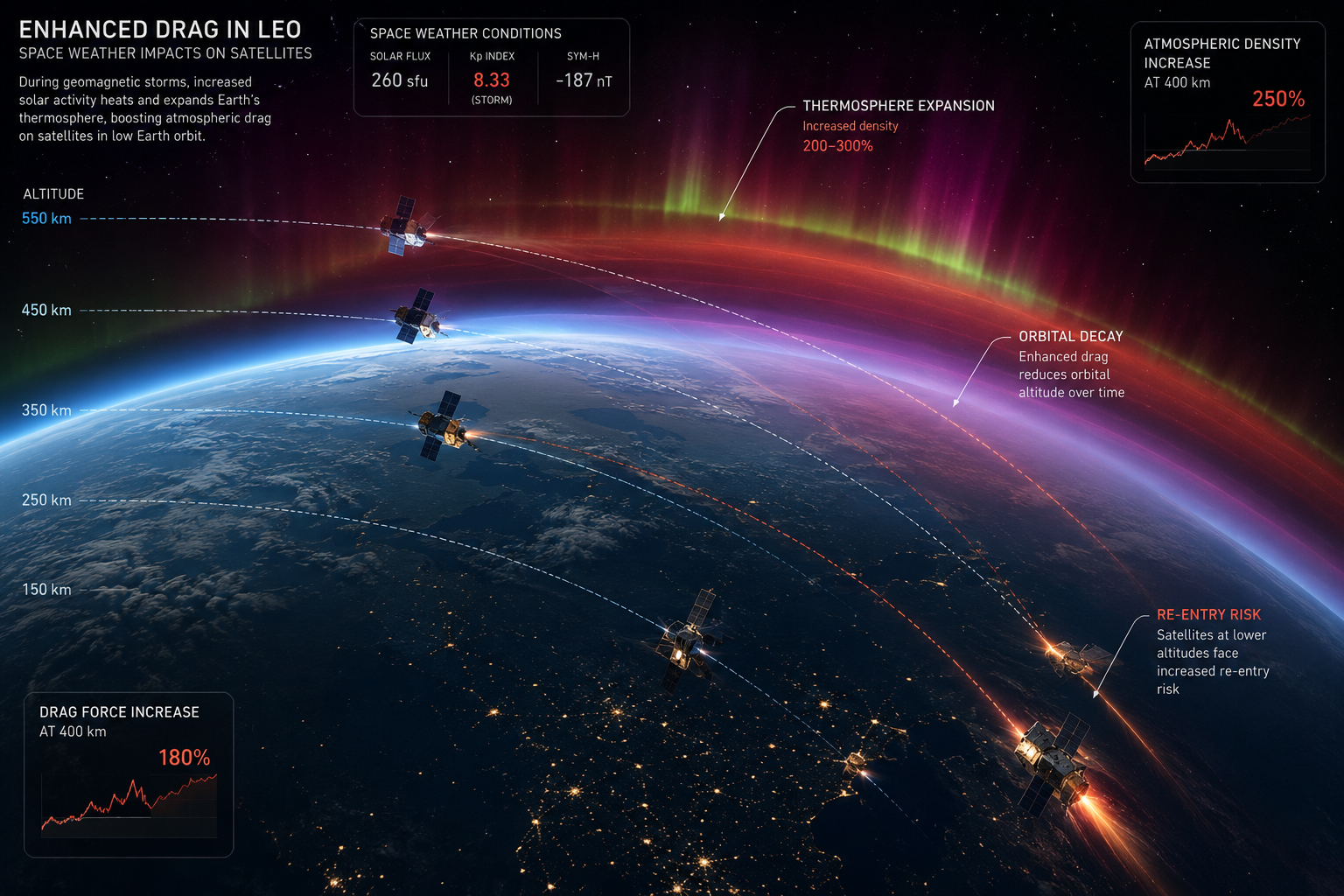
The findings showed that objects orbiting between 500 km and 600 km altitude experienced roughly eight times stronger drag effects than objects orbiting between 600 km and 700 km altitude. During the severe geomagnetic storm of 10–11 May 2024, orbital decay rates increased by as much as 233% to 266% during the storm’s peak phase.
Why Atmospheric Drag Matters in Low Earth Orbit
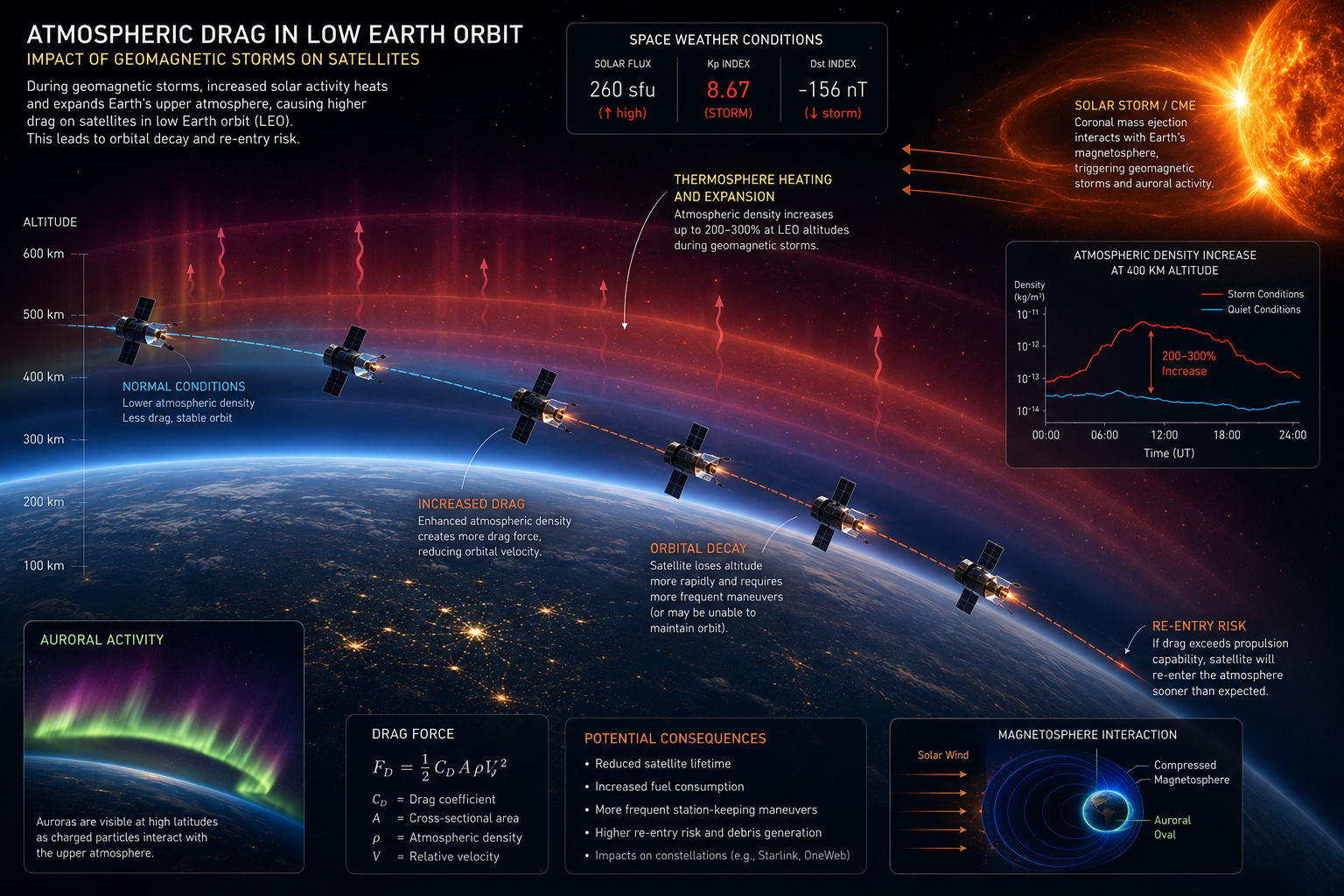
Although Earth’s atmosphere becomes extremely thin at orbital altitudes, it still exerts aerodynamic drag on satellites in LEO. Solar ultraviolet radiation and geomagnetic storms heat and expand the upper atmosphere, increasing atmospheric density at higher altitudes.
As atmospheric density rises, satellites encounter greater drag forces, causing them to gradually lose altitude. This process can shorten spacecraft lifetimes, complicate orbit prediction, and increase the risk of collisions with debris or other operational satellites.
The study notes that atmospheric drag is one of the most important non-gravitational forces affecting spacecraft below about 800 km altitude. Accurate drag prediction is therefore critical for:
- Space situational awareness (SSA)
- Collision avoidance planning
- Debris tracking
- Re-entry forecasting
- Long-term orbital sustainability
Using EDAC to Improve Long-Term Drag Prediction
The researchers developed an approach called Ephemeris Data-Assisted Calibration (EDAC). The method compares observed orbital decay data with simulated orbital evolution and applies a correction factor called the Drag Normalization Coefficient (DNC).
This correction helps compensate for uncertainties caused by:
- Changing spacecraft orientation
- Variations in projected surface area
- Atmospheric density model limitations
- Unmodeled perturbations
- Ballistic coefficient changes
The simulations closely matched historical orbital data for all eight investigated objects, with total orbital decay errors generally remaining below 10% over the six-month study period.
Geomagnetic Storm of May 2024 Produced Major Drag Increase
The severe geomagnetic storm on 10–11 May 2024 provided an opportunity to evaluate short-term drag enhancement under extreme space weather conditions.
During the storm, geomagnetic activity surged to extreme levels, with Ap values approaching 400 and elevated solar radio flux values indicating strong solar heating of the thermosphere.
The researchers found:
- Satellites below 600 km altitude experienced the strongest drag enhancement
- Storm-driven orbital decay rates increased by more than 250% in some cases
- Objects separated by only about 60 km in altitude experienced nearly sevenfold differences in drag impact
- Thermospheric density at lower altitudes became roughly four times higher than at higher orbital ranges
The study also showed that a satellite’s ballistic coefficient strongly influences how severely it is affected by atmospheric drag. Spacecraft with larger surface-area-to-mass ratios experienced stronger orbital decay even at higher altitudes.
Growing Orbital Debris Problem Increases Importance of Accurate Drag Models
The researchers highlighted the increasing threat posed by orbital debris to sustainable space operations. More than 10,000 active satellites are currently in orbit, while debris fragments already outnumber operational spacecraft.
The paper references major historical debris events including:
- The 2009 Iridium-Cosmos collision
- The Fengyun-1C anti-satellite destruction event
- Recent fragmentation incidents involving older satellites
Such events increase the risk of cascading debris generation, commonly known as the Kessler Syndrome, where collisions generate more debris and further raise collision probabilities.
Improved atmospheric drag modeling could help reduce orbital uncertainty and support future debris removal missions, satellite servicing operations, and safer orbital traffic management.
Implications for Future Space Operations
The study concludes that the EDAC-based drag modeling framework significantly improves long-term orbital decay prediction under both quiet and disturbed space weather conditions.
According to the researchers, future improvements could include adaptive drag normalization methods that dynamically respond to changing thermospheric conditions rather than relying on a single calibration factor.
The results could support a broad range of future applications, including:
- Satellite mission planning
- Space traffic coordination
- Debris removal mission design
- Conjunction assessment
- Re-entry risk forecasting
- Long-term orbital sustainability programs
As solar activity continues near the peak of Solar Cycle 25, understanding how space weather affects satellite trajectories is becoming increasingly important for both commercial and governmental space operations.
The researchers emphasise that accurate long-term drag forecasting will play a critical role in maintaining safe and sustainable access to low Earth orbit as satellite traffic continues to increase worldwide.