

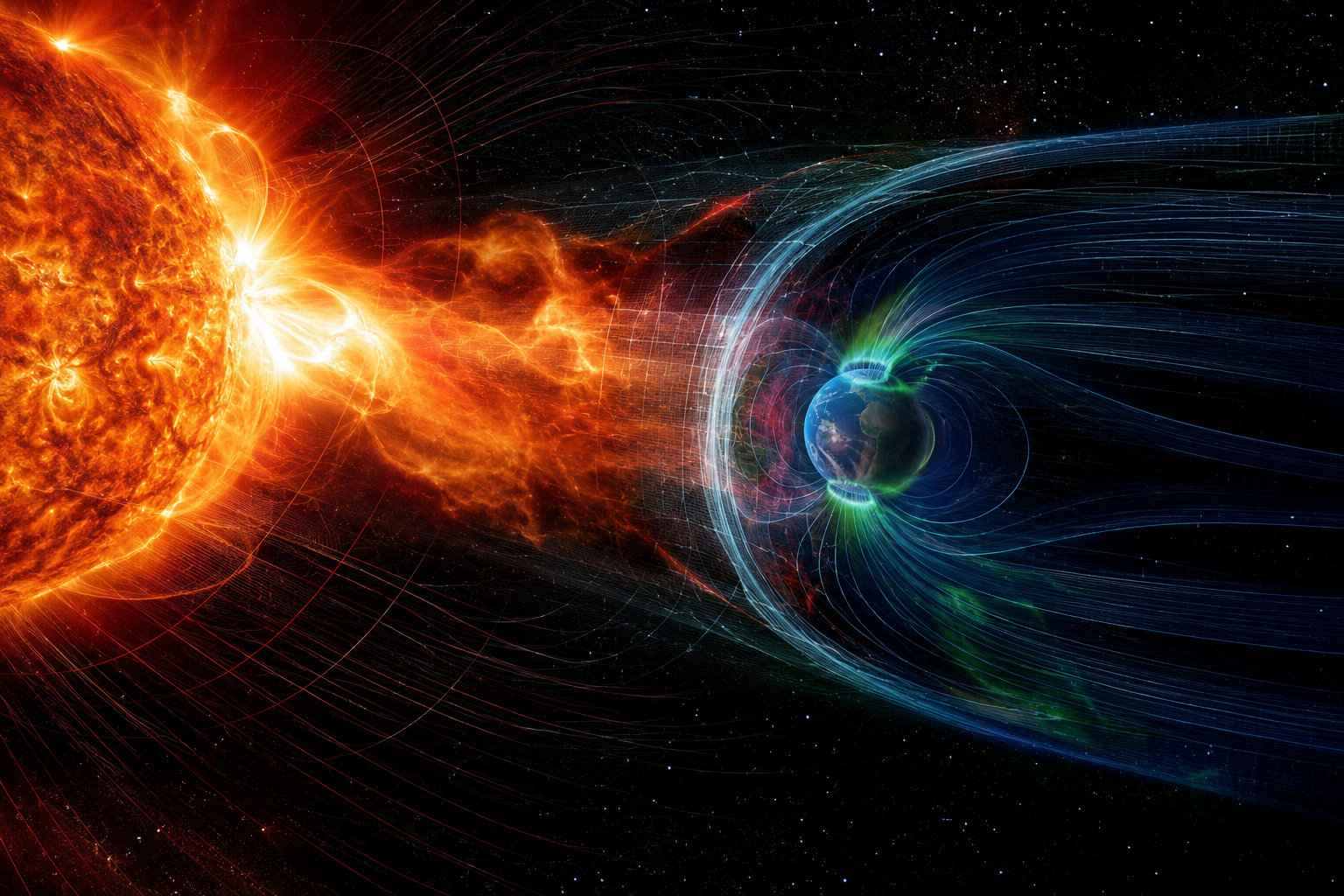
Space weather is no longer only a scientific curiosity. Solar eruptions, coronal mass ejections, geomagnetic storms and radiation events can disrupt satellites, power grids, navigation systems, communication networks and other technology-dependent infrastructure. A major review paper in the Journal of Space Weather and Space Climate explains how one long-running research effort turned this complex problem into a working physics-based modeling system.
The paper focuses on the Space Weather Modeling Framework, or SWMF, developed and maintained at the University of Michigan. Built around the high-performance BATS-R-US magnetohydrodynamic code, SWMF has matured over roughly a quarter century into a tool used for research through NASA’s Community Coordinated Modeling Center and for operational forecasting by NOAA’s Space Weather Prediction Center.
Why Space Weather Needs Advanced Models
Space weather begins with solar activity but its effects can spread across a vast region, from the solar corona through the heliosphere and into Earth’s magnetosphere, ionosphere and upper atmosphere. Each of these regions is governed by different physical processes and operates across different time and distance scales.
That makes forecasting difficult. A useful space weather model cannot simply track one solar eruption. It must connect solar physics, plasma physics, numerical mathematics, software engineering and high-performance computing. The paper argues that this type of model can only emerge from sustained multidisciplinary collaboration.
What SWMF Does
SWMF is designed as a modular framework. Instead of relying on a single model for the entire Sun–Earth system, it connects different physics models that represent different regions of space. This allows researchers to simulate the space weather environment from the upper solar chromosphere to Earth’s upper atmosphere, and in some configurations out toward the outer heliosphere.
Its core code, BATS-R-US, is a flexible magnetohydrodynamic model that can handle different plasma conditions and use adaptive mesh refinement. In simple terms, the model can place more computational detail where the physics is most important, while keeping broader regions less expensive to simulate.

Two Main Space Weather Configurations
For space weather studies, the paper highlights two major SWMF configurations.
AWSoM and AWSoM-R
The Alfvén Wave Solar-atmosphere Model, known as AWSoM or AWSoM-R, is used to model the solar corona and solar wind. It includes the role of Alfvén wave turbulence in heating the corona and accelerating the solar wind. This is important because the solar wind forms the background medium through which coronal mass ejections travel.
SWMF/Geospace
The SWMF/Geospace Model links the global magnetosphere, inner magnetosphere and ionospheric electrodynamics. This configuration is central to forecasting how solar wind disturbances affect Earth’s magnetic environment. According to the paper, an operational version of the SWMF/Geospace model has been running continuously at NOAA’s Space Weather Prediction Center since 2016.
From Research Tool to Operational Forecasting
One of the paper’s central points is that SWMF is not just a theoretical model. It is used in practical space weather prediction. The model can produce simulations that help estimate geomagnetic disturbances, including magnetic perturbations at ground level that matter for power grid operators and other infrastructure users.
The paper notes that SWMF runs can also be requested through the Community Coordinated Modeling Center at NASA Goddard Space Flight Center. This gives researchers access to advanced simulations without requiring them to run the full software stack themselves.
What Scientists Can Simulate With SWMF
The review describes a wide range of applications built around SWMF and BATS-R-US. These include:
- ambient solar wind conditions from the corona to Earth’s orbit;
- coronal mass ejection initiation and propagation;
- interplanetary CME simulations and comparisons with spacecraft observations;
- solar energetic particle acceleration and transport;
- geomagnetic storm effects on Earth’s magnetosphere and ionosphere;
- virtual magnetic observatories for simulated ground magnetic disturbances;
- planetary magnetospheres, including Mercury, Mars, Jupiter, Saturn and moons such as Ganymede and Europa.
This broad range matters because space weather is not one event in one location. It is a chain of connected processes. SWMF is designed to follow that chain across multiple regions and physical regimes.
Adding Kinetic Physics to Global Models
The paper also discusses one of SWMF’s more advanced directions: combining large-scale fluid models with local kinetic particle simulations. This approach, called MHD-EPIC, embeds particle-in-cell domains inside magnetohydrodynamic simulations.
This matters because some key space weather processes, such as magnetic reconnection, occur at scales where simple fluid models are not enough. By embedding kinetic regions inside a global model, researchers can study both the large-scale space environment and the smaller-scale plasma physics that drives major changes.
Machine Learning and the Future of Space Weather Forecasting
The paper also points toward future development using artificial intelligence and machine learning. These methods may improve total electron content forecasting, solar flare prediction, data assimilation and uncertainty quantification.
However, the authors do not present machine learning as a replacement for physics-based models. Instead, the future direction is a combined approach: physical models to represent the system, observational data to constrain it, and machine learning to improve forecasting and uncertainty estimates.
Why This Research Took Decades
The review makes clear that SWMF was not built quickly. The authors describe decades of work involving space scientists, applied mathematicians, computer scientists, software engineers, graduate students and research institutions. The paper states that the project required major long-term investment and about 200 person-years of effort.
That long development history is important. Operational space weather prediction requires reliability, speed, validation and continuous maintenance. A model must run faster than real time, handle changing observational inputs and remain scientifically credible under extreme conditions.
A Model for the Next Era of Space Weather Science
SWMF shows how space weather research has evolved from observation and theory into large-scale computational forecasting. It connects solar eruptions, solar wind propagation, magnetospheric response, ionospheric effects and ground-level impacts inside one flexible modeling framework.
The paper’s broader message is that major scientific infrastructure does not emerge from isolated breakthroughs alone. It requires long-term support, cross-disciplinary expertise and continuous refinement. For space weather, that kind of sustained work is becoming essential as modern society becomes more dependent on satellites, navigation, communications and power systems vulnerable to solar storms.