


Turbulent stellar winds may be concealing narrowband radio signals that current searches for extraterrestrial intelligence are designed to detect, according to a new study published in The Astrophysical Journal. The researchers found that plasma surrounding other stars can spread an originally sharp transmission across a wider range of frequencies, reducing its peak strength and making it less likely to trigger conventional technosignature detection systems.
The effect arises within the exoplanetary interplanetary medium, or Exo-IPM—the region of ionised gas, stellar wind and magnetic activity surrounding a planetary system. As a radio signal travels from a hypothetical transmitter toward Earth, fluctuations in electron density can scatter the signal and produce spectral broadening.
A Hidden Distortion Between Other Worlds and Earth
Many radio technosignature surveys search for signals that occupy less than about one hertz of bandwidth. Such extremely narrow transmissions are considered attractive candidates because known natural astrophysical sources rarely produce radio emission with such sharply confined frequencies.
However, the new research indicates that even a deliberately narrow transmission may not remain narrow during its journey through the plasma environment surrounding its host star.
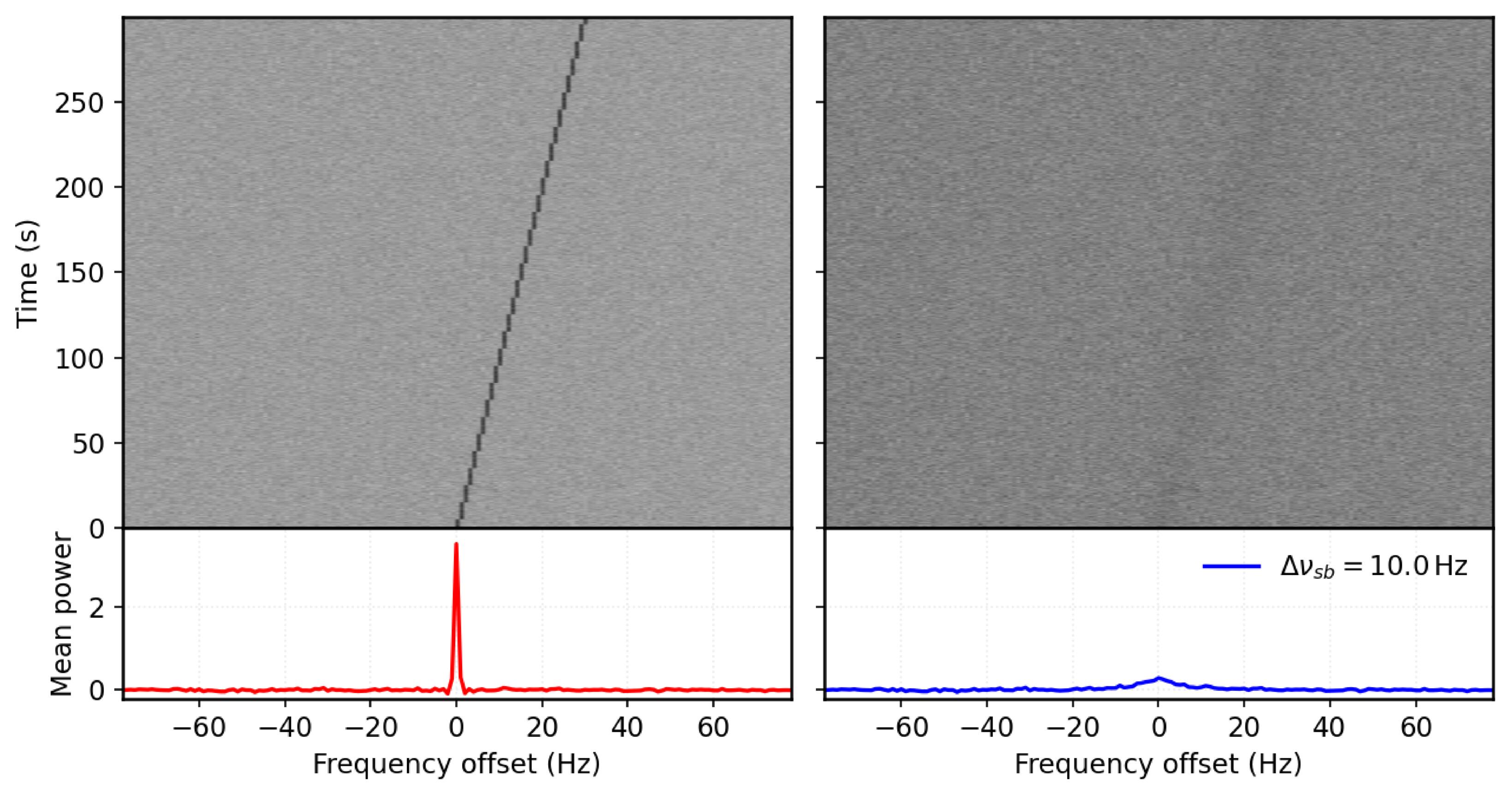
Small-scale electron-density irregularities can impose slightly different Doppler shifts on different parts of the radio wave. Instead of arriving as a sharply defined spectral line, the signal can develop a broader Lorentzian-shaped profile with extended wings. Its total energy may remain present, but the power becomes distributed across more frequency channels.
This redistribution reduces the signal’s peak signal-to-noise ratio. The researchers calculated that an intrinsically one-hertz-wide signal broadened to 10 hertz would retain only about 6% of its original peak signal-to-noise ratio. A search algorithm optimised for sub-hertz lines could therefore overlook the signal even when its integrated radio power remains detectable.
Spacecraft Signals Provided an Empirical Foundation
To construct their framework, Vishal Gajjar and Grayce C. Brown examined measurements of radio signals transmitted by spacecraft as those signals passed through the solar corona and interplanetary medium.
Data from missions including Mariner IV, Pioneer, Helios, Viking, Voyager, Cassini, Galileo, Mars Express, Venus Express and Rosetta provided an observational reference for how plasma turbulence broadens radio carrier signals at different distances from the Sun.
The compiled observations showed that broadening becomes substantially stronger when a signal’s line of sight passes close to the star. A power-law fit across the measurements produced a radial dependence close to that predicted by the researchers’ theoretical model.
The study then extended this empirically anchored solar-system framework to other stellar environments, including Sun-like stars and M dwarfs.
M-Dwarf Systems Could Be Particularly Difficult
M dwarfs account for roughly three-quarters of the stellar population considered in the study. These small, cool stars are common technosignature targets because they are abundant, long-lived and frequently host compact planetary systems.
Yet their surrounding plasma environments remain poorly constrained. M dwarfs can possess strong magnetic fields, energetic flares and turbulent stellar winds, although direct measurements of their Exo-IPM conditions are not currently available.
The researchers therefore estimated a range of possible M-dwarf wind speeds and turbulence strengths using published stellar-wind models, magnetic activity studies and solar comparisons. Their framework suggests that signals passing through some M-dwarf systems may experience greater broadening than comparable signals originating in Sun-like systems.
This part of the result remains model dependent. The authors emphasised that there are no direct measurements of radio spectral broadening in M-dwarf planetary systems, meaning the adopted turbulence and wind parameters carry substantial uncertainty.
One Million Planetary Systems Simulated
The team tested the framework using a Monte Carlo simulation of 10,00,000 hypothetical planetary systems. The simulated population contained 25% Sun-like stars and 75% M dwarfs.
Each system was assigned a range of orbital properties, including semimajor axis, eccentricity, inclination, orbital phase and orientation. These variables determine how closely the path between a transmitter and Earth passes to the host star, which strongly influences the amount of spectral broadening.
At an observing frequency of 1 gigahertz, the model indicated that approximately 70% of systems would produce more than one hertz of broadening. More than 30% would broaden a signal by over 10 hertz.
At 100 megahertz, the predicted effect was substantially stronger. More than 60% of simulated systems produced over 100 hertz of broadening. Lower-frequency radio waves are more sensitive to plasma scattering, making sub-gigahertz searches particularly vulnerable to this distortion.
Coronal Mass Ejections Could Temporarily Erase Signals
The researchers also modelled the influence of coronal mass ejections, or CMEs. These eruptions release magnetised, turbulent plasma into the stellar environment and can temporarily increase scattering along a signal’s path.
The probability of a CME crossing the precise line of sight during a typical observation was estimated to be below 3%. However, when such an alignment occurred, the simulations generally produced additional broadening of several orders of magnitude.
A transmission observed during one of these events could be spread across thousands of hertz, potentially moving it far beyond the range examined by a pipeline designed primarily for narrow spectral lines.
The authors did not conclude that stellar plasma alone explains the absence of confirmed technosignatures. Instead, they argued that propagation effects may create an important observational bias that has not been fully incorporated into past sensitivity estimates.
Why Standard SETI Pipelines May Miss the Signal
Most narrowband searches attempt to correct for frequency drift caused by relative motion between a transmitter, its planet and Earth. They commonly assume that the underlying signal remains intrinsically narrow after this drift is removed.
The new study challenges that assumption. A signal may follow a detectable drift path while simultaneously being broadened by turbulence into a shape that no longer matches the filters used by the search.
This mismatch could cause peak-based detection algorithms to reject or overlook genuine signals. It could also make reported limits on transmitter power appear more restrictive than they are, because those limits are generally calculated for sharply defined signals rather than broadened ones.
Researchers Recommend Width-Aware Searches
The authors propose treating linewidth as a fundamental search parameter alongside frequency and Doppler drift. Future pipelines could use matched filters capable of recognising signals across multiple widths rather than relying mainly on sub-hertz templates.
They also recommend processing observations at several spectral resolutions. Fine-resolution data would remain useful for sharply defined signals, while coarser channelisation could recover power from transmissions broadened across tens, hundreds or potentially thousands of hertz.
For targeted searches of known exoplanets, orbital information could help predict when the planet passes behind its star from Earth’s perspective. Observing away from these superior-conjunction configurations could reduce the amount of plasma encountered by the signal.
Higher observing frequencies may also mitigate the effect, while lower-frequency facilities such as SKA-Low would likely require broadening-aware processing as a standard component of technosignature searches.
Reconsidering the Great Silence
The absence of a confirmed radio technosignature is sometimes described as part of the “Great Silence”—the contrast between the possibility of technological life in the galaxy and the lack of an observed signal.
This study does not provide evidence that extraterrestrial transmitters exist. It instead identifies a mechanism that could reduce the detectability of certain narrowband signals before they reach Earth.
If the model is supported by future observations and more detailed stellar-wind measurements, some previous nondetections may need to be reassessed using filters that account for a wider range of spectral shapes. The findings suggest that the search for narrowband technosignatures may depend not only on where and when astronomers listen, but also on whether their detection systems recognise what a signal becomes after crossing a turbulent stellar environment.