

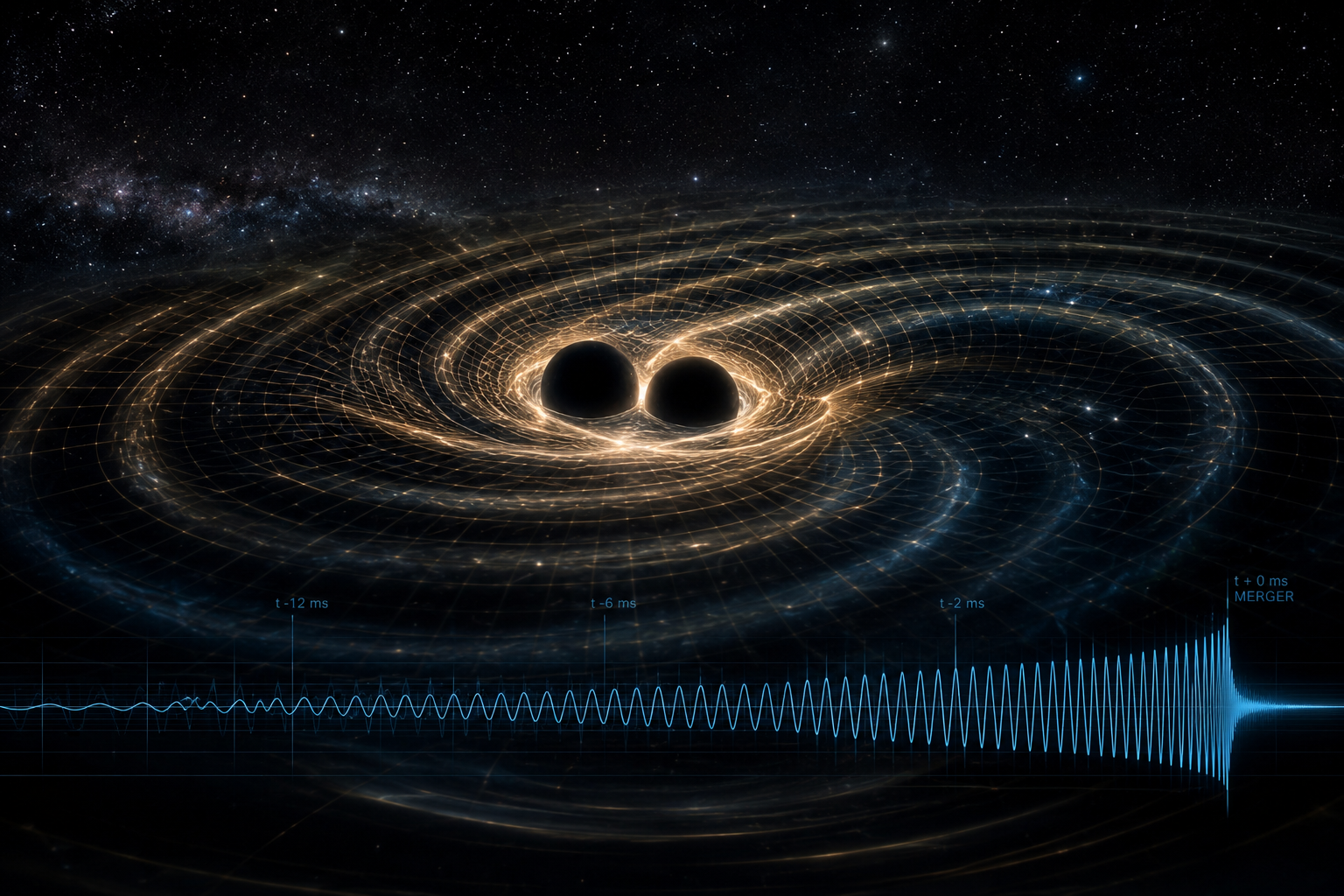
A Possible Black Hole Discovery Below One Solar Mass
The discovery of black holes with masses below that of the Sun would represent a major challenge to conventional astrophysics. Standard stellar evolution models do not predict the formation of sub-solar mass black holes through normal star collapse, making such objects strong candidates for an exotic origin.
A recent research paper explores this possibility following the November 2025 gravitational-wave candidate event S251112cm reported by the LIGO-Virgo-KAGRA (LVK) collaboration. The signal appears consistent with a compact binary merger involving at least one object below one solar mass, with the probability of a sub-solar component estimated above 99%.
The study investigates whether the event could be explained by Primordial Black Holes (PBHs), hypothetical black holes believed to have formed shortly after the Big Bang rather than from dying stars.
Why Sub-Solar Black Holes Matter
Black holes detected so far by gravitational-wave observatories typically originate from massive stars collapsing after exhausting their nuclear fuel. These stellar remnants are generally several times heavier than the Sun.
Objects lighter than roughly one solar mass are difficult to produce through known stellar mechanisms. If confirmed, a merger involving sub-solar mass black holes would therefore point toward new physics or early-Universe processes.
The authors argue that primordial black holes remain one of the strongest explanations because they could naturally form across a wide range of masses during conditions present in the very early Universe.
Primordial Black Holes and Dark Matter
Primordial black holes have long been proposed as a potential dark matter candidate. Unlike black holes formed from stars, PBHs could emerge from density fluctuations, phase transitions, or changes in the equation of state during the radiation-dominated era of the early Universe.
The paper specifically focuses on primordial black holes forming during the Quantum Chromodynamics (QCD) epoch, a period when quarks and gluons combined into protons and neutrons.
According to the researchers, physical processes occurring during this epoch may generate an extended PBH mass distribution with several preferred mass peaks, including one near the sub-solar range.
The S251112cm Gravitational-Wave Event
The event S251112cm was initially reported with a false alarm rate of roughly one event every four years, making it statistically significant enough to attract considerable scientific attention.
The signal was detected by the LIGO Hanford, LIGO Livingston, and Virgo interferometers. Researchers estimated the source to be approximately 93 million parsecs away, although the sky localization region remained extremely large.
The detected chirp mass was estimated to lie between 0.1 and 0.87 solar masses, placing the event directly within the expected range for primordial black hole mergers predicted by several theoretical models.
Estimating the Primordial Black Hole Merger Rate
To test the PBH hypothesis, the authors modeled how primordial black holes could form binary systems and eventually merge through gravitational-wave emission.
The study focused primarily on binaries forming in the late Universe through gravitational capture inside dark matter halos. In this scenario, two primordial black holes passing close to each other can lose enough energy through gravitational-wave radiation to become gravitationally bound.
The researchers combined these merger models with detector sensitivity estimates from LVK observing runs to calculate how frequently such events should be detectable.
Their calculations produced a predicted detection rate of approximately 0.8 detectable events per year for sub-solar PBH mergers under the assumed model parameters.
Compatibility With LVK Observations
The predicted event rate was found to be broadly consistent with the observational implications of a single detection during the LVK O1–O4 observing runs.
The authors argue that if S251112cm is ultimately confirmed as a genuine astrophysical event rather than detector noise, it would support the idea that primordial black holes may constitute a meaningful fraction of dark matter.
The study estimates that such a detection would imply a lower bound of approximately fPBH > 0.04 for the primordial black hole dark matter fraction within the adopted model framework.
No Confirmed Electromagnetic Counterpart
Multiple observatories performed rapid electromagnetic follow-up observations after the event alert. These searches covered optical and high-energy wavelengths in an attempt to identify any kilonova or transient counterpart.
According to the paper, no confirmed electromagnetic counterpart was detected. Existing candidates were later identified as unrelated supernovae or otherwise inconsistent with the estimated distance and localization of the event.
The absence of an electromagnetic signal is considered consistent with a black hole merger scenario, although the authors note that other compact object mergers could also remain electromagnetically dark.
Alternative Explanations Remain Possible
While primordial black holes provide a compelling explanation, the authors acknowledge that alternative mechanisms may still exist.
Some recent theoretical studies suggest that unusual supernova fragmentation processes could potentially produce sub-solar mass neutron stars. However, such scenarios remain speculative and are currently less established than primordial black hole formation models for explaining both the mass scale and the inferred merger rate.
What Future Observations Could Reveal
The paper emphasizes that the final interpretation of S251112cm depends on future LVK analysis and confirmation. Offline parameter estimation and additional data validation have not yet been fully released.
If future observing runs detect additional sub-solar mass mergers, the implications for cosmology and dark matter research could become profound. Repeated detections would strengthen the case for primordial black holes and potentially provide direct evidence for a previously unseen component of the Universe.
The upcoming LVK O5 observing run is expected to significantly improve sensitivity and could help determine whether sub-solar black hole mergers are exceptionally rare events or the first signs of a larger hidden population.