

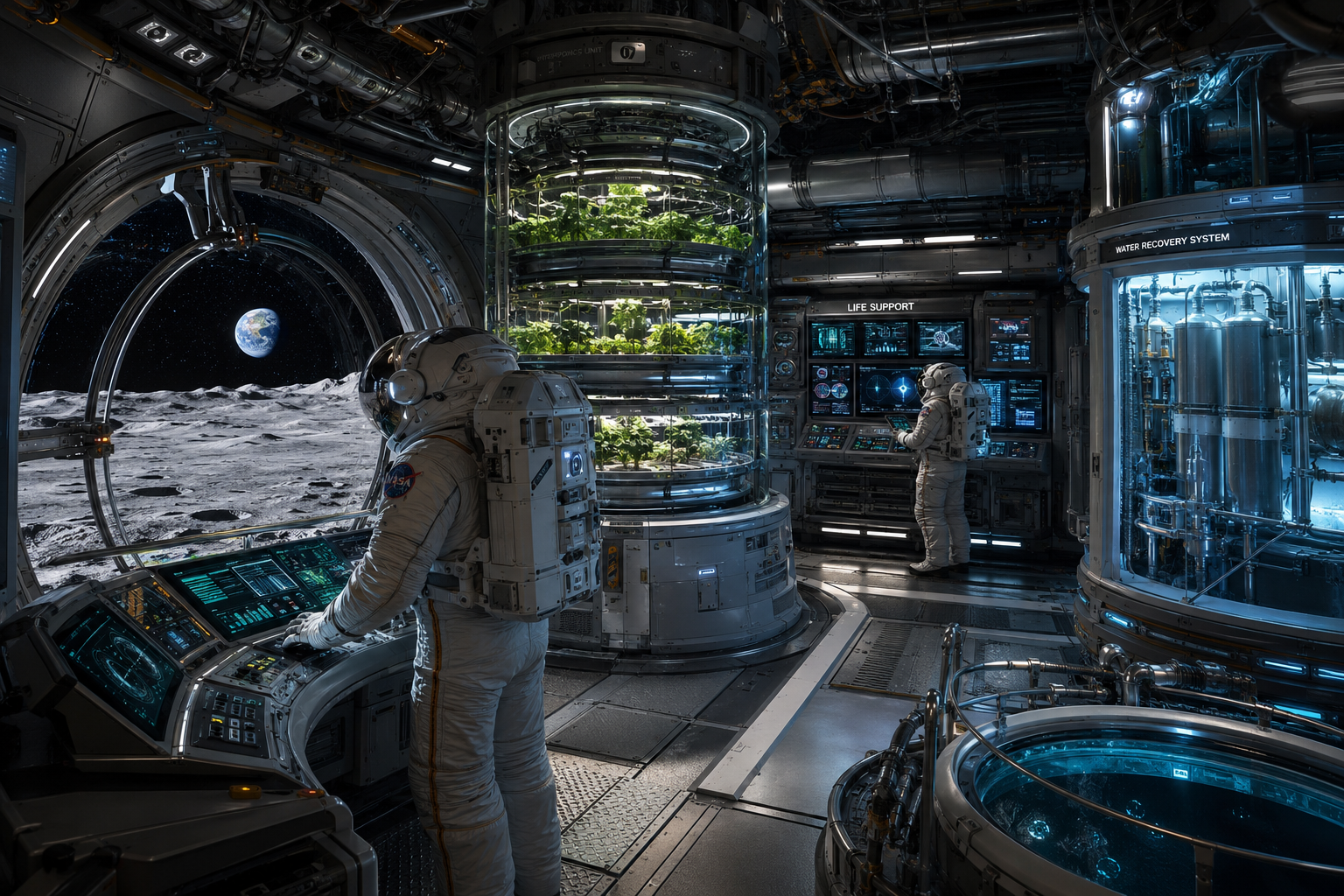
As global space agencies and private aerospace companies prepare for sustained missions to the Moon and Mars, researchers are increasingly focusing on how astronauts will survive far from Earth for months or even years at a time. A newly published review paper in Space Habitation explores how future habitats may depend on highly autonomous Environmental Control and Life Support Systems (ECLSS) capable of recycling air, water, food, and waste with minimal external resupply.
The review, authored by researcher Asif Raihan of King Fahd University of Petroleum & Minerals, analyzes more than 270 scientific studies and mission reports published between 2000 and 2025. The study examines current and emerging technologies designed to support long-duration human habitation in space while reducing dependence on Earth-based logistics.
Why Life Support Systems Matter for Deep-Space Missions
Current spacecraft and orbital stations rely heavily on periodic cargo deliveries from Earth. While the International Space Station (ISS) has demonstrated advanced recycling capabilities, future missions to the Moon and Mars will face much stricter limitations.
According to the paper, Mars missions could involve communication delays of up to 40 minutes and resupply windows separated by months or years. Under those conditions, future habitats will require systems capable of operating autonomously while maintaining stable environmental conditions for astronauts.
The review highlights that modern ECLSS technologies must evolve from short-term “life support” systems into long-term “life sustainability” infrastructures capable of supporting permanent extraterrestrial settlements.
Atmosphere Management and Oxygen Recycling
One of the most critical functions inside a space habitat is maintaining breathable air. Current ISS systems generate oxygen using proton exchange membrane electrolysis, splitting water into oxygen and hydrogen.
The paper explains that future systems could combine multiple technologies to improve oxygen recovery efficiency, including:
- Advanced carbon dioxide removal assemblies
- Sabatier reactors for carbon recycling
- Plasma pyrolysis systems
- Solid oxide electrolysis technologies
Researchers note that current ISS oxygen recovery systems achieve approximately 70–80% closure efficiency, while future Mars missions may require nearly complete atmospheric recycling to minimize resupply dependency.
Water Recovery Approaching Closed-Loop Operation
Water recycling remains another major challenge for long-duration missions. The ISS currently recovers around 90% of wastewater, including humidity condensate and astronaut urine.
However, the paper states that future Mars-class missions may require water recovery efficiencies exceeding 98% to maintain long-term sustainability.
The review discusses several advanced technologies being explored for future habitats:
- Forward osmosis systems
- Nanofiltration membranes
- Membrane distillation technologies
- Biological wastewater treatment systems
- Advanced brine recovery processors
The study also highlights the engineering difficulties of operating water systems in microgravity, where fluid behavior differs significantly from conditions on Earth.
Food Production Beyond Earth
Stored food degrades over time, making onboard agriculture increasingly important for long-duration missions. Researchers reviewed multiple approaches to space-based food production, including hydroponic farming, algae cultivation, and microbial protein generation.
The paper identifies several candidate crops for extraterrestrial agriculture, including lettuce, wheat, potatoes, soybeans, and microalgae. Lighting efficiency, carbon dioxide absorption, edible biomass yield, and nutrient recycling are considered major design factors.
Researchers also note that plants may provide psychological benefits for astronauts living in isolated environments for extended periods.
Waste Management and Resource Recovery
Future habitats will likely treat waste as a reusable resource rather than disposable material. The review examines several waste-processing technologies designed to recover water, gases, nutrients, and energy from human and biological waste streams.
Technologies discussed in the paper include:
- Pyrolysis systems
- Gasification reactors
- Anaerobic digestion systems
- Thermal oxidation technologies
Some of these approaches could generate hydrogen and carbon monoxide that may later be reused inside atmospheric recycling systems, helping improve overall habitat efficiency.
The Role of In-Situ Resource Utilization (ISRU)
The review places strong emphasis on In-Situ Resource Utilization, commonly known as ISRU. Instead of transporting all consumables from Earth, future missions may extract useful materials directly from lunar or Martian environments.
Potential ISRU applications discussed in the paper include:
- Extracting oxygen from lunar regolith
- Harvesting water ice from the Moon or Mars
- Using local materials for construction
- Producing fuel and industrial feedstocks on-site
However, the study also warns that dust contamination, corrosion, thermal stresses, and extreme environmental conditions remain major engineering obstacles for ISRU systems.
Autonomous and AI-Driven Habitat Systems
As missions move farther from Earth, future habitats will require increasingly autonomous operations. The paper highlights growing interest in AI-driven fault detection systems capable of identifying equipment failures before they become mission-critical.
Researchers also discuss the use of digital twin technologies, where virtual simulations continuously monitor and predict the condition of life support hardware in real time.
These systems may eventually allow future lunar or Martian habitats to operate for extended periods with limited direct intervention from Earth-based mission control.
From Survival to Sustainability
The review concludes that future human spaceflight depends on transitioning from partially closed life support systems to highly integrated regenerative ecosystems. While current technologies aboard the ISS provide a strong operational foundation, major advances are still required in reliability, automation, biological stability, and ISRU integration before sustainable extraterrestrial settlements become practical.
According to the study, the path toward long-duration habitation will require coordinated international research efforts, large-scale habitat simulations, and extensive testing of integrated systems under realistic lunar and Martian mission conditions.
The paper ultimately frames future ECLSS technologies not simply as engineering systems for astronaut survival, but as the foundation for sustainable human civilization beyond Earth.