

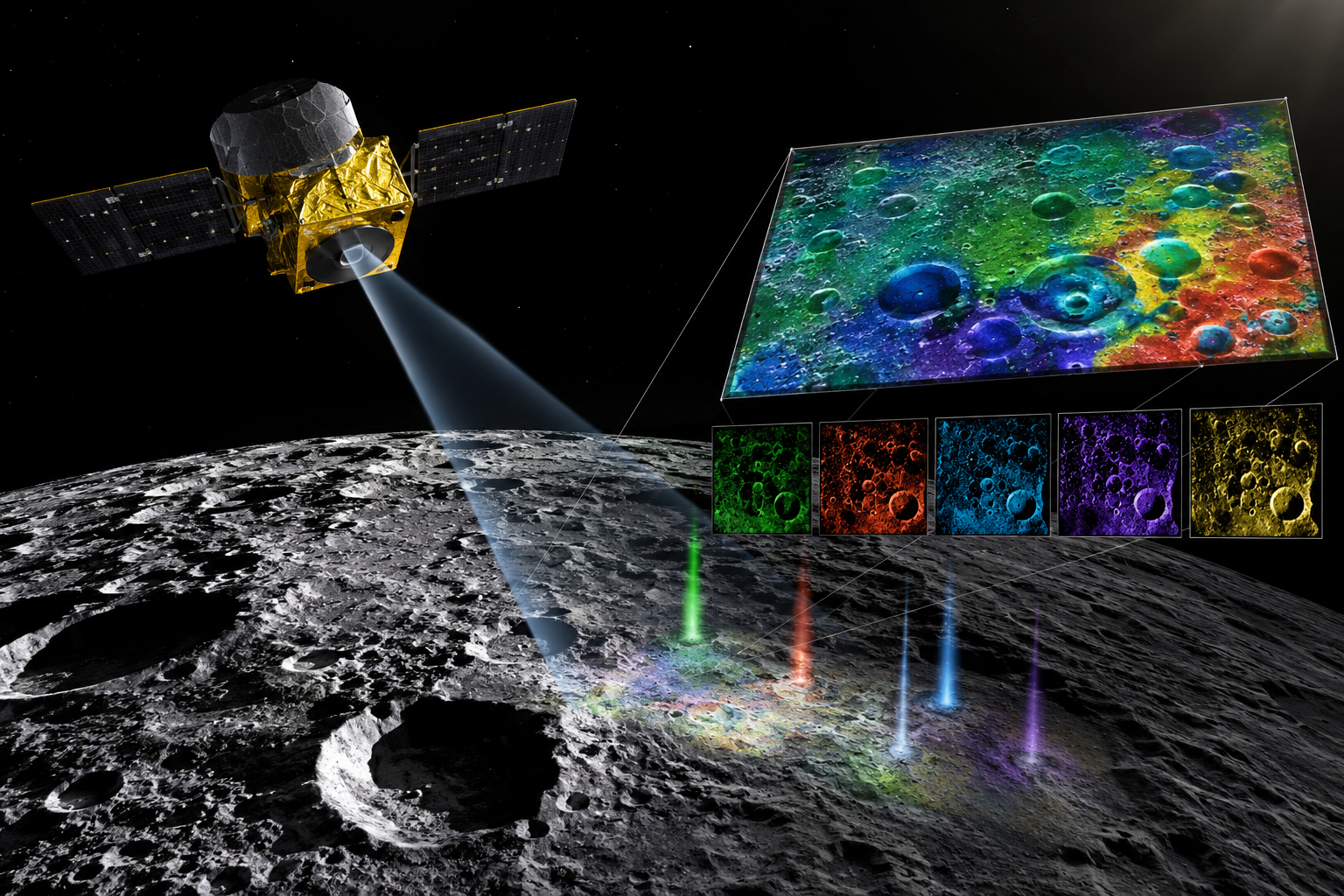
A compact X-ray telescope could give future lunar missions a new way to map the Moon’s surface chemistry, especially in regions where earlier orbital instruments struggled to collect enough data. A new simulation study published in Earth, Planets and Space evaluates whether a lightweight X-ray fluorescence imaging spectrometer could globally observe important lunar elements, including oxygen, magnesium, aluminium, silicon and iron.
The study focuses on a proposed instrument adapted from the Japanese GEO-X mission concept. Instead of relying on older non-imaging X-ray spectrometers, the proposed payload uses a wide-field lobster-eye X-ray telescope, a CMOS detector and an optical blocking filter. The researchers argue that this design could support future global lunar elemental maps while remaining compact enough for small spacecraft or lunar-orbiting platforms.
Why Lunar Chemistry Still Needs Better Global Maps
The Moon’s chemical composition is central to understanding how it formed, how its crust evolved and how different regions were shaped by volcanic and impact processes. Sample-return missions have provided detailed measurements from specific landing sites, but those samples represent only small areas of the lunar surface.
Orbital remote sensing is needed to place those local measurements into a global context. Existing techniques have already mapped several lunar properties, but light elements such as magnesium and aluminium remain difficult to measure accurately across the whole Moon. The challenge is greater near the poles, where sunlight reaches the surface at shallow angles and the X-ray fluorescence signal becomes weaker.
X-ray fluorescence, or XRF, works by using solar X-rays as a natural source of excitation. When solar X-rays strike atoms in lunar soil, those atoms emit element-specific fluorescent X-rays. By detecting those emissions from orbit, scientists can infer the abundance of elements on the surface.
The Problem With Earlier Lunar X-Ray Missions
Several lunar missions have used X-ray spectrometers, including Apollo 15 and 16, SMART-1, SELENE, Chandrayaan-1, Chandrayaan-2 and Chang’E-2. These missions delivered important results, but none produced a complete global XRF elemental map of the Moon.
The study identifies several reasons for this limitation. Solar flare activity is unpredictable, and strong flares are often needed to generate useful XRF signals. Detector degradation from radiation can reduce instrument performance over time. Some earlier detectors also lacked enough energy resolution to clearly separate the spectra of light elements.
Chandrayaan-2 produced elemental maps for magnesium, aluminium, silicon, calcium and iron at high spatial resolution, but weak X-ray signals during low solar activity limited element detection in some regions. Earlier missions also covered only parts of the lunar surface or could not fully separate key light-element signals.
A Compact Lobster-Eye Telescope for the Moon
The proposed instrument uses lobster-eye optics, a design inspired by the eyes of crustaceans. Instead of using a narrow field of view, the telescope uses a grid-like array of square pores to reflect and focus X-rays over a wide area.
In the study’s model, the telescope has a focal length of 300 mm, an aperture diameter of 10 cm and a field of view of 10 degrees by 10 degrees. The CMOS detector is designed for soft X-rays in the 0.3–2 keV range, which is important for detecting light elements on the lunar surface.
The instrument concept is also designed to be small and lightweight. The researchers describe it as approximately 3U in size, with a mass below 10 kg and power consumption below 10 W for the simulated payload. That makes the concept relevant for small spacecraft or future lunar infrastructure where payload mass and power are limited.

What the Simulation Tested
The researchers built a numerical model of lunar X-ray emission under M1-class solar flare conditions. The model includes fluorescent X-rays from the lunar surface as well as background contributions from Rayleigh and Compton scattering.
The simulation assumed a circular polar orbit at an altitude of 4,000 km from the lunar surface, broadly linked to the type of orbit relevant for future lunar infrastructure such as Gateway. At this altitude, the 10-degree by 10-degree field of view covers a footprint of about 711 km by 711 km, while each angular-resolution element corresponds to about 70 km by 70 km on the surface.
The team then evaluated how long the instrument would need to observe to reach a signal-to-noise ratio above 10 for different elements. This threshold was used to assess whether the instrument could produce scientifically useful elemental measurements.
Key Elements Could Be Mapped Globally
The simulation indicates that a single spacecraft carrying the proposed telescope could globally observe oxygen, magnesium, aluminium, silicon and iron within about two years, assuming suitable solar flare occurrence. The estimated spatial resolution for this configuration is about 70 km by 70 km.
Iron was used as a representative element for more detailed mapping because its global distribution has already been studied through other lunar datasets. The paper’s simulated maps show predicted Fe L-shell fluorescent X-ray counts across the Moon and in the north and south polar regions.
The polar results are important because permanently shadowed regions do not directly generate X-ray fluorescence. However, the model still shows non-zero counts in some polar cells because each 70 km by 70 km footprint can include illuminated areas around shadowed terrain. The researchers also note that surface roughness was not included in the model and could reduce actual counts.

A Larger Telescope Array Could Improve Resolution
The study also examined a more ambitious configuration using 25 telescopes arranged in a 5 by 5 array. This would increase the total field of view to 50 degrees by 50 degrees and allow the spacecraft to operate at a lower altitude of about 1,700 km.
In that configuration, the model suggests that global observations of oxygen, magnesium, aluminium, silicon and iron could be completed within one year, while sodium could be detected within about two years. The spatial resolution would improve to roughly 30 km by 30 km.
This wider-field configuration would require more power and more detector hardware. The authors estimate that the CMOS units alone would require at least 25 W, even before considering the full readout system and supporting electronics.
Why This Matters for Future Lunar Exploration
Better chemical maps of the Moon would help scientists compare lunar regions, test models of crust formation and interpret future returned samples. They would also be useful for evaluating landing sites, especially near the lunar south pole, where scientific interest is high and future exploration activity is expected to grow.
The south polar region is especially important because of its permanently shadowed regions, unusual illumination conditions and potential resource value. Understanding its surface composition could support both scientific investigations and mission planning.
The proposed XRF imaging approach does not replace earlier datasets from optical, infrared, gamma-ray or existing X-ray instruments. Instead, it could complement them by improving global measurements of light elements that are difficult to constrain with other methods.
A Promising Concept, Not Yet a Flight Mission
The findings are based on numerical simulations, not direct lunar observations from this instrument. The study assumes ideal detector conditions and uses simplified treatment of some factors, including surface roughness and solar flare availability. Actual performance would depend on spacecraft design, orbit, detector behaviour, solar activity and mission duration.
Even with those limitations, the study shows that compact X-ray imaging technology could make global lunar geochemical mapping more practical. If developed into a flight payload, a lightweight lobster-eye XRF spectrometer could help future missions study the Moon’s surface composition with wider coverage and improved efficiency.