

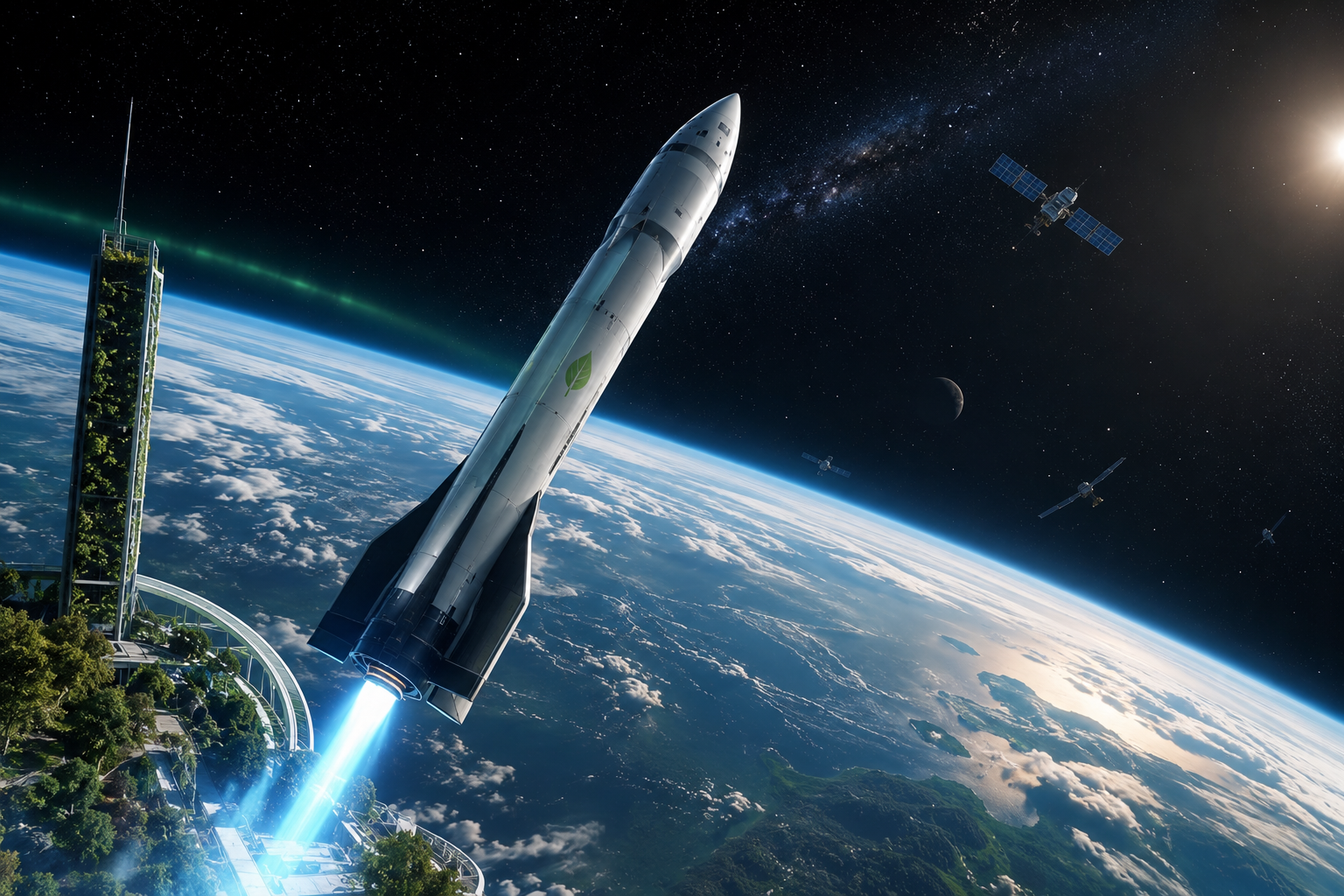
Space Exploration Faces Growing Sustainability Pressure
As governments and private companies accelerate plans for lunar missions, satellite constellations, and deep-space exploration, concerns are increasing over the environmental impact of space activities. A new review published in Science of the Total Environment explores how the global space sector could transition toward net-zero operations while maintaining scientific and commercial growth.
The paper highlights that rocket launches, orbital debris accumulation, and energy-intensive manufacturing processes are becoming increasingly important environmental issues. Researchers argue that sustainability must now become a central consideration in future space policy and spacecraft development.
Rocket Launches and Atmospheric Emissions
One of the major environmental concerns identified in the review is rocket launch emissions. Modern rockets release carbon dioxide, water vapor, nitrogen oxides, and black carbon particles into the atmosphere during ascent.
According to the study, these emissions can have amplified effects because they are injected directly into upper atmospheric layers, including the stratosphere. Black carbon particles are of particular concern because they absorb heat and may contribute to atmospheric warming and ozone layer disruption.
The review cites previous research estimating that human space travel can generate extremely high carbon-equivalent emissions per hour compared with average terrestrial activities. Researchers also note that increasing launch frequency could significantly intensify atmospheric effects in coming decades.
Green Propulsion Technologies Gain Attention
To reduce environmental impact, the paper examines several emerging propulsion technologies designed to replace or reduce reliance on conventional chemical rocket fuels.
Among the technologies discussed are:
- Solar-electric propulsion systems
- Hydroxyl-free hydrazine alternatives
- Green oxidizers for solid rocket motors
- Renewable and regenerative fuel cells
- Electric ion propulsion systems
These systems generally require less propellant and produce fewer harmful emissions than traditional propulsion methods. Solar-electric propulsion, already used in some spacecraft, is highlighted as one of the more promising long-term approaches for sustainable missions.
Researchers also point to reusable launch systems as an important advancement. By reducing the need to manufacture entirely new rocket stages for every mission, reusable rockets may lower the environmental costs associated with production and launch operations.
Space Debris Remains a Critical Challenge
Beyond emissions, the review identifies orbital debris as one of the most serious long-term threats to sustainable space exploration.
Large numbers of inactive satellites, spent rocket stages, and fragmentation debris continue to accumulate in low Earth orbit. The study warns that increasing congestion could threaten both current and future missions if mitigation efforts do not improve.
The authors call for stronger debris management systems, including:
- Improved satellite end-of-life disposal
- Active debris removal technologies
- International debris mitigation standards
- Better tracking and collision avoidance systems
The paper emphasizes that sustainable orbital management will become increasingly important as commercial satellite constellations continue expanding.
Policy Gaps and International Regulation
The review also examines weaknesses in current international governance frameworks for sustainable space operations.
Although organizations such as the United Nations Office for Outer Space Affairs (UNOOSA) and the International Telecommunication Union (ITU) have introduced sustainability guidelines, the researchers argue that many existing recommendations remain non-binding.
The authors propose several policy mechanisms, including:
- Standardized carbon accounting for space missions
- Emissions reporting frameworks
- International sustainability standards
- Potential emissions trading systems for space operations
- Expanded multinational cooperation on debris mitigation
The paper also highlights the role of public-private research partnerships in accelerating sustainable innovation across the space industry.
Balancing Exploration and Environmental Responsibility
The researchers conclude that space exploration can continue expanding while still supporting broader environmental goals, but only if sustainability becomes integrated into mission planning, spacecraft design, and international regulation.
While technologies such as reusable rockets, renewable energy systems, and electric propulsion are showing progress, major challenges remain. These include high implementation costs, technical limitations for deep-space missions, and the absence of enforceable global sustainability standards.
The review ultimately argues that future space exploration must balance scientific ambition with environmental responsibility if the industry is to align with long-term net-zero objectives.