

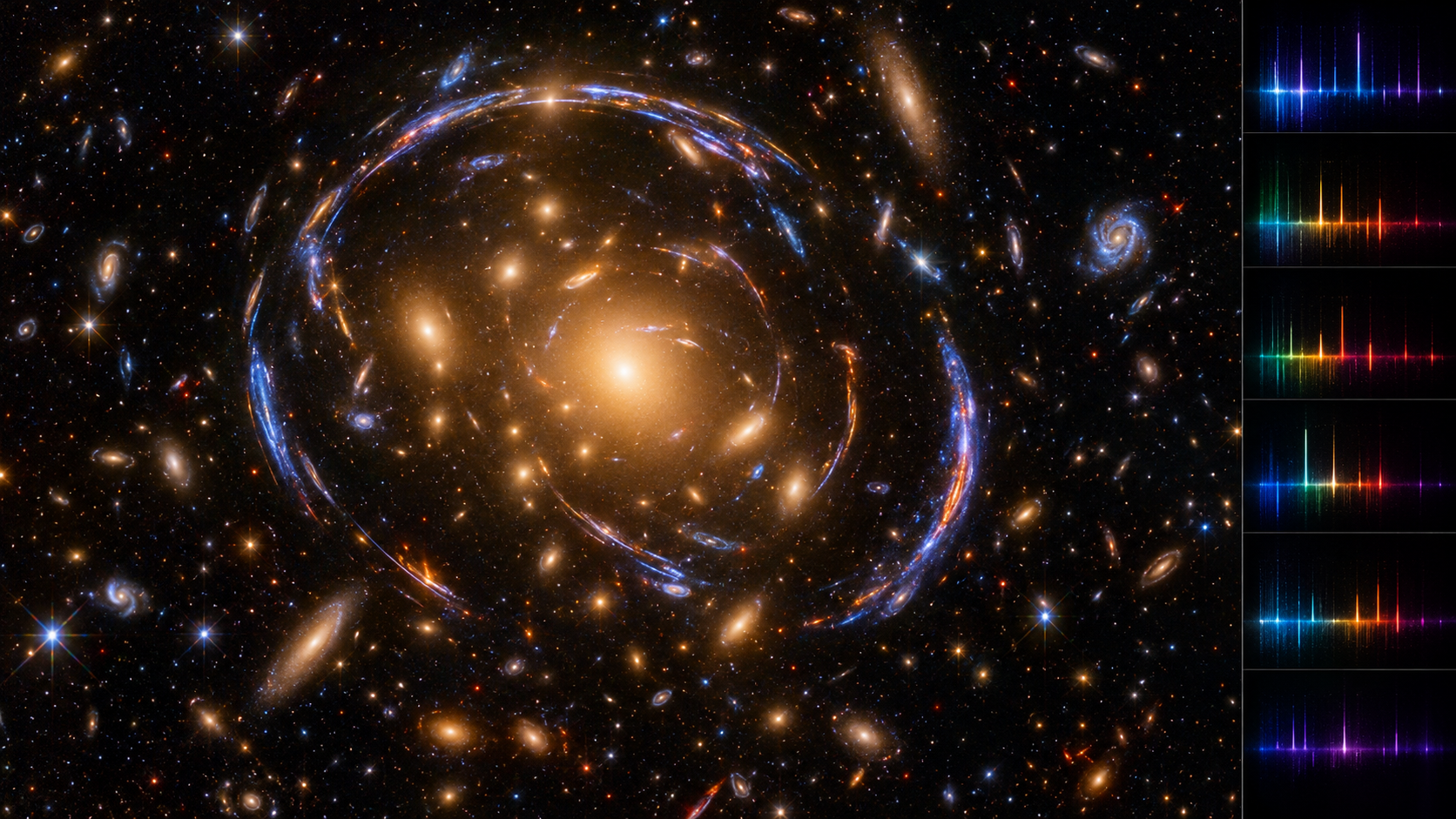
A spectroscopic survey using the Multi Unit Spectroscopic Explorer, or MUSE, on ESO’s Very Large Telescope has confirmed 55 strong gravitational lens systems selected from the DESI Legacy Imaging Surveys. By measuring the redshifts of both foreground lenses and the more distant galaxies whose light they distort, the researchers converted dozens of promising imaging candidates into spectroscopically established lens systems.
The study, led by Emerald Lin and colleagues, examined 76 gravitational lens candidates identified in the DESI Legacy Imaging Surveys. Across the observed fields, the team extracted and analysed 223 spectra. Both lens and source redshifts were successfully measured for 55 systems, while 15 additional candidates yielded a lens redshift but not a secure background-source redshift. Six candidates were determined not to be gravitational lenses.
Turning Gravitational Lens Candidates Into Confirmed Systems
Strong gravitational lensing occurs when the gravity of a foreground galaxy, galaxy group or cluster bends light from a more distant object. When the alignment is favourable, the background galaxy can appear as elongated arcs, multiple copies of the same source, an Einstein ring or an Einstein-cross configuration.
Imaging alone can identify objects that resemble these structures, but morphology does not always prove that gravitational lensing is taking place. Spiral arms, interacting galaxies and unrelated objects projected along the same line of sight can produce similar appearances.
Spectroscopy provides a decisive test. A genuine lensing configuration should place the presumed lens in the foreground and the lensed source at a larger redshift. Measuring those distances also provides essential information for later gravitational lens modelling.
The 76 targets in the study came from a much larger search for strong lenses in the DESI Legacy Imaging Surveys. Neural-network methods have been used to identify thousands of potential systems in the survey imaging, creating a need for efficient spectroscopic follow-up capable of separating real lenses from false positives.
Why MUSE Is Suited to Complex Gravitational Lenses
MUSE is an integral-field spectrograph installed on Unit Telescope 4 of ESO’s Very Large Telescope at Cerro Paranal in Chile. Instead of obtaining a spectrum through a single narrow slit, an integral-field instrument records spatial and spectral information across an extended field.
In its Wide Field Mode, MUSE covers a field approximately 60 arcseconds by 60 arcseconds with spatial sampling of 0.2 arcseconds per pixel. Its wavelength coverage extends from about 4,750 to 9,350 angstroms, with spectral resolving power ranging from roughly 2,000 to 4,000 across the band.
That combination allows astronomers to study the foreground lens, individual arcs, multiple images of a background galaxy and other nearby objects within the same observation. It is particularly valuable for systems containing multiple source planes or galaxies embedded in groups and clusters.
The observations used in the study were obtained between 2022 and 2024. Individual observations generally consisted of four 700-second exposures. The researchers ultimately obtained 92 useful MUSE pointings covering the 76 targets.
55 Systems Receive Lens and Source Redshifts
The researchers manually identified prominent absorption and emission features in extracted spectra before fitting selected spectral lines to obtain redshifts. Frequently used features included the calcium H and K absorption lines in foreground galaxies and the oxygen [O II] doublet in background galaxies. Depending on redshift, the team also used features associated with iron, magnesium, carbon, silicon and hydrogen.
The survey produced several clear outcomes:
- 55 systems were fully confirmed with measured redshifts for both the lens and background source.
- 223 spectra were analysed across the complete set of MUSE fields.
- 192 spectra were analysed within the 55 fully confirmed systems, including lenses, sources and significant foreground or background objects.
- 15 candidates remain unresolved because only their lens redshifts could be measured reliably.
- Six candidates were rejected as gravitational lenses after spectroscopy showed that the apparent lensing structures were instead associated with features such as spiral arms or unrelated objects along the line of sight.
The authors assigned quality levels to individual redshift measurements according to how clearly spectral features could be identified. Most measurements were classified as robust, while lower-confidence values were retained for spectra affected by weak features or lower signal-to-noise ratios.
Some Lenses Contain More Than One Background Source
A major advantage of spatially resolved spectroscopy is its ability to disentangle complicated lensing environments rather than treating every visible arc as part of a single background galaxy.
One example is DESI J168.7680+16.7604. The main lens galaxy was measured at a redshift of about 0.537. One background source was placed at approximately redshift 1.716, while a second source was measured at redshift 3.46264 using its prominent Lyman-alpha emission. The observations therefore identify two distinct source planes behind the same foreground lensing environment.
Another complex object, DESI J345.8606+23.4757, contains two separate background sources. One produces two images at a redshift near 1.296, while another is seen in four images with redshifts clustered around 3.010. The latter source has unusually strong absorption features, and the researchers discuss several possible interpretations for its spectral properties rather than assigning a definitive source classification.
The sample also includes visually distinctive configurations such as DESI J253.2534+26.8843, an Einstein-cross system in which four images of a source at redshift about 2.596 surround a foreground galaxy at redshift about 0.636.
The previously studied Carousel Lens, DESI J090.9854−35.9683, demonstrates the complexity possible in cluster-scale lensing environments. Seven lensed sources have been observed around its foreground galaxy group. In the MUSE analysis presented here, four images of one source were measured near redshift 1.432 while two examined lens galaxies lie near redshift 0.488.
Spectroscopy Also Identified False Positives
The six rejected candidates illustrate why follow-up spectroscopy is essential for constructing reliable strong-lens catalogues. Objects can resemble gravitational arcs in survey images even when no distant background source is being multiply imaged.
In some rejected systems, structures initially interpreted as arcs were found to be connected to galaxies at similar or lower redshifts. In other cases, the apparent lensing features were consistent with spiral structure or unrelated foreground and background objects.
The remaining 15 candidates occupy a different category. The researchers successfully determined the foreground-lens redshifts, but the MUSE data did not provide sufficiently clear features from the suspected background sources. The paper therefore does not classify those systems as fully confirmed and states that additional observations are required.
Why a Larger Strong-Lens Sample Matters
Strong gravitational lenses provide natural laboratories for studying mass that cannot be mapped from starlight alone. Once sufficiently precise imaging, spectroscopy and lens models are available, confirmed systems can be used to investigate the mass distributions of galaxies and galaxy clusters.
The authors identify several potential applications for the expanding sample, including measurements of dark-matter halo profiles, stellar mass-to-light ratios and the abundance of dark-matter subhalos. These are future scientific uses of the confirmed sample rather than measurements delivered directly by the present survey.
Multiply imaged quasars and supernovae can also be used for time-delay cosmography. Differences in the arrival times of light from separate images can provide independent constraints on the Hubble constant, offering another way to compare measurements of the Universe’s expansion rate.
Preparing for the Next Generation of Lens Discoveries
Future wide-field surveys from the Vera C. Rubin Observatory, ESA’s Euclid mission and NASA’s Nancy Grace Roman Space Telescope are expected to greatly expand the number of strong gravitational lens candidates available for study. Identifying those candidates is only part of the challenge; large samples will also require efficient methods for confirming redshifts and characterising complicated lens environments.
The VLT/MUSE programme demonstrates one approach: machine-learning-based discovery in large imaging surveys followed by integral-field spectroscopy capable of examining the lens, source and surrounding environment together. With 55 systems now carrying measured lens and source redshifts, the study provides both a larger confirmed lens sample and a practical framework for the much larger gravitational-lens catalogues expected from upcoming surveys.